Trade-in Value vs Market Value: What’s the Difference?
Trade-in value is usually below market value because a dealer has to cover reconditioning, wholesale exit costs, and resale risk; a gap of roughly 10% to 20% is commonly reported. Ignore that gap and you can leave money on the table or accept an offer that no longer makes sense. This guide explains how dealer math, not a simple definition, creates the price difference and how to decide between trading in and selling privately.
| Decision factor | Trade-in value | Market value | Winner |
|---|---|---|---|
| Cash to owner today | Usually lower, but applied instantly as a down payment credit or payoff offset | Usually higher, but requires a private sale or retail sale to realize it | Trade-in value |
| Price basis | Closest to wholesale value and auction exit math | Built from current demand and comparable sales in the open market | Market value |
| Dealer costs reflected in the number | Includes room for reconditioning, auction fees, transport, and resale risk | Usually does not subtract dealer costs; it estimates what a buyer may pay | Market value |
| Speed and effort | Fastest path, with one appraisal and one transaction | Slower, because you must list, show, and negotiate | Trade-in value |
| Best use case | Good when convenience, time, or payoff handling matters most | Good when your goal is the highest possible sale price | Split by goal |
How each value is calculated
Trade-in value is the dealer’s offer for a car as part of a purchase or payoff deal. Market value is the estimated price your car could bring in the current market, which may mean private-party value or dealer retail value depending on context.
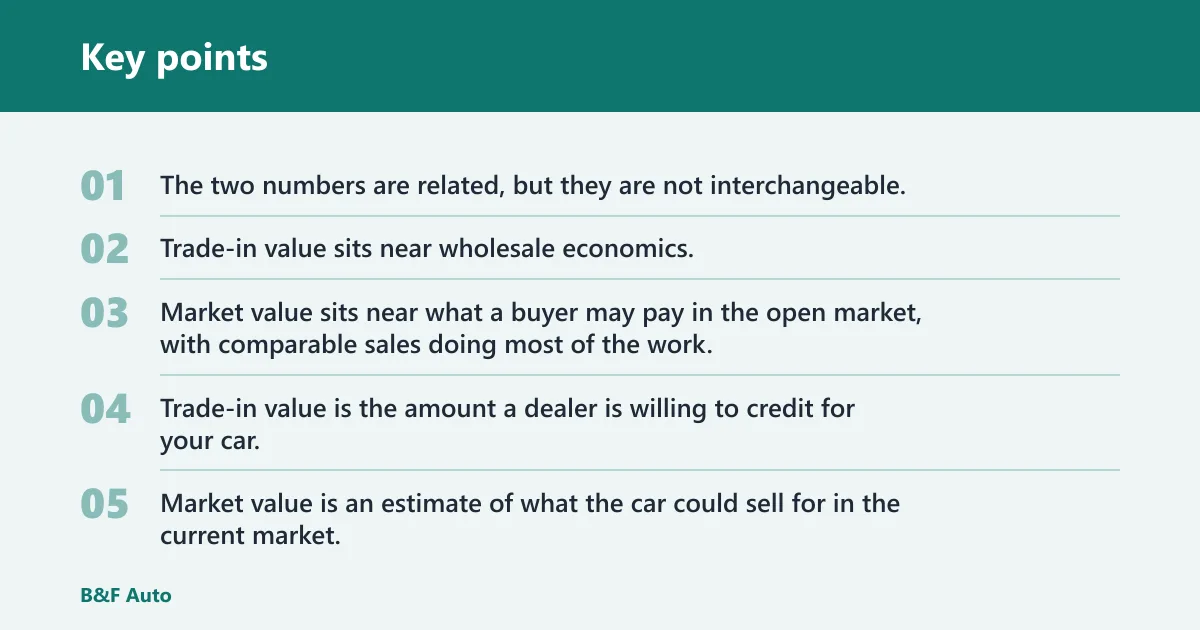
The two numbers are related, but they are not interchangeable. Trade-in value sits near wholesale economics. Market value sits near what a buyer may pay in the open market, with comparable sales doing most of the work.
Trade-in value
Trade-in value is the amount a dealer is willing to credit for your car. That credit may reduce the amount financed, reduce sales tax in some states, or cover a loan payoff if you still owe money.
Market value
Market value is an estimate of what the car could sell for in the current market. The number changes with trim, mileage, condition, location, and recent comparable sales, and it can mean either private-party value or retail value depending on who is quoting it.
Private-party value
Private-party value is what an individual buyer may pay directly to an owner. It is usually higher than trade-in value because the seller keeps more of the resale spread, but the owner also takes on listing, showing, and negotiating.
Retail value
Retail value is the dealer asking price. It is usually the highest of the common comparison points because it includes reconditioning, overhead, and a profit margin the dealer needs in order to hold the car on the lot.
Why dealers offer less

Dealers do not price a trade-in as if they were selling it retail the next morning. They price it against what they can safely recover after repairs, fees, and market risk, which is why the offer often lands below market value.
Wholesale exit price
The trade-in offer is usually anchored to wholesale value, or to the price the dealer could get at auction or through another dealer. That exit price matters because it sets a ceiling on how much room exists before the dealer loses money.
Reconditioning and repairs
Reconditioning cost can include mechanical repairs, detailing, tires, brakes, and cosmetic fixes. Even a clean car can need several hundred dollars before it is ready for resale, and a worn car can need much more.
Auction, transport, and holding costs
If the dealer does not retail the vehicle locally, auction fees and transport can eat into the spread. Holding costs also matter: floorplan interest, lot space, and the time value of money all reduce what the dealer can safely pay today.
Profit cushion and resale risk
Dealers need a cushion for price drops, slower sales, and surprise defects. If the car sits, the market may move before the dealer sells it, and that risk is built into the offer from the start.
How dealers calculate an offer
Dealers start with comparable sales and auction data, then adjust for condition and mileage. The result is an appraisal-based offer, and it can differ from online estimates because the dealer is pricing both market reality and resale risk.
- Check comparable sales. Look at recent vehicles with the same year, trim, drivetrain, and similar mileage. Comparable sales matter most for market value, because they show what buyers are actually paying now.
- Estimate wholesale exit value. Dealers compare your car to auction results and dealer-to-dealer pricing. If the likely exit price is close to $14,000, the offer must leave room below that figure for costs and risk.
- Subtract reconditioning. Add up likely repairs, detailing, tires, brakes, and cosmetic fixes. A car that needs $1,200 in work cannot be priced like one that needs nothing.
- Account for fee exposure. Include auction fees, transport, and holding costs if the car may not retail quickly. These costs are small one by one, but they stack up fast on low-margin vehicles.
- Apply a risk cushion. Leave room for a price drop, a slow sale, or a hidden defect. That final cushion is why a dealer offer often lands below a private-party estimate even when the car looks clean.
Trade-in value worksheet
Picture a 2018 Honda Civic with 72,000 miles, no accident history, average tires, and clean cosmetic condition. The numbers below show why the trade-in offer can sit well below retail asking price without being arbitrary.
| Line item | Amount |
|---|---|
| Dealer retail value | $18,900 |
| Private-party market value | $16,300 |
| Trade-in offer | $13,800 |
| Expected reconditioning | -$900 |
| Auction and transport fees | -$250 |
| Holding cost allowance | -$200 |
| Profit cushion | -$1,200 |
| Net to dealer | $11,250 |
The math is simple. A dealer offering $13,800 on this car is not saying the car is worth only $13,800 in every context; the dealer is pricing a wholesale-style exit after costs and risk. That spread is why retail and private-party figures should not be read as direct buy offers.
How condition and mileage change value
Condition and mileage affect both trade-in value and market value, but they hit trade-in value harder when repairs or risk are obvious. A car with a clean history and normal wear can support a much smaller gap than one with body damage, mechanical issues, or overdue maintenance.
Mechanical condition
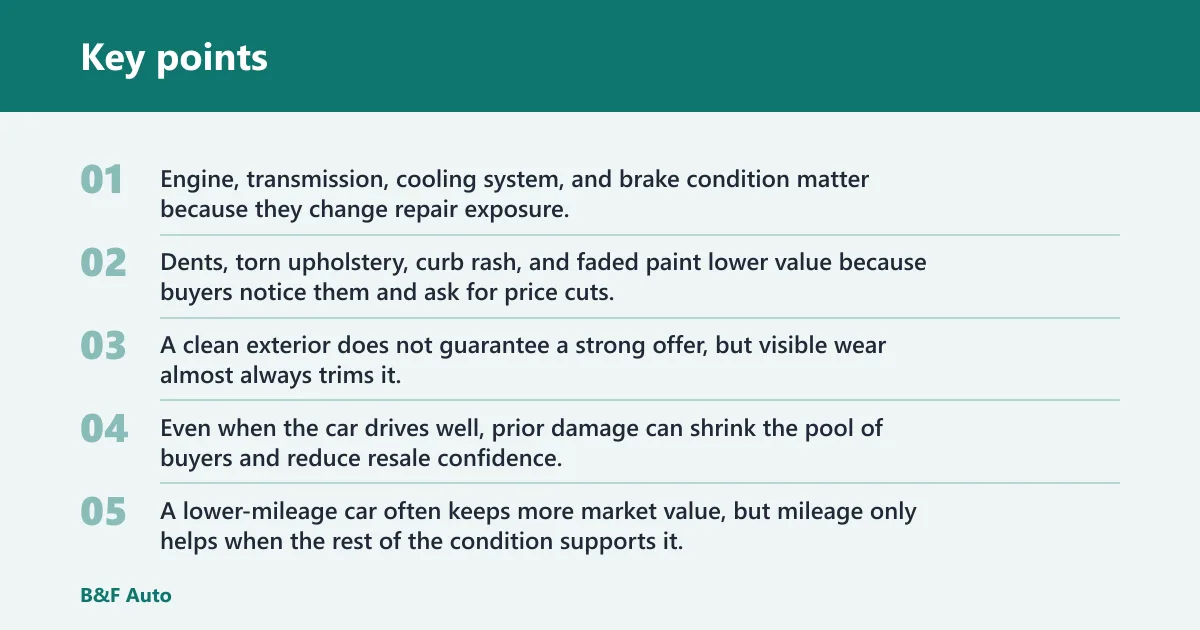
Engine, transmission, cooling system, and brake condition matter because they change repair exposure. A warning light, rough idle, or slipping transmission can cut the offer quickly, since the dealer may need to fix the problem before resale.
Cosmetic condition
Dents, torn upholstery, curb rash, and faded paint lower value because buyers notice them and ask for price cuts. A clean exterior does not guarantee a strong offer, but visible wear almost always trims it.
Accident history
Accident history can widen the gap between market value and trade-in value, especially if structural repairs or airbag deployment are involved. Even when the car drives well, prior damage can shrink the pool of buyers and reduce resale confidence.
Wear items and mileage
High mileage usually lowers value because tires, brakes, fluids, suspension parts, and interior wear are more likely to need attention. A lower-mileage car often keeps more market value, but mileage only helps when the rest of the condition supports it.
Suppose two cars are the same year and trim. One has 48,000 miles and fresh brakes; the other has 132,000 miles, a cracked windshield, and older tires. The higher-mileage car will usually see a larger trade-in discount because the dealer must price in repairs and slower resale.
Should you use market value or trade-in value?
Use market value when you are negotiating a replacement purchase, checking whether a loan payoff leaves you with negative equity, or deciding whether a private sale is worth the effort. Use trade-in value when you want a fast transaction and want to know what credit the dealer is likely to apply.
Negotiating a replacement purchase
Market value helps when you are comparing offers from multiple dealers or deciding whether the car you own is worth more than the trade number. It gives you a better sense of your position before you accept a deal on the next vehicle.
Checking a loan payoff or negative equity
If the payoff on your loan is higher than the trade-in offer, you have negative equity. In that case, the gap between trade-in value and market value matters because it can determine whether you need cash down, a longer loan, or a private sale.
Choosing between trade-in and private sale
Private-party value is the better reference when you are willing to handle listing, phone calls, meetups, and payment risk. Trade-in value is the better reference when you need a clean handoff and want to avoid the time cost of selling on your own.
Choose Trade-in value if… / Choose market value if…
Choose trade-in value if you want speed, want the dealer to handle the paperwork, or need the car’s equity applied directly to your next purchase. Choose market value if your goal is the highest sale price, you can wait for the right buyer, or you need a number that reflects the current open market.
Choose trade-in value if…
- You are buying another vehicle and want one transaction.
- You need to know the likely down payment credit right now.
- Your car has flaws that make a private sale difficult.
- You would rather avoid listing, meeting strangers, and negotiating.
Choose market value if…
- You want to compare your car against recent similar sales.
- You are deciding whether a private sale could net more money.
- You need a better estimate for loan payoff or negative equity.
- Your car is clean enough to attract private buyers.
Frequently asked questions
What is the difference between trade-in value and market value?
Trade-in value is the dealer’s offer for your car, while market value is the estimated price it could bring in the current market. Trade-in value is usually lower because it has to leave room for reconditioning, fees, and resale risk. Market value depends more on comparable sales and buyer demand.
Why is trade-in value lower than market value?
Dealers do not buy a car at full retail expectation and hope for the best. They price in repairs, auction or transport costs, holding time, and the chance the car will sell for less than expected. That gap is the dealer’s business math, not an error in the appraisal.
How do dealers calculate trade-in value?
Dealers start with comparable sales and auction data, then adjust for mileage, condition, accident history, tires, brakes, and visible wear. They also subtract expected reconditioning and include a cushion for resale risk. Online tools may miss some of those deductions, which is why offers can differ.
What is my car’s market value if I trade it in?
If you trade it in, market value is still useful as a reference point, but it is not the same as the dealer offer. In practice, you should compare the trade number against private-party value and retail value so you know how much of the resale spread the dealer is keeping.
Is market value the same as private party value?
Not always. Market value is a broader term that can refer to either private-party value or retail value, depending on the source. Private-party value is the price an individual buyer may pay directly to an owner, which is often the most relevant market figure when you are selling on your own.
Can I use trade-in value as a down payment estimate?
Yes, but use it as an estimate, not a guarantee. The dealer’s appraisal can change after a closer inspection, and any loan payoff, negative equity, or repair issue can change the final amount credited. A written offer is the number that matters.