How to Turn Auto Loan Preapproval Into a Budget
Turn a preapproval into an out-the-door budget by treating the approved loan amount as a gross ceiling, then subtract sales tax, title, registration, dealer fees, insurance, and a reserve buffer. Skip those costs, and you can overcommit before signing, then face a payment that strains your monthly budget. This guide shows how to convert your approval amount into a realistic total budget you can use on the lot.
What preapproval really gives you
Auto loan preapproval is a conditional borrowing cap, not a final loan. It usually tells you the maximum amount the lender will finance, the APR or rate range, the term it is willing to consider, and how long the offer stays open. Final approval still depends on the exact car, the deal structure, and the lender’s last review.
Loan cap, APR, term, and expiration window
A preapproval can be built around a specific loan amount cap, such as a maximum principal the lender will finance. It may also list a fixed APR or a rate range, a term limit, and an expiration window. Use those terms exactly as written; do not assume the dealer can stretch them without another lender review.
Hard inquiry, soft inquiry, and final approval conditions
Experian says pre-qualification can be done without hurting your credit scores, while a loan application is subject to a credit check that may impact your scores. That difference matters. A soft inquiry helps you shop around, but a final loan request often triggers a hard inquiry and can still be denied if the vehicle, income, title status, or paperwork do not meet lender conditions.
How to convert preapproval into a safe budget
Start with the lender’s approval amount, then add any cash down payment and positive trade equity, because both expand the total amount you can pay for the car. From that gross purchase ceiling, subtract sales tax, title and registration, dealer documentation fees, add-ons, insurance reserve, and a buffer so the budget still works after signing.
Use the ceiling, not the payment alone
U.S. News says securing a car loan early makes shopping easier because you know how much you can borrow. That number is a ceiling, not a target. A payment that looks fine can still fail once taxes, fees, and insurance are added.
Convert the ceiling into a real cap
Start with the approved loan amount. Treat that figure as the maximum amount to finance, before taxes and fees. If your preapproval is about $28,000, begin there.
Add cash you will actually apply. Include a down payment and any positive trade equity. These increase the gross amount available for the deal.
Subtract non-vehicle costs. Remove estimated sales tax, title, registration, dealer documentation, and any add-ons you already know you will accept. Then subtract an insurance reserve and a safety buffer.
Solve for the sticker price. Whatever remains is your maximum vehicle price before tax and fees. That is the number to use while shopping.
Out-the-door budget worksheet
This worksheet turns a preapproval into a maximum sticker price and a monthly payment check. The out-the-door total is the vehicle price plus tax, title, registration, dealer fees, and add-ons. Use one reserve method and keep it consistent so you do not spend your whole approval on the car itself.
| Line item | Example amount | How it works |
|---|---|---|
| Approved loan amount | $28,000 | Gross lending ceiling |
| Down payment | $3,000 | Cash applied upfront |
| Positive trade equity | $0 | Added only if trade-in value exceeds payoff |
| Sales tax | 7% of vehicle price | Varies by state and locality |
| Title and registration | $400 | Government fees, vary by state |
| Dealer documentation fee | $499 | Dealer-controlled charge |
| Optional add-ons | $0 | Protection products, etching, accessories |
| Insurance reserve | $600 | Set aside for the first premium change |
| Safety buffer | $1,400 | Room for repair, tax, or quote changes |
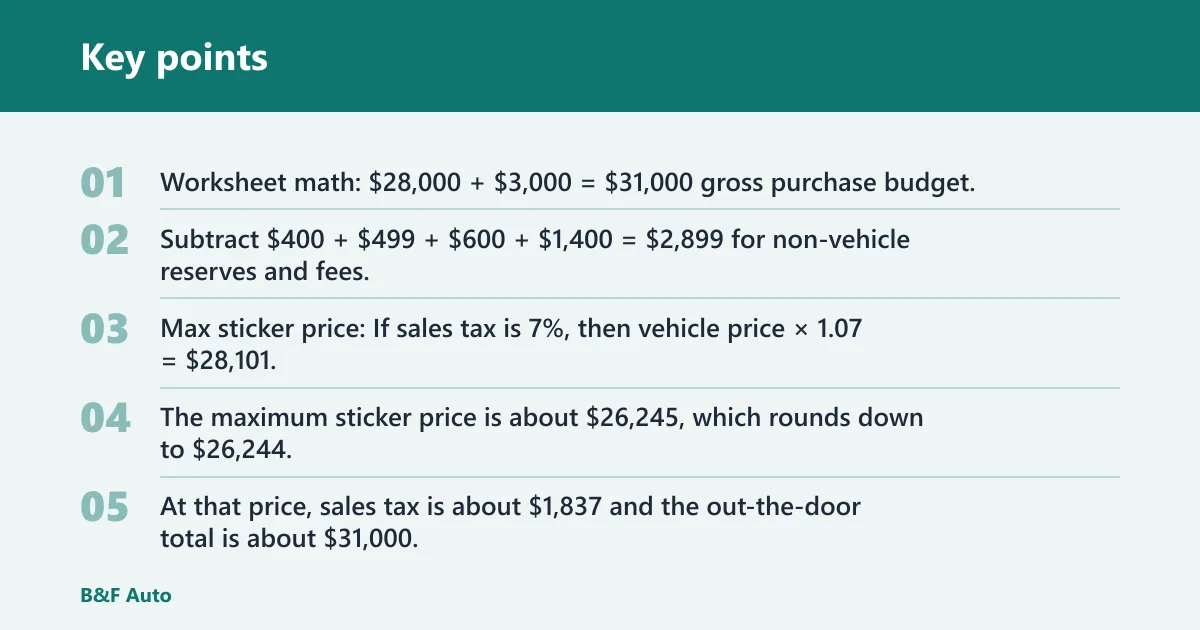
Worksheet math: $28,000 + $3,000 = $31,000 gross purchase budget. Subtract $400 + $499 + $600 + $1,400 = $2,899 for non-vehicle reserves and fees. That leaves $28,101 for the vehicle price plus sales tax.
Max sticker price: If sales tax is 7%, then vehicle price × 1.07 = $28,101. The maximum sticker price is about $26,245, which rounds down to $26,244. At that price, sales tax is about $1,837 and the out-the-door total is about $31,000.
Max monthly payment: On a loan of about $28,000 at 8% APR for 60 months, the monthly payment is about $565.59 before insurance and fuel. That figure is only the loan payment; it does not include operating costs.
Use the calculator inputs carefully. NerdWallet’s calculator lets you adjust price, term, rate, and down payment to fit your budget. It can also factor in sales tax, title, registration, and other fees, plus trade-in value and any loan balance you still owe. Those inputs are what make the worksheet realistic.
What is included in the out-the-door price?
The out-the-door price is the amount you actually sign for at delivery: vehicle price, sales tax, title, registration, dealer documentation fees, and any add-ons or rolled-in products. Some items are negotiable, some are fixed by the government, and some are dealer-controlled. Separate them before you agree to anything.
Vehicle price and dealer documentation fees
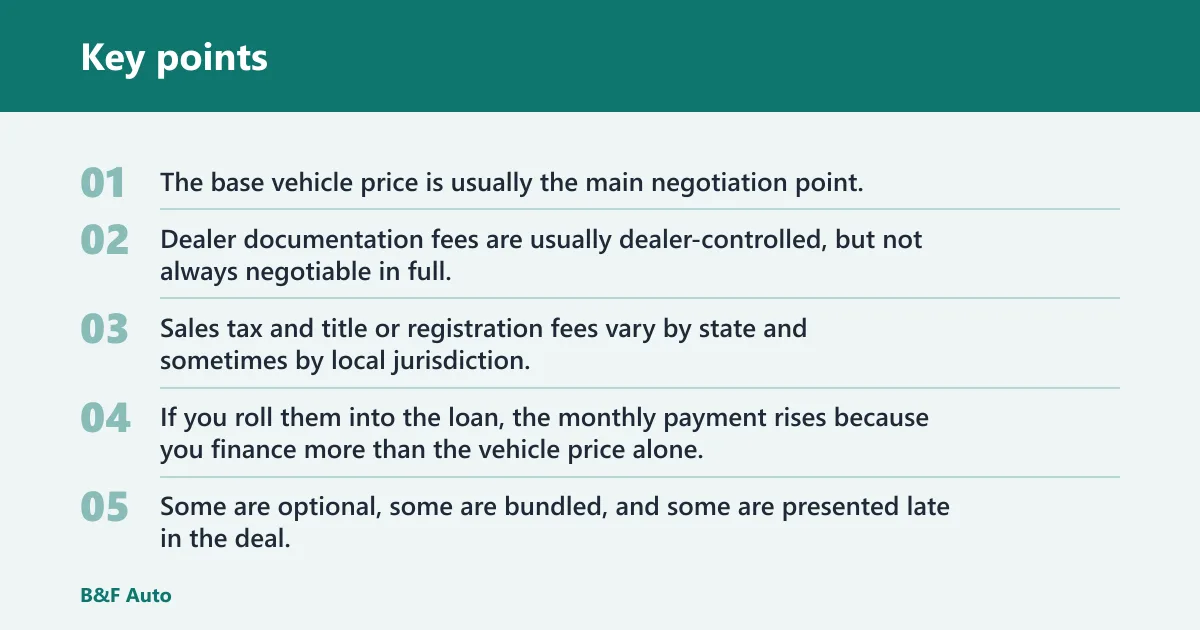
The base vehicle price is usually the main negotiation point. Dealer documentation fees are usually dealer-controlled, but not always negotiable in full. Ask for an itemized sheet so you can see the difference between the car’s selling price and the dealer’s administrative charges.
Sales tax, title, and registration
Sales tax and title or registration fees vary by state and sometimes by local jurisdiction. Those charges are generally non-negotiable. If you roll them into the loan, the monthly payment rises because you finance more than the vehicle price alone.
Add-ons, protection products, and rolled-in charges
Accessories, paint protection, window etching, service contracts, gap coverage, and similar products can move the budget quickly. Some are optional, some are bundled, and some are presented late in the deal. If you do not want them, decline them before the final buyer’s order is printed.
A common first-timer mistake is spotting a car that fits the preapproval amount, then adding $1,200 in dealer products and $900 in paperwork and taxes at signing. The monthly payment climbs even though the sticker looked safe at first glance.
Should you use your down payment now?
Yes, if the goal is to keep the payment and the total interest lower. A down payment is cash applied upfront, so it reduces the amount you need to finance and usually lowers the monthly payment. NerdWallet recommends putting down 20% on a new car and 10% on a used car.
How down payment changes the loan amount
Down payment works best when you apply it to the deal, not when you keep it mentally separate from the budget. If you have $3,000 available and use it at closing, that money increases your purchase capacity and reduces the amount financed. It also reduces the risk of being upside down early in the loan.
How much to keep in reserve
Do not spend every dollar on the car. Set aside money for registration, the first insurance bill, and early maintenance. If the car needs tires, a battery, or an initial service soon after purchase, a thin reserve can turn a manageable payment into a stressful one.
Use the down payment and reserve together. The down payment improves the loan; the reserve protects the rest of your budget.
Loan term and APR tradeoffs
Longer terms lower the monthly payment, but they increase total interest and can leave you paying for too long. The same source notes common auto loan terms include 24, 36, 48, 60, 72, 84, and even 96 months. APR matters too, because a small rate difference can add a noticeable amount over the full term.
Monthly payment versus total interest
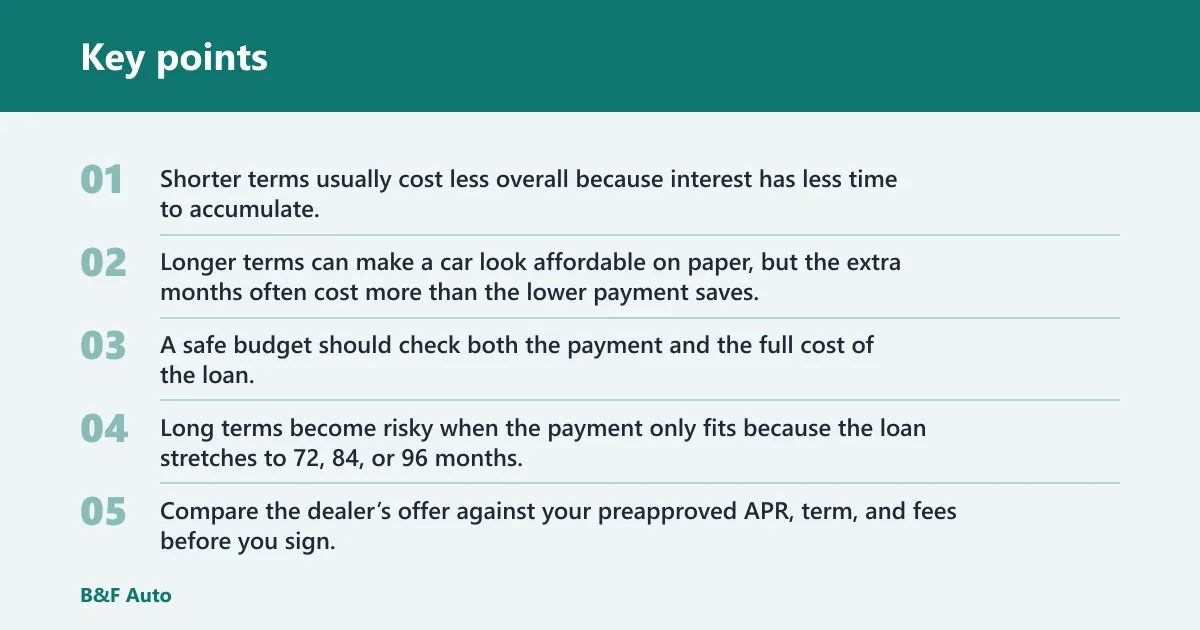
Shorter terms usually cost less overall because interest has less time to accumulate. Longer terms can make a car look affordable on paper, but the extra months often cost more than the lower payment saves. A safe budget should check both the payment and the full cost of the loan.
When a longer term becomes too expensive
Long terms become risky when the payment only fits because the loan stretches to 72, 84, or 96 months. That can leave little room for insurance, fuel, or repairs. It can also keep you paying long after the car’s value has dropped.
Comparing dealer financing against your preapproved loan
Compare the dealer’s offer against your preapproved APR, term, and fees before you sign. A lower APR from the dealer may beat your preapproval, but only if the term, rebates, and add-ons still leave you with a better total cost. If the dealer’s rate is higher, your preapproval gives you a clear fallback.
Suppose a dealer offers a lower monthly payment by stretching the term from 60 to 84 months. That can free up cash today, but it also raises the total interest cost and keeps the loan open much longer. The cheaper payment is not always the cheaper loan.
What if the car costs more than your budget?
If the car is above your safe out-the-door cap, do not treat the gap as small. Lower the price, raise the down payment, or shorten the term only if the payment still fits after taxes and fees. If none of those moves works, walk away and keep shopping.
Lower the price
Start with the selling price, because that is the cleanest variable to change. A lower sticker reduces sales tax too, which can improve the whole deal. Ask for a lower price before accepting add-ons or finance products.
Increase the down payment
If you can add more cash without harming your emergency fund, the extra down payment can close a small gap. Use this option only if the reserve in the worksheet still stays intact. Cash should improve the deal, not leave you short on repairs or insurance.
Shorten the term or walk away
If the car only works by extending the loan far beyond your comfort zone, shorten the term and see whether the payment still fits. If it does not, walk away. A deal that only works by breaking your budget is not a good budget.
How much car can I afford with my preapproved auto loan?
You can afford no more than the approved loan amount plus any cash down payment and positive trade equity, minus taxes, title, registration, dealer fees, add-ons, insurance reserve, and a buffer. That gives you a safe out-the-door cap, which is usually lower than the headline number on the sticker.
Frequently asked questions
How do I figure out the out-the-door price from a preapproval amount?
Start with the loan cap, add your down payment and any positive trade equity, then subtract sales tax, title, registration, dealer documentation fees, add-ons, an insurance reserve, and a buffer. The result is the maximum vehicle price you can shop for before taxes and fees are added.
What fees and taxes should I include in my car budget?
Include sales tax, title, registration, dealer documentation fees, and any dealer-installed products or optional protection plans you might accept. Sales tax and government fees vary by location; dealer fees vary by store. If they are rolled into the loan, the payment rises.
Should I use my down payment with preapproval or keep it separate?
Use it in the budget if your goal is to reduce the amount financed and the monthly payment. A larger down payment usually helps, especially on new vehicles, where NerdWallet recommends 20%, and on used vehicles, where it recommends 10%. Keep enough cash aside for the first round of ownership costs.
How much should I leave for insurance, registration, and maintenance?
Leave enough to cover the first insurance premium change, the registration bill, and at least a basic maintenance cushion for tires, fluid changes, or other early repairs. The same source says a typical first-time buyer should spend less than 10% of take-home pay on the car payment, and total car expenses should stay under 15% to 20% of take-home pay.
Can I compare dealer financing against my preapproved loan?
Yes, and you should. Compare APR, term, fees, and any rebates tied to financing. A dealer offer can be better, but only if it lowers the total cost after you include the full payment schedule and any extra products added to the deal.
How long does an auto loan preapproval last before I need a new one?
It depends on the lender’s expiration window, which is usually listed in the approval terms. If the window expires or your credit, income, or deal details change, you may need a new review. Final approval still depends on the car and the lender’s conditions at signing.
Should I use a longer loan term to fit a bigger car budget?
Only if you have checked the total interest and the payment still fits your full budget. Longer terms can lower the monthly bill, but they raise overall borrowing cost and can keep you tied to the loan for 72, 84, or even 96 months.