Can You Remove Aftermarket Products Before a Trade-in?
Yes, remove aftermarket parts only if you can restore the car to stock for less than the dealer’s trade-in haircut, or sell the parts separately for more than the removal and reinstall cost. Skip that math and you can lose money twice: on the trade-in offer and on parts you could have sold. This guide breaks down which parts to pull, which to leave, and when a private sale beats trading modified.
What upside-down trade-in means
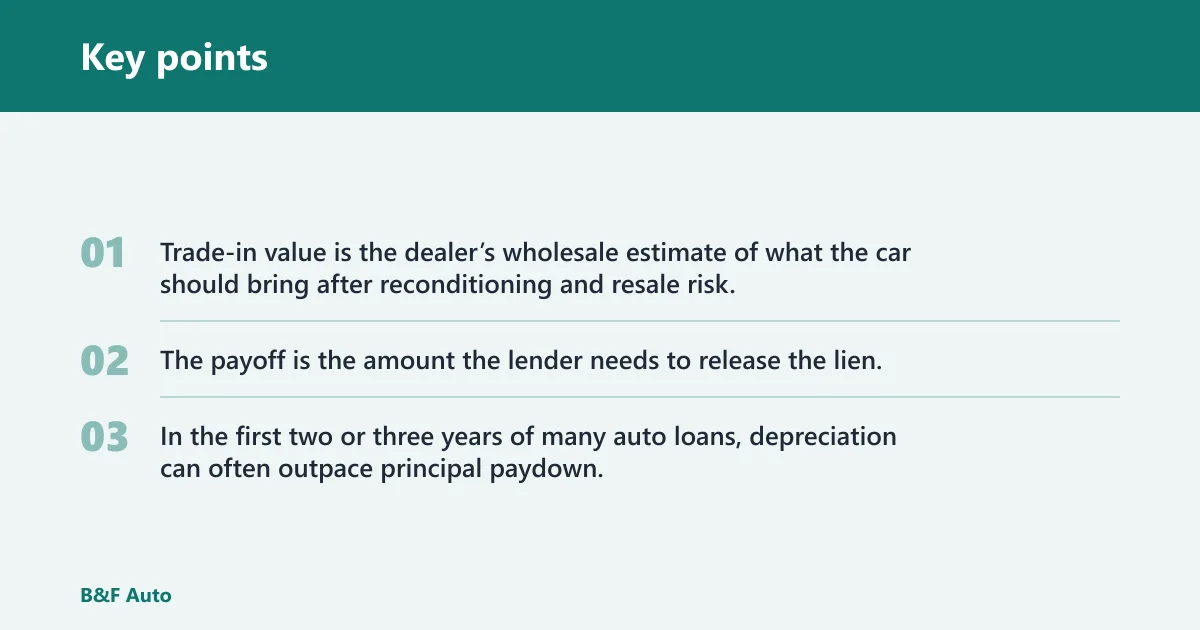
Upside-down means the loan balance is higher than the car’s trade-in value. That matters because the dealer’s offer and the payoff to the lender are separate numbers, and any shortfall can sometimes be rolled into the next deal if the lender allows it. In the first years of a loan, depreciation often outruns principal reduction, so negative equity can stack up fast.
The payoff math comes first. If the dealer offers less than the amount owed, the gap does not vanish; it becomes part of the deal structure, or it stays with you if you walk away.
How negative equity changes the payoff
Trade-in value is the dealer’s wholesale estimate of what the car should bring after reconditioning and resale risk. The payoff is the amount the lender needs to release the lien. If the payoff is about $24,000 and the trade-in offer is about $19,500, the car is about $4,500 upside down before fees, tax treatment, or any rolled balance from a new purchase.
That gap changes the decision on accessories. A part that looks valuable on paper may not matter if removing it costs more than the appraiser would discount the car for leaving it on.
Why early loan years matter most
In the first two or three years of many auto loans, depreciation can often outpace principal paydown. A heavily modified car can be in the same position as a stock one, but the trade-in math gets tighter because the dealer still prices the vehicle against market demand, not against what the owner spent.
How dealers appraise modified cars
Dealers usually appraise a used car in stock or near-stock condition. They look at condition, mileage, maintenance signs, and how quickly the vehicle should sell on the lot or at auction. A car that is easy to price and easy to recondition is easier to take in.
Aftermarket accessories can help a car stand out, but they often do not add dollar-for-dollar value. A dealer used-car department may like a clean, tasteful build if it is easy to resell. It may also discount a car that needs missing factory parts, extra labor, or a narrower buyer pool.
Condition, mileage, and market demand
Condition still drives most of the appraisal. Tires with uneven wear, a warning light, torn trim, or visible wiring from an audio install can lower the offer faster than the modification itself. Mileage and market demand still matter, and the dealer will price around the fastest likely resale path.
Why stock or near-stock cars are easier to price
Stock cars are simpler to value because the dealer can compare them with similar units. Once a vehicle has nonstandard wheels, a lift kit, an aftermarket exhaust, or other nonfactory changes, the appraiser has to judge whether the car will appeal to a smaller buyer pool. That often means a more conservative number.
Should you remove aftermarket parts before trading in?
Remove aftermarket parts only when the net gain is positive after labor, missing hardware, and reinstall risk. If the dealer will subtract less for the modification than it costs to restore the car, leaving it installed is usually cheaper. If the part has strong separate resale value, removal can make sense.
A common first-timer mistake is pulling a part that looked expensive, then discovering the car now needs stock pieces, special bolts, and several hours of work before it looks complete again. That can cut the offer more than the original mod did.
When removal can protect value
Removal makes sense when the part is easy to take off, the OEM part is on hand, and the removed part has a clear used market. Bolt-on wheels, a bolt-in stereo head unit, and some remote start kits can fit that pattern if the original parts are intact and the labor is simple.
When removal lowers the offer
Removal backfires when the car looks incomplete, the factory parts are missing, or the deleted item leaves obvious evidence of modification. A stripped stereo opening, missing wheel-lock key, cut wiring, or an exhaust with no stock pieces can make the car harder to appraise and harder to sell.
Remove aftermarket products decision table
| Aftermarket item | Estimated reinstall difficulty | Likely appraisal impact | OEM part needed? | Break-even condition | Net-gain formula |
|---|---|---|---|---|---|
| Wheels | Low to medium | Can help if stock wheels are included; can hurt if the car looks incomplete | Yes, stock wheels and tire sensors if applicable | Remove only if the used wheel set sells for more than mounting, balancing, and any missing stock wheel cost | Part resale minus removal, reinstall, and missing stock-part cost |
| Tires | Medium | Usually neutral unless tread, size, or noise is a problem | Usually yes, if returning to OEM size | Only remove if the current set has high separate resale value and the stock set is already available | Part resale minus mounting, balancing, and swap labor |
| Lift kit | High | Often lowers appraisal unless the truck market likes the setup | Yes, stock suspension parts | Remove only if you already have every factory component and labor is lower than the appraisal discount | Appraisal haircut avoided minus labor, alignment, and factory-part cost |
| Intake | Low to medium | Usually small or negative | Yes, stock intake parts | Leave it on unless the stock parts are on hand and the intake can be sold separately for more than removal time | Part resale minus removal time and any stock-part replacement cost |
| Exhaust | Medium to high | Can lower value if loud, cut, or noncompliant | Yes, stock exhaust pieces | Remove only if the factory exhaust is complete and the resale value exceeds labor and gasket/hardware cost | Part resale minus labor, gaskets, hardware, and reinstall risk |
| Stereo system | Medium to high | Can hurt if wiring is cut or dash parts are missing | Yes, original infotainment parts | Remove only if the stock radio and trim are ready to reinstall and the system has separate buyer demand | Part resale minus labor, trim, and wiring-restoration cost |
| Window tint | Low to medium | Usually small; poor tint can hurt | No | Remove only if it is failing, bubbled, or illegal and the car needs a cleaner presentation | Appraisal improvement minus removal labor and cleanup cost |
| Remote start | Medium | Can help convenience appeal, but rarely adds much cash value | Often yes, original wiring or modules may be needed | Leave it if it works cleanly; remove only if the stock system is simple to restore and the module has good resale value | Part resale minus programming, wiring, and reinstall cost |
| Aftermarket wheels | Low to medium | Can raise appeal if stock wheels are included; can lower appeal if the car looks unfinished | Yes | Remove only if the wheel set sells well and the OEM set is ready to go back on | Wheel-set resale minus swap, balance, and stock wheel cost |
| Aftermarket stereo | Medium to high | Can help or hurt depending on wiring quality and dash fit | Yes | Remove only if the stock head unit, trim, and harness are intact | Stereo resale minus labor, trim, and wiring restoration cost |
| Performance tunes | Medium | Can lower confidence if the car is flashed, unstable, or obviously altered | Often yes, if stock calibration can be restored | Remove only if the car can return cleanly to stock calibration before appraisal | Appraisal haircut avoided minus restoration and reflash cost |
| Lighting | Low to medium | Usually small unless the setup is flashy, mismatched, or illegal | Sometimes | Leave it on if the lights work cleanly; remove only if the install looks messy or noncompliant | Appraisal improvement minus labor and any wiring repair cost |
| Tint | Low to medium | Usually small; poor tint can hurt | No | Remove only if it is failing, bubbled, or illegal and the car needs a cleaner presentation | Appraisal improvement minus removal labor and cleanup cost |
Which accessories are worth removing first?
Start with parts that have clear resale value, easy removal, and a known stock replacement path. Wheels and tires usually come first, then plug-in stereo gear or remote start modules. Harder jobs, such as lift kits or cut exhaust systems, need a tighter math check before you touch them.
Wheels and tires
Aftermarket wheels are often the easiest parts to value separately. If you still have the stock wheels, the trade-in tends to stay cleaner, and the removed set can be sold on its own. If the car is sitting on oversized tires that cost more to mount back up than the appraiser would subtract, leaving them installed may be smarter.
Picture a truck on 35-inch tires with stock wheels in the garage. If the shop quotes two hours for swap work plus mounting and balancing, and the used tire set would only bring a modest amount, the better move may be to leave the truck complete and negotiate the trade-in as-is.
Stereo systems and remote start
Stereo upgrades are only worth removing when the stock head unit, trim bezel, and wiring adapters are complete. Cut factory wiring or missing trim can reduce the car’s presentation more than the aftermarket radio helped it. Remote start follows the same logic: if the install is clean and works, it may be easier to leave it in place.
Lift kits, intake, exhaust, and tint
Lift kits often create the biggest reinstatement bill because suspension geometry, alignment, and factory parts all matter. Intake and exhaust pieces are easier to remove, but they can still leave the car sounding or running differently than stock. Tint is different: it does not depend on OEM parts, but peeling it off costs labor and can leave adhesive or scratched glass if done poorly.
What to do with OEM parts and removed accessories
Keep every factory part you still have. OEM components, stock wheels and tires, stock suspension pieces, and original infotainment parts are often the difference between a clean return to stock and a discount for missing equipment. If the dealer has to source those parts, that cost can come out of your offer.
Inventory the stock parts. List every OEM part in hand, including fasteners, sensors, brackets, and trim. Missing hardware can turn a simple reinstall into a hunt for discontinued pieces.
Estimate reinstall cost. Get labor quotes for removal and reinstall, plus alignment, wheel balancing, or programming if needed. A part with a strong resale market can still be a bad trade if reinstall work is expensive.
Compare resale paths. Check the likely private-sale price of the removed part against the dealer’s expected haircut. Use the lower of the two as the real benchmark, since time, storage, and sales friction matter.
Decide before the appraisal. If the dealer sees a stripped car, the offer can fall before you get the chance to explain the missing part. Return the car to a coherent condition before the first appraisal whenever possible.
Missing or damaged factory parts
If the OEM parts are gone or damaged, the removal math changes fast. A vehicle without stock wheels, a factory exhaust, or the original infotainment pieces may appraise worse than a modified car that still looks complete. In that case, replacing parts just to trade can cost more than the value recovered.
Can GAP insurance or negative equity rollovers change the math?
GAP insurance may cover a payoff shortfall after a total loss, depending on the policy terms and claim limits. It does not usually improve a weak trade-in offer on its own. Negative equity rollovers are different: the dealer and lender may fold the shortfall into a new loan, but that makes the next balance larger and can increase the total cost of the next vehicle.
What GAP may cover
GAP exists for a loss event, not as a trade-in booster. If the car is stolen or totaled and the insurance settlement is less than the payoff, GAP may help close the gap under the policy rules. On a normal trade, the appraisal still depends on condition and market demand.
Why rolling the shortfall into a new loan can get expensive
If you roll about $4,000 of negative equity into a new loan, the new car starts underwater too. That can matter more if the replacement car depreciates fast. The dealership may still complete the deal, but the extra balance increases interest costs and can make the next trade cycle harder.
Frequently asked questions
Can I remove aftermarket parts before trading in my upside-down car?
Yes, but only if the part comes off cleanly, the OEM part is ready to reinstall, and the removed item will sell for more than the labor and storage cost. If the car looks incomplete or the dealer notices missing stock pieces, the appraisal can drop more than the part is worth.
Will removing accessories lower my trade-in value?
It can. Removing accessories lowers value when the car loses factory equipment, needs extra labor to restore, or ends up with visible damage from the install. A clean stock return usually helps more than a half-finished teardown.
Which aftermarket upgrades should I keep on the car for trade-in?
Keep upgrades that are clean, functional, and easy to explain, especially if they are hard to remove without parts loss. A working remote start or a tasteful wheel setup may be easier to leave installed than to strip out, especially when stock parts are missing or the swap needs alignment or coding.
Can I sell removed parts separately before I trade it in?
Yes, and that can be smarter than trading them in, but only if there is enough demand and you can store the parts safely. Separate sale works best for wheels, tires, and some audio gear. It is weaker when the part is bulky, fragile, or needs a buyer who matches the exact vehicle.
Do dealers care about factory parts being put back on?
Yes. Dealers usually prefer a vehicle that can be sold or sent to auction without extra reconstruction. Factory parts reduce reconditioning risk and make the unit easier to price, so missing OEM wheels, suspension pieces, or infotainment parts can hurt the number.
How do I know if taking off mods is worth the labor and parts cost?
Compare three numbers: the dealer’s likely haircut if you leave the mod on, the cost to remove and reinstall it, and the used resale value of the part. If the resale value is not clearly higher than the work and missing-part risk, leave the car complete and negotiate from there.