Trade-in Value for Electric Cars: Battery Health
EV trade-in offers may drop when battery health is weak, especially once usable capacity falls below about 80% or the pack shows fault codes, charging limits, or uneven module data. Ignore that evidence, and you may leave money on the table or face a low appraisal. This guide explains what dealers check, which battery records matter, and how to present proof that supports a stronger offer.
How battery health changes trade-in value
Battery condition changes an EV offer because the pack is the largest value item under the floor. A healthy high-voltage traction battery with strong usable capacity, clean scan data, and valid warranty coverage gives the dealer less risk. A weak pack raises the chance of reduced range, repair costs, or a resale discount.
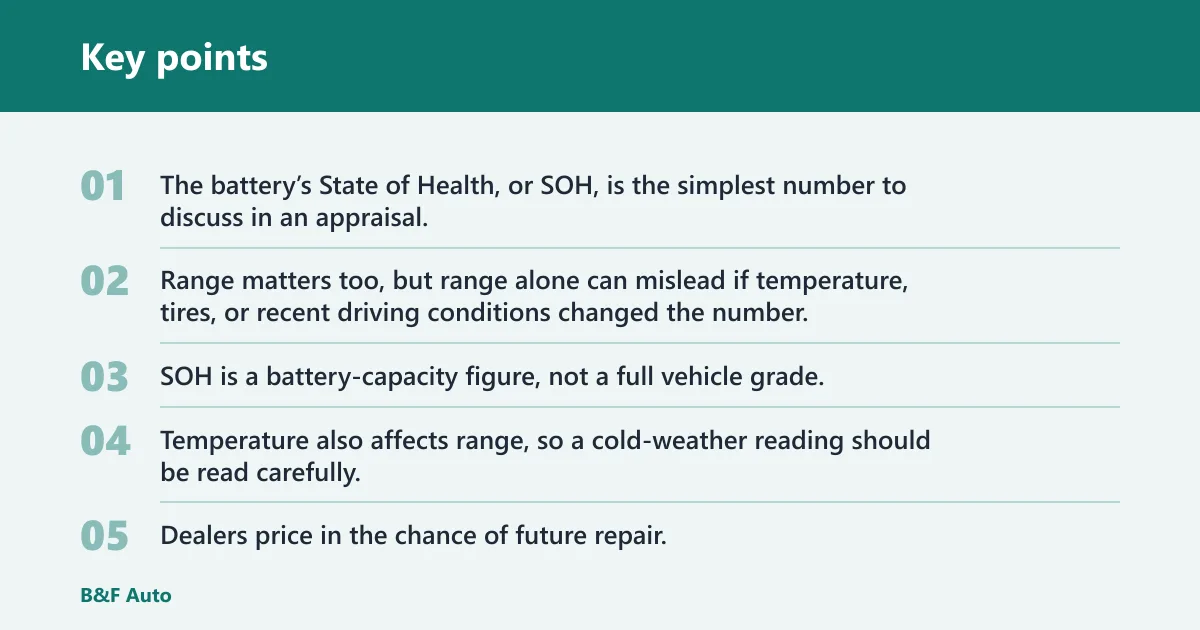
The battery’s State of Health, or SOH, is the simplest number to discuss in an appraisal. It is usually shown as a percentage of remaining capacity from scan tools or dealer diagnostics, and higher SOH usually supports a stronger offer. Range matters too, but range alone can mislead if temperature, tires, or recent driving conditions changed the number.
What SOH tells an appraiser
SOH is a battery-capacity figure, not a full vehicle grade. A dealer may treat 92% SOH very differently from 78% SOH because the lower figure suggests less usable range and a shorter useful life before repair becomes a concern. If the report shows balanced cells and no active faults, that usually helps your case more than a vague claim that the car “still drives fine.”
Why range and pack size matter together
EV range is the practical proxy buyers understand first. If a 75-kWh pack now delivers far less range than the window sticker suggested, the appraiser may assume the battery has degraded, even if the car still charges normally. Temperature also affects range, so a cold-weather reading should be read carefully.
How battery risk affects dealer offers
Dealers price in the chance of future repair. Replacement battery cost can be a major risk factor on older EVs, and in some models it can exceed the value of the vehicle itself. That risk can soften an offer even when the car is otherwise clean, especially if the battery report is missing or the pack is out of warranty.
What dealers check in an EV appraisal
Dealers usually look at more than odometer mileage. Dealers often review battery scan data, warranty status, fault codes, visible condition, and service records before setting an offer. If the pack has warning flags or missing documentation, the appraisal can move down quickly even when the body and interior look presentable.
Battery scan data and BMS fault codes
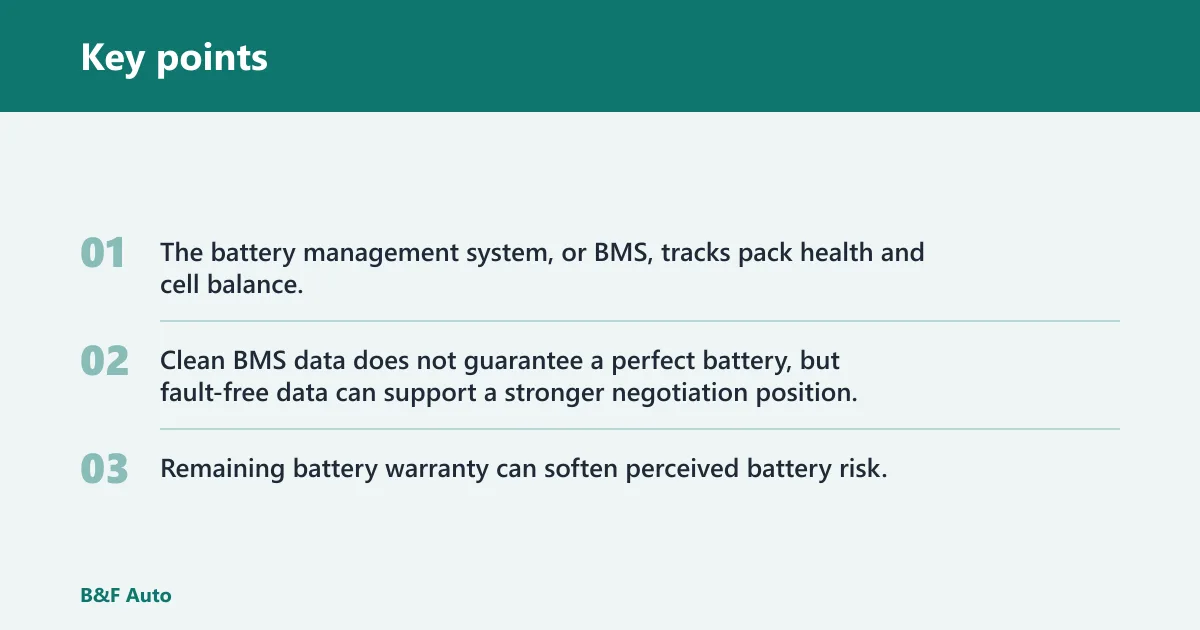
The battery management system, or BMS, tracks pack health and cell balance. A dealer may review BMS data during inspection because stored fault codes can point to imbalance, isolation faults, charge control issues, or repeated warnings. Clean BMS data does not guarantee a perfect battery, but fault-free data can support a stronger negotiation position.
Mileage, age, and overall condition
Odometer mileage still matters. Higher mileage often means more wear on suspension, tires, brakes, and cabin parts, and it can also increase concern about battery age. A 9-year-old EV with 140,000 miles may appraise differently from a 9-year-old EV with 55,000 miles, even if both still run well.
Warranty status and remaining coverage
Remaining battery warranty can soften perceived battery risk. Many factory warranties transfer with the vehicle, which matters because a buyer sees less exposure if the pack is still covered. If coverage is close to expiring, the dealer may discount more aggressively unless the battery report is especially strong.
| Battery-health signal | What it means to an appraiser | How it affects offer strength |
|---|---|---|
| SOH percentage | Shows remaining capacity as a percent of the original pack | Higher SOH usually supports a stronger offer; low SOH weakens it |
| Range loss | Suggests reduced usable energy or cold-weather limitations | Moderate loss may be explainable; large loss can cut offer strength |
| BMS fault codes | Signals possible pack, cell-balance, or charging control issues | Active or stored faults usually weaken the offer sharply |
| Warranty remaining | Reduces buyer risk if the pack is still covered | More remaining coverage can support a firmer offer |
| Fast-charging history | Shows how often the car relied on DC fast charging | Frequent use may raise concern, though it is not proof of damage |
| Accident or repair history | May indicate pack damage, cooling issues, or incomplete repairs | Clean history helps; battery-related repairs can reduce confidence |
| Recent battery report results | Provides documented SOH, cell balance, and fault status | A clean report can offset age or mileage in negotiations |
How to check your EV battery health before trading it
You can check battery health with a scan tool, a dealer printout, or a third-party battery report. The goal is to walk into the appraisal with documented SOH, range behavior, and any stored codes. That evidence matters because a clean report can offset mileage or age better than a verbal explanation.
-
Pull a battery report.
Use a scan tool or dealer diagnostic that reads SOH, cell balance, and fault codes. Save the report as a PDF or printed copy so the appraiser can review the numbers without guessing. -
Check range under normal conditions.
Compare displayed range after a full charge with the vehicle’s usual use pattern, not a single cold morning. If range looks low, note temperature, heater use, and recent highway driving so the dealer can separate weather effects from degradation. -
Review warning lights and history.
Look for battery, charging, or drivetrain alerts on the dash and in stored codes. If a warning appeared and later cleared, bring the repair order or service note that explains what was done. -
Confirm warranty coverage.
Check the in-service date and the remaining battery warranty terms. Bring proof of coverage because transferable warranty status can soften concern about a pack that is still within factory limits. -
Gather service records.
Collect battery-related maintenance, software updates, tire rotations, and repair invoices. Organized records help show that the car was maintained, even if the appraisal centers on battery condition.
Using a scan tool or battery report
A documented battery report carries more weight than an estimate from the dash. It can show SOH, module balance, and whether the BMS stored any codes. If the report is recent and clean, it gives you a concrete point to defend during negotiation.
Reviewing range, charge history, and warning lights
DC fast charging history can matter, but it should be explained carefully. Frequent fast charging may raise buyer concern because it suggests a harder use pattern, yet it is not direct proof of poor health by itself. A car with many fast-charge sessions and a clean report may still appraise well.
Suppose a compact EV shows about 84% SOH, no fault codes, and about a 10% drop in displayed range during a winter appraisal. If the same car has a recent battery report and a remaining factory battery warranty, that combination can support a firmer offer than mileage alone would suggest.
Confirming warranty coverage and service records
Warranty papers help because they reduce the dealer’s downside. If the battery pack is near a coverage threshold, the offer may depend on whether the warranty transfers cleanly and whether the battery symptoms started before or after the cutoff. Service records also help show that any charging issue was inspected instead of ignored.
Will a high-mileage EV still appraise well?
Yes, a high-mileage EV can still appraise well if the battery data is strong and the pack has no fault codes. Mileage hurts most when it lines up with age, weak SOH, or missing documentation. A clean battery report can offset some mileage pressure because it reduces the dealer’s repair risk.
When mileage hurts more than age
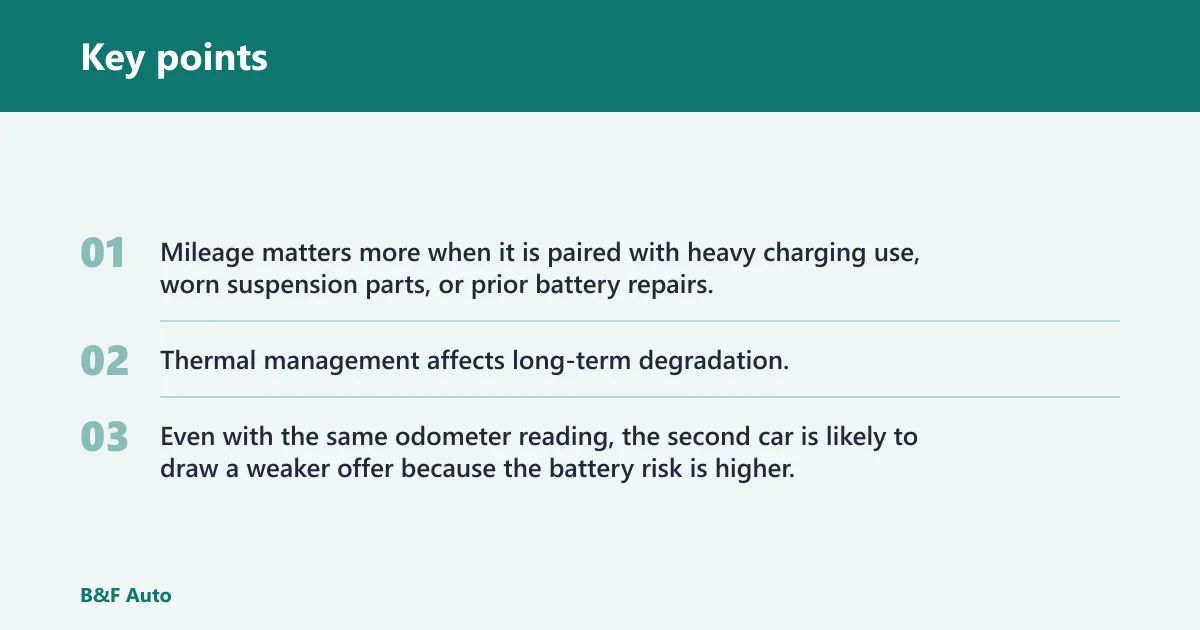
Mileage matters more when it is paired with heavy charging use, worn suspension parts, or prior battery repairs. A six-year-old EV with 120,000 miles may concern a dealer more than an eight-year-old EV with 55,000 miles if the higher-mileage car shows weaker SOH and less warranty remaining.
When good battery data can offset mileage
If the battery report is clean, the pack is balanced, and range still matches the model’s expected use, high mileage becomes one factor among several. Dealers often react better to measurable evidence than to a general claim that the car “runs great.” That is especially true when the battery report is recent.
How thermal management changes the story
Thermal management affects long-term degradation. Liquid-cooled packs generally manage heat better than air-cooled packs, which can matter in hot climates or under repeated fast charging. The architecture is model-specific, so two EVs with the same mileage may age differently because the pack design is not the same.
Picture two similar EVs with 90,000 miles. One has a liquid-cooled pack, 88% SOH, and a clean report; the other has an air-cooled pack, 79% SOH, and a stored charge-control fault. Even with the same odometer reading, the second car is likely to draw a weaker offer because the battery risk is higher.
How to support a stronger offer
To support a stronger offer, arrive with documents that answer the dealer’s questions before they ask. A clean battery report, service history, warranty proof, and clear notes about charging behavior can keep the discussion focused on facts. If the pack has no major issues, the appraisal should reflect that instead of relying on guesswork.
Documents to bring to the appraisal
Bring the following items in printed or digital form:
- Recent EV diagnostic scan or battery report
- Warranty paperwork showing remaining battery coverage
- Service records for maintenance, software updates, and repairs
- Any battery-related repair orders or inspection notes
- Odometer reading and the date it was recorded
- Notes on charging habits, especially frequent DC fast charging
When a battery report helps negotiation
A battery report helps most when the dealer is worried about an older pack, a higher-mileage vehicle, or a model with mixed reputation for degradation. It can also help when the EV range looks low but the report shows the pack is still healthy enough for normal use. That evidence gives you a clearer basis for the asking position.
When replacement is not worth it
Replacing the battery before trade-in is often not the default move. If the vehicle is already near the end of its value curve, a new pack may cost more than the trade-in gain it creates. A replacement only makes sense when the math is unusually favorable for that specific model, pack size, and market.
Frequently asked questions
How does battery health affect electric car trade-in value?
Battery health affects trade-in value because the pack is one of the biggest cost risks in an EV. Lower SOH, fault codes, and reduced range usually weaken the offer, while a clean battery report and remaining warranty can support a stronger one. Dealers price the car around future repair exposure.
How can I check my EV battery health before trading it in?
Use a scan tool, dealer diagnostic, or battery report that shows SOH, cell balance, and stored fault codes. Then compare range, review warning lights, and collect service records. A recent report is better than a verbal claim because it gives the appraiser something concrete to evaluate.
Will a high-mileage electric car still have good trade-in value?
Yes, if the battery data is strong and the car has no major faults. Mileage still matters, but it does not automatically sink the offer. A high-mileage EV with clean SOH, good range, and valid warranty coverage can appraise better than a lower-mileage car with battery problems.
What battery metrics do dealerships use when appraising an EV?
Dealers often look at SOH, BMS fault codes, module balance, charging behavior, range, and warranty status. They may also review service records and visible battery-related repairs. The most useful evidence is a clean, recent diagnostic report that ties the numbers to the current condition of the pack.
Does EV warranty coverage improve trade-in value?
Yes. Remaining battery warranty usually reduces buyer risk and can improve the offer, especially if the pack is older or the car has high mileage. Transferable coverage matters because the dealer may be able to resell the vehicle with less fear of a near-term battery expense.
Should I replace an EV battery before trading the car in?
Usually no. Battery replacement can cost more than the value it adds to the trade, especially on older EVs. It only makes sense if the vehicle’s market value rises enough to cover the repair, which is uncommon without model-specific evidence and a dealer willing to pay for that change.