How Long Do You Have to Switch Out-of-State Registration?
Most states require you to switch an out-of-state registration within 30 to 60 days after residency starts, but the clock can begin sooner if you take a job, enroll in school, sign a lease, or otherwise meet the state’s residency rule. Miss it and you can face tickets, fines, inspection trouble, and delays that may also complicate insurance claims.
What starts the registration clock?
The clock usually starts when your new state treats you as a resident, not when your old plate expires. That difference matters because a move by itself does not always trigger the filing deadline. States often key the deadline to a residency event such as leasing a home, starting work, changing a legal address, or qualifying for resident taxes. (Txdmv)
Moving date vs. residency date
Some drivers assume the move date controls everything. It does not. Many state motor vehicle agencies use residency triggers, which can happen before or after the moving truck arrives, depending on what the law says and what documents you create first. A lease, utility account, school enrollment, or address change can matter more than the day you crossed the state line.
Residency rules also differ from temporary presence. A student, military member, or short-term worker may keep a home-state registration longer if the state grants an exception. That is why you should check the exact language on your new DMV page instead of guessing from the calendar.
Common residency triggers states use
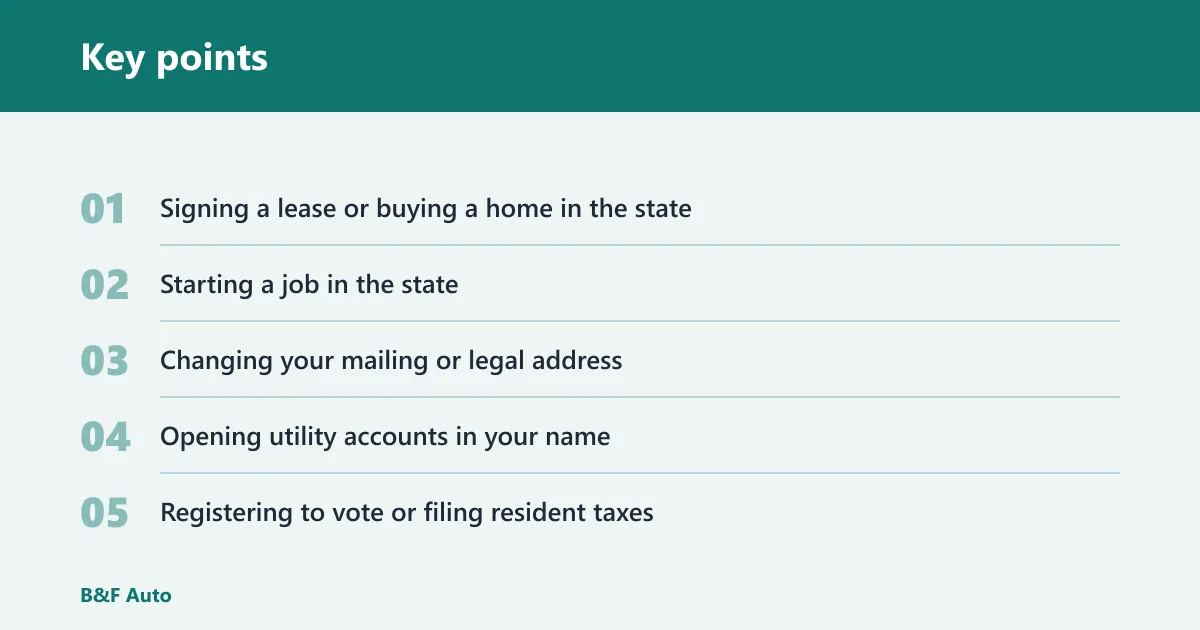
- Signing a lease or buying a home in the state
- Starting a job in the state
- Changing your mailing or legal address
- Opening utility accounts in your name
- Registering to vote or filing resident taxes
- Enrolling as an in-state student, if the state treats that as residency evidence
Picture a driver who rents an apartment on April 3, starts work on April 8, and keeps the old plates until June because the registration packet is incomplete. If the state counts the lease or job date as the residency trigger, the deadline may already be running even though the old plates still show a later expiration.
Why the old plate expiration date is not the same thing
Your current plate can expire after the new-state deadline, before it, or on a date that has nothing to do with residency. States do not generally tie the switch deadline to the plate sticker alone. If you wait for the old registration to run out, you can still miss the new-state filing window.
Out-of-state registration decision table
Use this table to sort your likely deadline path before you file. The trigger date is the event that usually starts the clock in that scenario. Then confirm the exact rule on the official DMV or motor vehicle agency page for your new state, because filing method, required forms, and grace periods vary.
| Trigger date | Likely DMV steps | Common delay points |
|---|---|---|
| You sign a lease, start work, or otherwise establish residency | Gather identity, address, insurance, title, and inspection paperwork; file the registration application online, by mail, or in person if allowed | Proof of address does not match; insurance policy still shows the old state; residency proof is incomplete |
| You move but the state uses a residency rule tied to a later event | Wait until the state’s rule is met, then complete any VIN inspection, emissions test, and ownership paperwork before filing | Assuming the move date controls the deadline; missing a required inspection appointment |
| You are a student, military member, or temporary resident with a separate rule | Check whether your status qualifies for a different filing window, a waiver, or an exemption from local registration | Using the general rule when a status-specific rule applies; not carrying the documents the agency asks for |
| Your car is financed or leased | Confirm what the lienholder or leasing company must send, then register once the title or ownership record is ready | Lienholder mail delays; name mismatch; the title is held electronically and the state wants a separate release or authorization |
| Your state requires inspection before first-time registration | Complete VIN verification, safety inspection, or emissions testing first, then finish the registration packet | Inspection station wait times; failing emissions; paperwork is submitted before the test result is in the system |
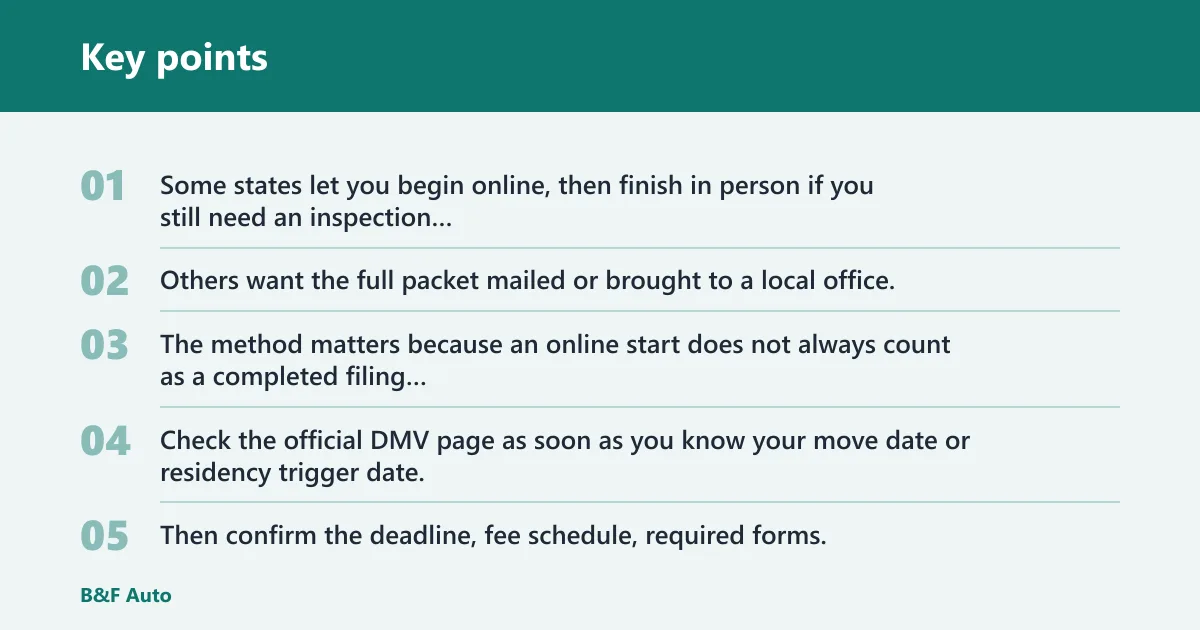
Some states let you begin online, then finish in person if you still need an inspection report, title record, or identity check. Others want the full packet mailed or brought to a local office. The method matters because an online start does not always count as a completed filing if the agency still needs a supporting document.
When to confirm your state rule on the official DMV site
Check the official DMV page as soon as you know your move date or residency trigger date. Then confirm the deadline, fee schedule, required forms, and filing options on the state’s first-time registration page. If the site offers a first-time registration checklist, use that instead of a generic renewal page.
What documents do you need first?
Many states ask for proof of identity, proof of address, proof of ownership, and proof of insurance before they will finish an out-of-state registration. If any one of those items is missing or out of date, the filing can stall even if you are still inside the deadline window.
Proof of identity and address
Bring the documents your new state accepts for identity and residency. That can include a driver license, passport, birth record, lease, utility bill, bank statement, or pay stub, depending on the agency list. The key is not the type of paper alone, but whether it matches the name and address on the application.
Title or ownership documents
You usually need a title, an electronic title record, or another ownership document to prove the vehicle is yours to register. If the title name does not match your current name, or if there is an error in the VIN, the DMV may stop the filing until the record is corrected.
Suppose the registration is in your married name but the title still shows your former name. That small mismatch can hold up the filing until you provide a marriage record or a corrected ownership document. The same problem can happen if a middle initial, apartment number, or VIN digit does not line up across the paperwork.
Insurance and lienholder paperwork
Your policy usually has to meet the new state’s minimum coverage rules, and the address on the policy may need to be updated. Some agencies accept digital proof of insurance; others want a paper card or an insurer-generated document. If the vehicle is financed or leased, the lender or leasing company may also need to authorize the registration or send title paperwork.
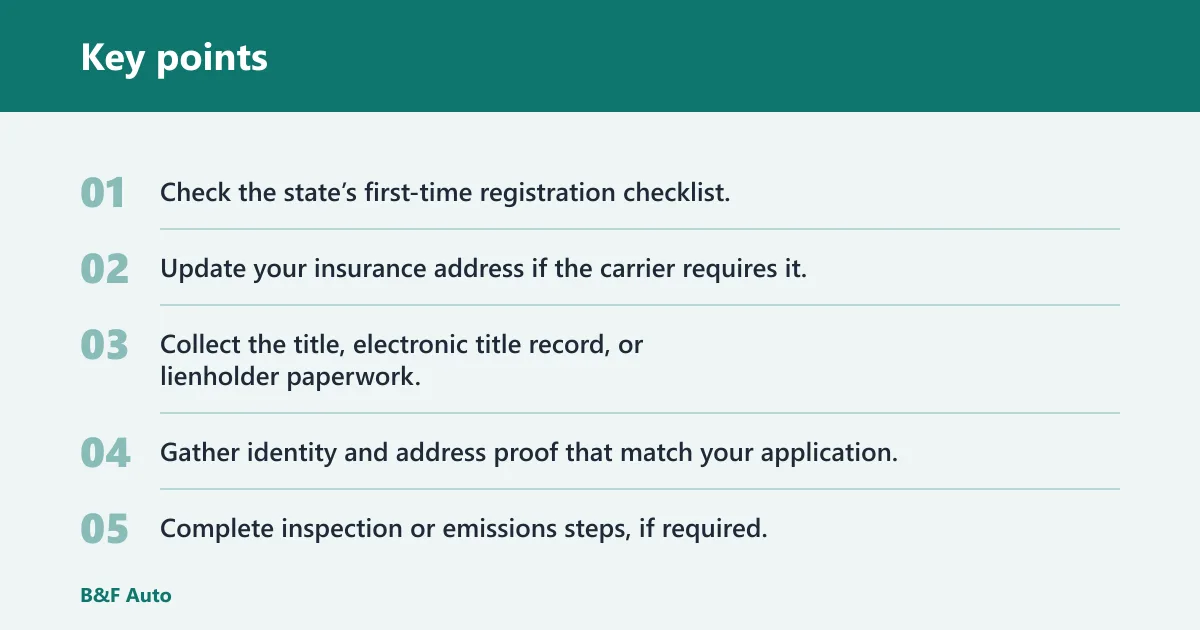
- Check the state’s first-time registration checklist.
- Update your insurance address if the carrier requires it.
- Collect the title, electronic title record, or lienholder paperwork.
- Gather identity and address proof that match your application.
- Complete inspection or emissions steps, if required.
- File online, by mail, or in person, depending on the state’s allowed method.
Do you need VIN or emissions checks?
Some states require a VIN inspection, emissions test, or both before they will issue a new registration. If your state lists those steps, treat them as filing requirements, not optional extras. A missing inspection result can stop the DMV from completing the registration even when every other document is ready.
When a VIN inspection is required
A VIN inspection is commonly used to verify that the vehicle identification number on the car matches the paperwork. States may require it for out-of-state vehicles, rebuilt titles, salvage histories, or first-time registrations. The check may happen at a DMV office, police station, inspection station, or another authorized site.
When emissions or smog testing applies
Emission or smog testing rules are state-specific and can depend on the vehicle’s model year, fuel type, county, or weight class. Some vehicles are exempt by age, while others need a current test result before the registration application will move forward. Check the state’s inspection page before you book an appointment.
A common first-timer mistake is to complete the DMV form first and schedule testing later. If the state wants a current emissions certificate before filing, the sequence runs the other way around. The same goes for VIN verification in states that require it before the registration packet is accepted.
Can you register before getting a new license?
Sometimes yes, sometimes no. In many states, the driver license change and vehicle registration change can happen on separate timelines, but the agency may still want the same address on both records. Confirm whether your state lets you register the car first or wants the license update completed as part of the same visit.
State DMV timing rules
Some DMVs process vehicle registration before the new license is issued. Others tie the two together because both records need the same residency proof. If your state allows separate filing, the registration may still require a current in-state address even if your license card has not been replaced yet.
What to verify before you file
Check whether the agency wants a license number from the new state, whether an out-of-state license is acceptable during the transition, and whether the address on your proof of residency matches the address you plan to use on the registration. If those items do not line up, the filing can be rejected or placed on hold.
Financed or leased vehicle timing
Financed and leased vehicles can take longer because title paperwork may move through the lienholder or leasing company. That affects registration timing even when you already have insurance and address proof. In this situation, the registration deadline and the title-transfer timeline are related, but they are not the same step.
How lienholders can slow the process
The lender may hold the title, use an electronic title system, or require its own state forms before the DMV accepts the registration. If the lienholder is in another state, mail time alone can add days or weeks. That is why drivers with financed cars should request the needed paperwork as soon as the move is planned.
Why title paperwork may take longer than registration
The DMV may be willing to register the vehicle once it has proof of insurance, identity, address, and a lienholder authorization. But if the title record needs correction, transfer, or release, the registration can still stall. The practical question is not only “Can the car be registered?” but also “Is the ownership record ready?”
Name mismatches and address updates
Name mismatches create avoidable delays. So do incomplete address changes, especially when the insurer, lienholder, and DMV all use different versions of the same street address. Make the records agree before you submit the packet, or be ready for a correction notice.
What if your old plates expire first?
If the old registration expires before the new state approves your filing, ask whether the state offers a temporary permit, a temporary registration, or another short-term option. The answer depends on the agency and the reason for the delay. Do not assume you can keep driving indefinitely while the paperwork is pending.
Temporary registration and permit options
Some states issue a temporary plate or paper permit while the permanent registration is processed. Others do not. If a temporary option exists, the state page should say who qualifies, how long it lasts, and whether you need inspection or insurance first. Keep that permit with the vehicle exactly as instructed.
Driving while paperwork is pending
You should not treat a pending application as permission to ignore the deadline. If the old plate expires, you may need proof of submission, a temporary permit, or a DMV receipt that the state accepts during processing. Carry whatever the agency says is valid and keep your insurance current during the wait.
Where delays come
Delays usually come from one of four places: missing inspection results, a title problem, insurance that does not match the new state, or a residency document that does not satisfy the agency. Fixing the delay often means correcting the paperwork path, not just waiting longer.
Frequently asked questions
How long do I have to switch my out-of-state registration after I move?
The answer depends on your new state, but many set a filing window of 30 to 60 days after residency starts. Some states use a different trigger, such as a lease, job, school enrollment, or tax residency. Check the official DMV page for the exact deadline before your old plate expires.
What happens if I miss the deadline to change my registration?
The outcome varies by state, but missing the deadline can bring tickets, fines, registration refusal, or a stop on your renewal until the record is corrected. If inspection or insurance is also out of date, the delay can grow. Fix the filing as soon as possible and keep proof of submission.
Is the deadline based on moving date or establishing residency?
Usually it is based on residency, not the day you physically moved. States may treat a lease, job start, utility account, address change, or tax filing as the event that starts the clock. That is why a move on one date and residency on another can produce different deadlines.
Can I register my car before I get a new license?
Sometimes you can, but the state may require the same address on both records or may want the license change first. Check whether your DMV allows separate filing. If the records must match, your registration packet may be held until the license update is in the system.
What if my car is financed or leased?
Expect extra timing issues because the lienholder or leasing company may need to release title information or authorize the filing. Registration may be possible before final title transfer, but not always. Check whether your state wants electronic title data, lender paperwork, or a direct mailing from the lienholder.
How do I know which DMV rules apply in my new state?
Use the official motor vehicle agency site for your new state and look for first-time registration, out-of-state transfer, residency, inspection, and title pages. If the site offers forms or a checklist, use those as the controlling source. When rules conflict, the state page and form instructions win.