Signed Title Mistakes: How to Fix Common Errors
Most signed title mistakes have one safe rule: stop writing, preserve the title as it is, and check the issuing state’s DMV or motor vehicle agency instructions to see if that title form allows a single-line correction in that field or requires a duplicate title first. Some states allow limited strike-through-and-initial corrections in specific fields, while others do not. Handled the wrong way, a crossed-out signature, altered odometer entry, or overwritten buyer name can void the transfer and add fees, delays, or a full re-signing. This guide sorts the common signing errors, explains when the title is still usable, and shows the least disruptive fix for each.
A title defect can come from an error or a missing signature, and missing signatures are a common defect example. Some mistakes are clerical and can sometimes be cured by affidavit. Others cloud ownership, break the assignment chain, or alter required disclosures, which can push the file into duplicate-title or DMV-review territory depending on the state and the field involved.
The key is triage. Preserve the original title as it sits unless the issuing state expressly allows a limited correction in that exact field, identify whether the problem is in the seller fields, buyer fields, odometer disclosure, notary block, lien area, or reassignment section, and then match that problem to the smallest fix the state will accept.
What makes a signed title mistake serious?
A signed title mistake becomes serious when it affects ownership, assignment validity, required disclosures, or identity verification rather than simple clerical wording. DMVs often allow only narrow corrections. Altered signatures, overwritten names, missing co-owner signatures, odometer changes, and broken notarization usually draw rejection because they cloud ownership or raise fraud concerns.
Clerical errors versus transfer-blocking defects
Clerical mistakes are common in public records. A scrivener’s error usually means a mechanical writing or transcription mistake that does not change the parties’ intended transfer. Examples can include a minor address omission where the state has a correction form for that field, or an issuing-agency typo printed on the face of the title.
By contrast, changes affecting rights usually require more than a simple affidavit. If the mistake changes who sold the vehicle, who bought it, the odometer statement, the lien status, or whether all listed owners agreed, the problem is no longer a harmless clerical issue.
Misspelled names can create title problems. So can an incorrect legal description or a document filed in the wrong index. On vehicle paperwork, the parallel issue is that a name mismatch, wrong VIN character, missing release, or incomplete assignment can stop the transfer even when everyone intended the same sale.
Why altered titles draw DMV scrutiny
Most motor vehicle agencies reject obvious alterations because the title itself is the ownership instrument. Correction fluid, erasures, crossed-out entries, strike-through lines, and handwritten text written over earlier entries can make it hard to verify the original title and what changed later.
That matters most in signature blocks and odometer fields. A later explanation may help, but a later notary stamp or written note rarely cures an altered title by itself if the state treats the title as void for transfer or requires a different correction procedure.
When the problem is the title document, not the signature
Sometimes the signature is fine and the title stock is the issue. The issuing agency may have printed the wrong owner suffix, omitted a lien release notation, misstated a brand such as salvage or rebuilt, or issued a document that is already fully assigned on the back.
Those cases call for title correction or reissue from the issuing agency, not a new signature in the margin. Keep the original intact and gather the prior title copy, current registration, lien payoff or release record, bill of sale, and any rejection notice that shows the printing error before asking for a replacement or corrected title.
Where title signing errors usually happen
Seller assignment fields
The seller assignment area is the most common trouble spot. Review the printed owner name on the front, then compare it to the exact seller name and signature on the back. If the title lists two owners, also check whether the ownership wording uses and or or, because that can affect signing authority under that state’s rules and forms.
Look for the sale date, sale price if your state prints that box on the title, and any dealer assignment boxes nearby. A seller who signs in the buyer field or in a dealer reassignment box can contaminate an otherwise usable title.
Buyer assignment fields
The buyer section often includes printed lines for purchaser name, address, date of sale, and signature. Some states want the buyer to sign immediately. Others do not require a buyer signature on the title itself, or they require it only if an odometer acknowledgment appears in the assignment.
That is why copying advice from another state can backfire. A missing address may be a correction-form issue in one state and a duplicate-title problem in another if the buyer wrote in the wrong block and cannot cleanly fix it.
Odometer and damage disclosure areas
Odometer disclosures are treated more strictly than ordinary clerical fields. If the title has a mileage box, check the reading, date, seller signature, and buyer acknowledgment. Overwriting a digit or changing a mileage status can trigger rejection, even if the rest of the assignment appears otherwise complete.
Some states also pair the title with a separate odometer or damage disclosure statement. If one form says one thing and the title says another, the DMV may pause the transfer until the mismatch is explained or corrected.
Notary, lien, and reassignment sections
Notary blocks matter only where state law requires acknowledgment, but where required they matter a lot. The signatures may need to occur in front of the notary, with identity verified at that time. If the state uses a different notarization format or a separate correction procedure, follow that process instead of assuming a later stamp fixes the title.
Check the lien area on the front and back. A signed title can still be untransferable if the lienholder has not released the lien in the form your state accepts. Also inspect any reassignment section. Dealers and resellers may use that area, but prior assignments should not be overwritten or stacked outside the printed boxes.
What if the seller signed in the wrong spot or forgot to sign?
If the seller signed in the wrong field or left the required seller signature blank, the transfer may pause until the assignment is corrected or the title is replaced. Some misplaced signatures can be cured with a correction form, but missing seller authority, name mismatch, or absent co-owner signatures can force DMV review or a duplicate title.
Seller signed the buyer field or wrong assignment box
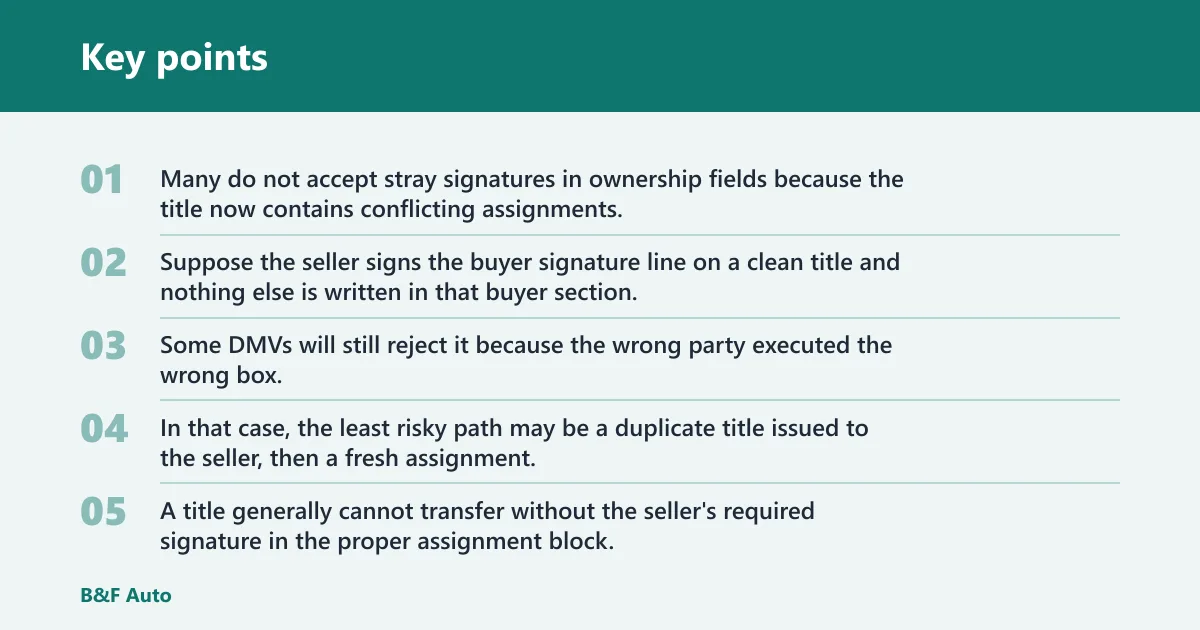
When a seller signs the buyer line, the safest outcome depends on whether the state allows a correction affidavit tied to the original title number. Many do not accept stray signatures in ownership fields because the title now contains conflicting assignments.
Suppose the seller signs the buyer signature line on a clean title and nothing else is written in that buyer section. Some DMVs will still reject it because the wrong party executed the wrong box. In that case, the least risky path may be a duplicate title issued to the seller, then a fresh assignment.
Seller signature is missing or incomplete
A title generally cannot transfer without the seller’s required signature in the proper assignment block. An unsigned title is sometimes easier to fix than an altered one because the document is still clean. The seller can sign correctly if the state still allows the original assignment to be completed.
Problems rise when the buyer already filled fields, taxes are due, or the seller is unavailable. If the seller cannot sign the original in a way the state accepts, the seller may need to obtain a duplicate title and complete the transfer again.
Seller name does not match the printed title
Name mismatch is different from sloppy handwriting. If the title shows Robert J. Smith and the seller signs Bob Smith, the agency may require supporting ID, a name affidavit, or a duplicate title corrected into the current legal name.
Misspelled names can create title problems, and that is especially true when the mismatch looks like a different person rather than a shortened first name. If the title itself was printed wrong by the issuing agency, treat it as an agency-printing error, not a signing error.
Joint owners and missing co-owner signatures
Joint titles need close reading. If the front of the title joins owners with and, or, or survivorship language, check that state’s title rules and forms before assuming who can sign. Title wording, death of an owner, and lienholder requirements can change the answer.
Survivorship wording can add delay if one owner has died and the state requires a death certificate, affidavit, or probate-related paperwork before transfer. A correction form does not fix absent legal authority.
Can the buyer fix a title they signed incorrectly?
Buyer-side mistakes are sometimes salvageable because they often affect intake fields rather than ownership authority, but only if the title remains unaltered and the state offers a correction process. A buyer should stop after any wrong-field signature, mileage acknowledgment problem, or address/date omission and check the issuing state’s title instructions or correction forms to see whether that exact field can be corrected, or whether re-signing or a duplicate title is required. Do not assume the buyer was supposed to sign the title at all, because some states do not require a buyer signature on the title assignment.
Buyer signed too early or in the wrong place
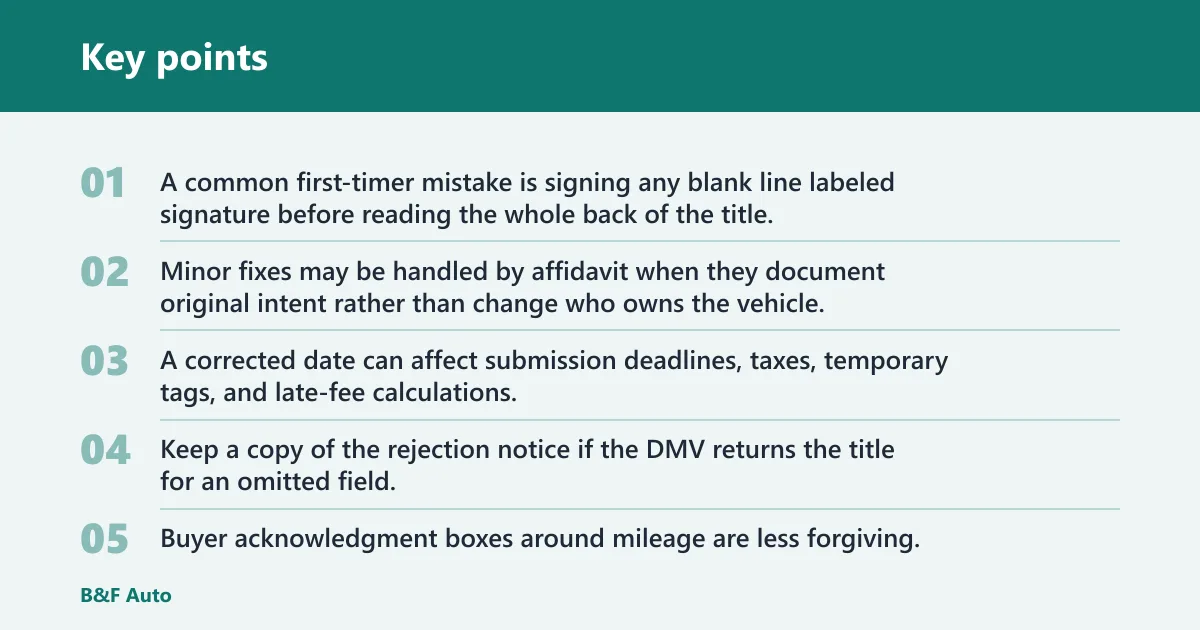
A common first-timer mistake is signing any blank line labeled signature before reading the whole back of the title. If the buyer signs a reassignment box meant for a dealer, or signs before the seller fills the assignment, the title can become unusable.
Picture a buyer filling their name and signature in a dealer reassignment section because the seller assignment looked cramped. Nothing else is wrong. The buyer still should not cross it out. That stray signature may force a duplicate title because the reassignment chain is now contaminated.
Missing address, date, or acknowledgment fields
These are the buyer errors most likely to qualify for a correction form or affidavit, assuming the state collects them on the title and the ownership chain is otherwise clear. Minor fixes may be handled by affidavit when they document original intent rather than change who owns the vehicle.
Even then, check timing. A corrected date can affect submission deadlines, taxes, temporary tags, and late-fee calculations. Keep a copy of the rejection notice if the DMV returns the title for an omitted field.
Buyer-side odometer mistakes
Buyer acknowledgment boxes around mileage are less forgiving. If the buyer signs the wrong mileage status, enters numbers in the seller field, or writes over the mileage, many DMVs will refuse a simple correction because odometer records carry separate compliance concerns.
That does not always mean fraud. It does mean the fix needs state instructions, and sometimes a new title assignment plus a separate odometer statement signed fresh by both parties.
When the buyer should stop and seek DMV review
Stop immediately if the title has any overwrite, crossed-out ownership name, mismatched VIN, missing required co-owner signature, lien still shown without release, notary defect in a state that requires one, or full use of all assignment spaces. Those are the cases most likely to fail at the counter.
When does a title mistake require a correction form or a duplicate title?
A correction form usually fits small clerical defects that do not change ownership, assignment validity, or mileage reporting. A duplicate title can be more likely when the original is altered, damaged, fully assigned, or signed in a way the state treats as unusable. Lien, dealer, and printed-title mistakes often need separate agency action. Before requesting a duplicate, call or visit the issuing state’s DMV or motor vehicle agency because the next step can depend on whether a lien is still active, whether the seller is available, and whether the title is electronic.
Errors commonly cured by affidavit or correction form
Correction affidavits and title correction forms work best where the original intent is clear and the title is still readable and internally consistent. Good candidates include a missing buyer address where required, a typo in a non-ownership field, or an issuing-agency printing error supported by matching sale documents.
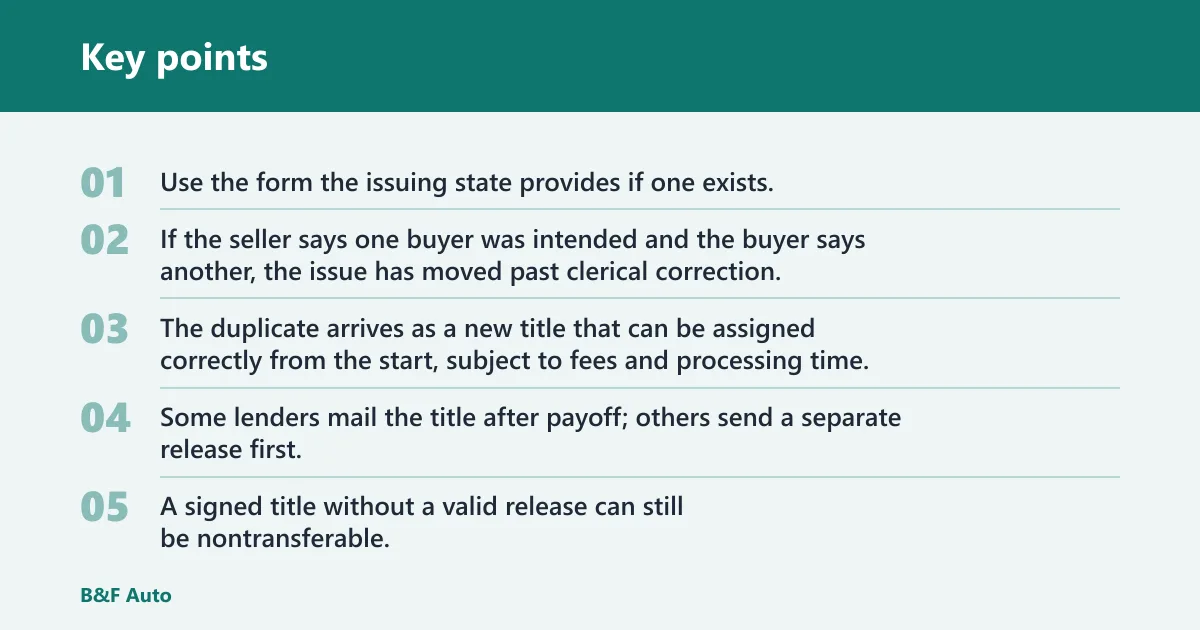
Use the form the issuing state provides if one exists. Generic letters carry less weight than a state-specific correction document tied to the title number or vehicle identification number.
These forms are not a cure for ownership disputes. If the seller says one buyer was intended and the buyer says another, the issue has moved past clerical correction.
Errors that usually force a duplicate or replacement title
Duplicate-title territory includes correction fluid, erasures, strike-throughs, overwritten names or mileage, major tears, water damage in assignment areas, use of every assignment box, seller signature in the wrong ownership field where the state does not allow correction, and signatures from missing joint owners.
A duplicate may also be required when the title was signed but never completed and the state will not accept a late clean-up on the same document. The duplicate arrives as a new title that can be assigned correctly from the start, subject to fees and processing time.
Cases that need lienholder, dealer, or DMV involvement
If a lien appears on the title, the transfer may stay blocked until the lienholder release is recorded in the exact format the state accepts. Some lenders mail the title after payoff; others send a separate release first. A signed title without a valid release can still be nontransferable.
Dealer reassignments add another layer. The reassignment section is usually for licensed dealers and resellers, with limited boxes. If a private buyer or seller writes over an earlier dealer assignment, that is DMV-review territory.
Brandings such as salvage or rebuilt can also bring extra steps after the signing error is fixed. A corrected assignment does not remove inspection or rebuilt-title paperwork required under state rules.
Title mistake decision table
| Error | Safest fix | Can original title be salvaged? | Documents to gather | When DMV review is likely |
|---|---|---|---|---|
| Seller signed buyer line | Duplicate title, then fresh assignment | Usually no | ID, bill of sale, duplicate-title application, rejection notice if any | If state disallows wrong-field signatures |
| Seller forgot to sign required seller block | Complete original assignment if still clean; otherwise duplicate title | Often yes if nothing else was altered | Original title, seller ID, bill of sale | If seller unavailable or buyer already filled conflicting fields |
| Seller name signed does not match printed owner name | Name affidavit or DMV correction; duplicate if title face is wrong | Sometimes | ID, supporting name-change record if any, title copy | If mismatch suggests different owner |
| One joint owner did not sign | Obtain missing signature or DMV review for legal authority | Sometimes | Title, both IDs if available, death certificate or authority papers if relevant | If title uses and or one owner is deceased |
| Buyer signed too early before seller completed assignment | DMV review; duplicate title if state rejects pre-signing | Sometimes | Title, bill of sale, rejection notice | If buyer signature appears in incomplete assignment |
| Buyer signed wrong field or dealer reassignment box | Duplicate title | Usually no | Duplicate-title application, IDs, bill of sale | Almost always |
| Buyer address or date missing | Correction form or affidavit | Often yes | Correction form, ID, title, rejection notice | If state requires notarized correction |
| Odometer entry crossed out or overwritten | DMV review; often duplicate title plus fresh odometer statement | Usually no | Title, odometer disclosure form, bill of sale | Almost always |
| Title signed but not notarized where notarization is required | State-specific notarization cure or duplicate title | Sometimes | ID, title, notary form if state uses one | If signatures were not made before the notary |
| Active lien still shown on title | Lien release or lien-satisfied title reissue | Yes, if title itself is clean | Lien release, payoff proof, title | If release format does not match state rules |
| Title office printed wrong owner name or branding | Agency correction or reissued title | Usually yes, but not by handwriting on the title | Current title, prior title copy or registration, supporting records | If branding affects inspections or disclosures |
| Reassignment section already full or overwritten | Dealer or seller obtains new title | Usually no | Title, dealer paperwork if any, duplicate-title application | Almost always |
How do you fix a signed title without making it worse?
The safe approach is to freeze the document, sort the error by section, and submit only the remedy that fits that section. Most damage happens after the mistake is noticed, when someone adds cross-outs, correction fluid, extra notes, or replacement signatures that the DMV never asked for.
Correction procedure
- Stop writing now. Put the title in a sleeve or folder and leave every mark untouched unless the issuing state’s title manual, form instructions, or DMV clerk has confirmed that this exact title field can be fixed with one line through the wrong entry, the correct entry beside it, and required initials or affidavit.
- Photograph both sides. Take clear photos of the front and back before anyone handles the title again. Include the seller assignment, buyer assignment, odometer area, lien section, notary block, and any reassignment boxes so you can compare the original if the DMV rejects it.
- Classify the error. Decide whether the problem is seller-side, buyer-side, lien-related, notarization-related, reassignment-related, or an issuing-agency printing mistake. This is the decision point that separates a possible correction form from a likely duplicate title.
- Check state instructions. Use the issuing state’s rules, not the buyer’s assumptions and not advice from another title design. Look for state forms covering title correction, affidavit of correction, duplicate title, odometer statement, and lien release.
- Match the remedy. Use a correction form for small clerical defects that do not change ownership, and move to duplicate-title or DMV review when the title is altered, assignment validity is broken, or required signatures are missing. If the issue affects rights, the state usually wants a reissued document, not a handwritten repair. If you think a duplicate title may be next, confirm that path with the issuing DMV first because lien status, seller availability, and electronic-title rules can change the process.
- Resubmit as a packet. Bring or mail the title with supporting documents together: IDs, bill of sale, lien release, correction form, duplicate-title application, and any rejection notice. A complete packet reduces back-and-forth and helps the clerk see the issue as a contained fix rather than a suspicious alteration.
Say your seller wrote the sale date one day early, but all names, signatures, and mileage are clean. That is often the sort of narrow clerical issue a state correction affidavit can address. Change only that field, and only if the state form authorizes it.
What if the title office, lienholder, or notary caused the problem?
Third-party mistakes should be handled differently from buyer or seller signing mistakes. If the issuing agency printed the wrong information, the lienholder has not properly released the lien, or the notary block is defective, handwriting on the title is rarely the fix. Preserve the title and pursue the correction from the party that caused it.
Title-company or DMV printing errors
If the title was printed with the wrong owner name, wrong VIN character, omitted branding, or incorrect lien notation, gather the prior title copy, registration, payoff proof, and any sale papers that show the intended data. Request a corrected or reissued title from the issuing agency.
This is where the distinction between clerical and rights-affecting changes matters. Minor fixes may be handled by affidavit, but changes affecting rights usually require a corrected issuing document rather than a note in the margin.
Lien release delays and payoff timing
A paid vehicle can still have a transfer problem if the lienholder release has not posted or the paper title has not been mailed. Some states accept a separate signed lien release. Others require the title itself to show the release or require an electronic satisfaction to clear before transfer.
If the lien release arrives after the title has already been signed, submit both together if your state allows it. Do not assume a payoff receipt alone clears the title.
Missing or defective notarization
Where notarization is required, the notary’s role is identity verification and acknowledgment of the signature. A missing seal, expired commission, absent notary signature, or acknowledgment done after the fact can all create a rejection.
Later notarization does not always cure a title that was signed incorrectly the first time. In some states, an acknowledgment defect, a jurat-style problem on a related form, or another title-specific notarization issue has its own correction path. The state may require the seller and buyer to sign a fresh title or duplicate title in front of a notary, rather than having the old signature retroactively acknowledged.
Documents to gather before you resubmit the title
Signed title mistakes checklist
- Collect the original title. Keep the paper flat, dry, and unchanged. If the title has a torn assignment area or unreadable printing, note that before filing because either problem can create title issues on its own.
- Add clear copies. Include photos or copies of the title front and back and a copy of the rejection notice if the DMV returned the packet. Those copies help show the original condition before anyone attempts a cure.
- Gather identity records. Bring seller and buyer IDs if the state counter may need to compare names, addresses, or notarization details. Name mismatch cases often turn on whether the documents point to the same legal person.
- Include the sale papers. Add the bill of sale, any separate odometer statement, and tax form required by the state. If the title error involves the date of sale or buyer address, these records help document original intent.
- Attach lien proof. Include lien release paperwork, payoff confirmation, or title-satisfaction notice when a lien appears on the title. Transfer can stall even if the signing issue is fixed when the lien record is still open.
- Bring the remedy form. Include the exact correction form, affidavit, or duplicate-title application the issuing state uses. If notarization is part of that form, wait to sign until you are in front of the notary if the form requires acknowledgment.
- Review the front and back title sections before resubmitting: seller assignment, buyer assignment, odometer disclosure, lien area, notary block, and reassignment section.
- Check brandings such as salvage or rebuilt for added forms or inspection requirements.
- Watch the calendar. A title correction can affect transfer deadlines, temporary tags, tax timelines, and possible late fees.
Frequently asked questions
What if the seller signed the car title in the wrong spot?
If the seller signed the wrong field, do not cross it out or add initials. Some states allow a correction form for limited wrong-box errors, but many treat conflicting signatures in assignment areas as a spoiled title and require a duplicate title before the seller signs again.
Can you transfer a car title if the seller forgot to sign it?
Usually no, at least not until the seller signs the required seller assignment or the state accepts another lawful cure. If the title is still clean and unaltered, the missing signature may be added properly. If other fields were filled in around it, DMV review or a duplicate title may follow.
Can white-out or cross-outs void a signed car title?
They often can. DMVs commonly reject correction fluid, erasures, strike-throughs, crossed-out entries, and overwritten text because the title no longer shows a reliable original assignment. The risk is highest in names, signatures, dates tied to transfer timing, and any odometer disclosure field.
What if a car title is signed but not notarized?
If your state requires notarization, a missing or defective notary block can stop the transfer. Sometimes the parties can execute a proper acknowledgment or correction form, but later notarization does not always cure a title that was already signed incorrectly outside the notary’s presence.
Do you need a correction form for title mistakes?
A correction form fits narrow clerical issues that do not change ownership, lien rights, assignment validity, or mileage reporting. It is a poor fit for ownership disputes, altered signatures, missing co-owner authority, overwritten odometer entries, or titles so marked up that the DMV treats them as unusable.
How to reassign a car title after a signing error
Do not overwrite a prior assignment or reuse a dealer reassignment space casually. Reassignment after error usually means the seller or dealer gets a duplicate or corrected title first, then executes one clean assignment in the proper box with any required lien release and notarization.