Can You Get Auto Loan Preapproval Without a Hard Inquiry?
Yes, you can sometimes get auto loan preapproval with only a soft inquiry, but many lenders switch to a hard pull once you submit a full application or accept final terms. A hard inquiry can trim points from your credit score and may matter if you plan to shop for several loans. This guide shows when a hard inquiry is avoidable, when it is not, and how to verify the inquiry type before you apply.
Can you get auto loan preapproval without a hard inquiry?
Sometimes. Some lenders start with a soft inquiry for prequalification or an early preapproval screen, which means your credit scores should not be affected. Other lenders reserve the hard pull for the full application or final approval stage, so the wording on the lender’s site matters.
When a soft pull is possible
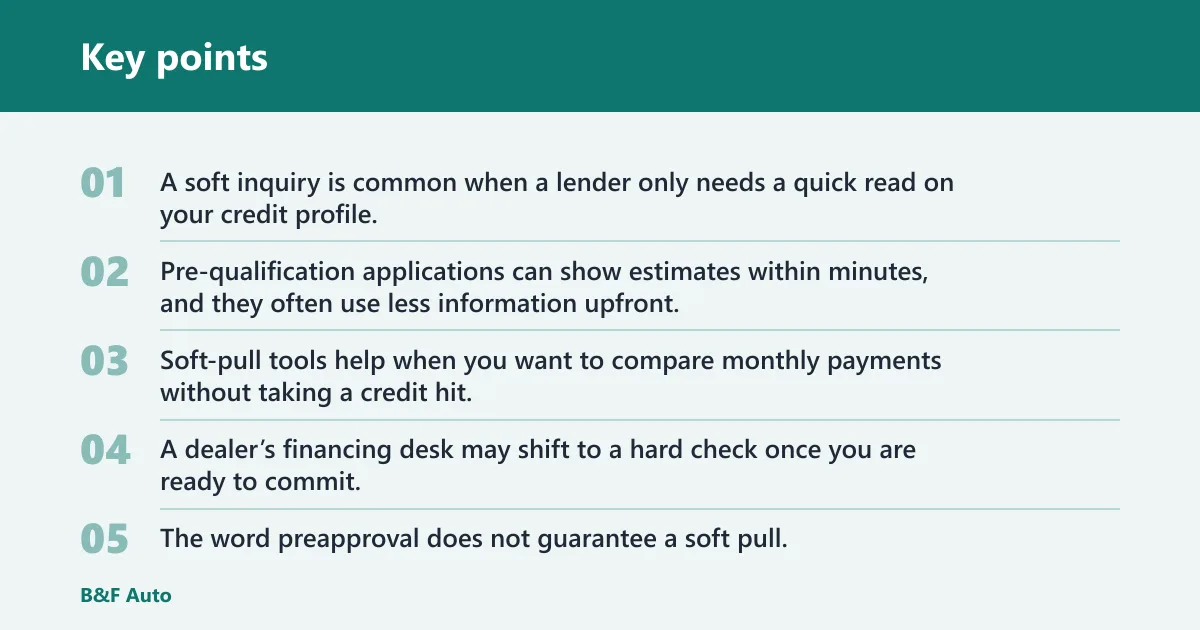
A soft inquiry is common when a lender only needs a quick read on your credit profile. Pre-qualification applications can show estimates within minutes, and they often use less information upfront. That path may give you a rate estimate and a loan amount limit before you shop.
Soft-pull tools help when you want to compare monthly payments without taking a credit hit. They also show up in basic lender screening, where the lender only needs enough detail to estimate terms and decide whether a full application makes sense.
When a hard pull is more likely
Auto loan preapproval can use a hard credit inquiry, especially when the lender reviews your credit report and score as part of the formal application. That stage is more binding than a quick screen, so the lender can tighten the rate, amount, and approval terms after a full review.
If the lender says it will verify your identity, pull your full report, and move from an estimate to final terms, expect a hard inquiry unless the disclosure says otherwise. A dealer’s financing desk may shift to a hard check once you are ready to commit.
Why lender wording matters
The word preapproval does not guarantee a soft pull. Some lenders use it for a more complete review that still starts with a soft inquiry, while others use it for a formal application that can trigger a hard inquiry right away. The label alone is not enough.
Look for the inquiry language, not only the headline. If the disclosure says “soft inquiry,” “no effect on credit score,” or “prequalification,” the path is usually lighter. If it says “credit report,” “score review,” or “final approval,” the hard pull is more likely.
Prequalification vs. preapproval for a car loan

Prequalification is usually the softer, faster screening path. Preapproval is a stronger financing signal and may require a hard inquiry. Both paths can help you set a budget before shopping, but preapproval usually gives you firmer numbers and may show a maximum loan amount.
What prequalification usually means
Prequalification often uses a soft inquiry and less detailed information upfront. It can be available online and may show rate estimates within minutes. Because it is lighter, the numbers are usually broader and more likely to change after a full application.
For a shopper, that can still be useful. A prequalification result can show whether the budget is closer to about $18,000 or about $28,000 before comparing vehicles, and that range can steer the search away from cars outside the likely approval window.
What preapproval usually means
Preapproval usually tells you more about how much a lender may be willing to lend and what rate you may qualify for. It is a stronger signal than prequalification, but it may require a hard inquiry. The final rate and amount are still subject to lender review and could change.
That makes preapproval useful when you want to walk into a dealership with a clearer budget. It can also improve your negotiating position because you know the outside range before you discuss financing with the sales desk.
How the two paths affect your budget
Both paths can produce an auto loan rate estimate and a loan amount limit. The difference is how much confidence you should place in the numbers. Prequalification is better for quick screening. Preapproval is better when you are close to buying and need a firmer ceiling on price and payment.
Suppose one lender gives a prequalification estimate of around 7.9% and about $24,000, while another gives a preapproval with a stated maximum of about $26,500. The second figure gives you a tighter shopping target, but it can still change if the lender completes a full credit review later.
Soft inquiry vs. hard inquiry
A soft inquiry does not affect credit scores and is commonly used for pre-qualification or some lender screening. A hard credit inquiry can slightly lower your credit scores and is often used when the lender reviews your credit report and score for an auto loan application. The difference matters most before you shop.
What a soft inquiry can reveal
A soft pull can show enough credit information for a lender to generate a rate estimate and a loan amount range. It is useful when you want to compare options without adding a hard inquiry to your file. The lender may still ask for more information later if you move ahead.
What a hard inquiry can trigger
A hard inquiry is often triggered when you submit a formal application or accept final terms. It can slightly lower your credit scores, especially if you have several recent hard pulls. It also signals that the lender is doing a deeper review before final approval or funding.
How credit score impact differs
The score impact is usually the reason shoppers try to keep early screening soft. A soft inquiry should not affect the score, while a hard inquiry can slightly lower it. If you plan to compare multiple lenders, it helps to know which stage triggers the hard pull before you submit forms.
One practical rule is simple: keep the early search soft, then allow the hard pull only when the lender you actually want is the one you are ready to use. That timing reduces unnecessary hits and keeps the pre-shopping stage cleaner.
Auto loan decision table
This table shows how to interpret the lender’s language and what to ask next before you submit an application.
| Lender says prequalification/preapproval | Likely inquiry type and what to ask next |
|---|---|
| “Prequalification” with instant estimate | Likely soft inquiry. Ask whether the check is soft only, whether it affects your score, and whether a hard pull happens later if you move forward. |
| “Preapproval” with a rate range and loan limit | Could be soft or hard. Ask whether the lender will pull your credit report now or only after you accept the offer. |
| “Get your financing range before shopping” | Often a screening tool, but not always soft. Ask which bureau it uses and whether the estimate is based on a soft inquiry or a full application. |
| “Final approval” or “final financing” | Likely hard inquiry. Ask when the hard pull occurs, whether the lender will reuse an earlier soft check, and whether the result can change after full review. |
| “No effect on credit score” | Usually soft inquiry. Confirm that the statement applies to the first screen, not only to marketing language or a brief quote tool. |
What to ask before you apply
Ask three things before submitting any auto loan application: whether the lender uses a soft or hard inquiry, which bureau it checks, and when the hard pull happens. Those questions tell you whether you can rate-shop first or whether the application will hit your credit now.
-
Check the disclosure language.
Look for phrases such as “soft inquiry,” “hard inquiry,” “credit report,” “score review,” “no effect on credit score,” and “final approval.” The wording should appear near the application, FAQ, or terms screen, not only in a marketing banner.
-
Ask when the hard pull happens.
Some lenders start with a soft screen and move to a hard pull only if you accept the terms. Others trigger the hard inquiry at the first full application. Ask which step changes the inquiry type so you can decide when to apply.
-
Ask which bureau is used.
Even when a lender says the check is soft, you still want to know which credit bureau it uses and whether it reports to one bureau or several. That helps you understand where the inquiry may appear and whether a later hard pull will duplicate it.
-
Confirm the quote type.
Make sure the rate estimate and loan amount limit are tied to a prequalification or preapproval screen, not to final financing. If the lender says the numbers may change after full review, treat them as planning figures, not a locked offer.
Disclosure phrases to look
- “Soft inquiry”
- “No effect on credit score”
- “Prequalification”
- “Estimate within minutes”
- “Credit report and score”
- “Hard inquiry”
- “Final approval”
- “Final financing”
Say your lender advertises a “preapproval amount” of $22,000 and an APR range, but the fine print says “credit report required for final approval.” That usually means the first screen may be softer than the final step. The quote helps you shop, but the hard pull can still happen later.
A common mistake is assuming a preapproval quote guarantees the same interest rate after the lender reviews the full credit file. Dealer desks may give you a financing range and interest rates you may qualify for, but the dealership final financing step can still require a hard credit check when you are ready to commit.
Can a dealership preapprove you without a credit hit?
Sometimes a dealership can give you a preapproval quote without a credit hit, but that is usually a dealer pre-screening step, not final financing. The hard pull usually happens later, when you agree to proceed and the dealer or its partner lenders run the formal credit check.
Dealer pre-screening vs. final financing
Dealers often use an early screening process to show a financing range and possible rates before you sign anything. That can help you compare vehicles and monthly payments without committing right away. Still, the dealer may need a hard inquiry to finalize the loan through partner lenders.
Good Fellow’s Auto says its tool uses a soft inquiry, which is the kind of language to look for in dealer-backed screening. The dealership also says customers can see a pre-approval amount before shopping, while finalization happens with a hard credit check. Those details show why the wording matters.
When the hard pull usually happens
In a dealership setting, the hard pull usually happens after you choose a vehicle and move into final financing. That is the point where the dealer, lender, or both need a full credit review. If you want to avoid surprises, ask before you sign whether the quote is still soft-check only.
Frequently asked questions
Is auto loan preapproval always a hard pull?
No. Some lenders use a soft inquiry for an early preapproval-style screen, especially when they are only estimating your range. Others use a hard inquiry at the formal application stage. The only reliable answer is the lender’s disclosure or customer-service confirmation.
What’s the difference between prequalification and preapproval for a car loan?
Prequalification is usually the lighter screen. It often uses a soft inquiry and may show estimates within minutes. Preapproval is usually a stronger step, may require a hard inquiry, and can give you a clearer loan amount limit and more stable rate details.
How can I check my auto loan options without hurting my credit score?
Use lenders that clearly say they rely on a soft inquiry for the first screen. Read the application disclosure, look for “no effect on credit score,” and ask whether the hard pull happens only after you accept terms. That lets you compare options before you commit.
Which lenders use a soft inquiry for car loan preapproval?
Some lenders and dealership tools do, but not all. The safer approach is not to assume based on the word “preapproval.” Check the lender’s own disclosure, FAQ, or terms page and ask whether the screen is a soft inquiry, a hard inquiry, or a soft screen followed by a hard final check.
When does a soft inquiry become a hard inquiry on an auto loan application?
It becomes a hard inquiry when the lender moves from screening to a formal credit decision that requires a full credit report and score review. That often happens at the full application stage or final approval stage. Ask the lender exactly which step changes the pull type.
Should I ask the lender before applying if preapproval is a hard pull?
Yes. Ask before you submit anything. The right questions are whether the first check is soft, whether a hard pull happens later, and which bureau is used. That is the cleanest way to avoid unexpected score impact while you compare loan offers.
Can a dealership give me a preapproval quote without a credit hit?
Yes, a dealership can sometimes show a preapproval quote or financing range without a hard inquiry at first. But that quote may be only a soft-screen estimate. Final financing often requires a hard credit check once you decide to buy and the lender finalizes the loan.