What Hidden Costs Should You Include in a First Car Budget?
Budget 10% to 20% above the car’s sticker price for hidden first-car costs, and keep an extra $500 to $1,000 for repairs or fees that show up right away. Skip those items, and a low-priced car can pressure your cash flow in the first month. This guide splits costs into purchase-time, monthly, and surprise buckets so you budget the full amount.
This guide is part of our First car budget: how much can you really afford? series.
Budgeting for upfront and ongoing car expenses
Start with the charges that change the deal on day one: sales tax, registration, title, licensing, insurance, and any finance charges. Then add monthly fuel, maintenance, and loan interest. Finally, set aside money for repairs, tires, brakes, towing, and any deductible you could owe after a claim.
| Cost bucket | Common expense | What triggers it | Typical timing | Buyer estimate |
|---|---|---|---|---|
| Purchase-time | Sales tax | State rate applied to the purchase price or out-the-door price rules | At purchase | |
| Purchase-time | Registration, title, licensing | State paperwork and plate transfer or new-vehicle filing | At purchase or annual renewal | |
| Purchase-time | Dealer documentation fees | Dealer processing charge on the contract | At purchase | |
| Purchase-time | Optional add-ons | Extended warranty, paint protection, GAP insurance, accessories | At purchase | |
| Monthly | Car payment and loan interest | Financing term, loan balance, and interest rate | Every month | |
| Monthly | Auto insurance premium | Coverage level, deductible, age, vehicle, ZIP code, theft and repair risk | Monthly or every six months | |
| Monthly | Fuel | Annual mileage, commute length, route type, and driving style | Monthly | |
| Monthly | Maintenance reserve | Oil changes, filters, fluids, inspections, and wear items | Monthly set-aside | |
| Annual | Registration renewal | State renewal cycle and local fees | Yearly or every renewal cycle | |
| Annual | Inspection or emissions test | State requirement or local compliance rule | Yearly or periodic | |
| Surprise | Tires, brakes, battery, alignment | Wear, age, potholes, heat, driving style, or unknown service history | When needed | |
| Surprise | Repairs, towing, diagnostics | Breakdown, warning light, collision deductible, or no-start event | Unplanned |
A common first-timer mistake is to budget only for the payment and treat everything else as “later.” That order is backward. If cash is tight, cover insurance, taxes and fees, fuel, maintenance reserve, then repair reserve and optional extras.
What upfront fees belong in your out-the-door price?
Do not stop at the sticker price. The out-the-door price should include sales tax, registration, title, and licensing fees, plus any dealer documentation charge and any optional add-ons you actually want. These are often due immediately, so they matter as much as the down payment.
Sales tax and state fees
Sales tax is state-dependent, and in some states it is collected as part of the out-the-door price. Registration, title, and licensing charges also vary by state and can be due up front or at renewal time. Budget them separately so they do not hide inside a vague “fees” line.
Dealer documentation and add-ons
Dealer documentation fees are contract charges, not maintenance or insurance. Add-ons such as paint protection, extended warranties, and GAP insurance are optional line items, though GAP can matter if you owe more than the car is worth. If you do not want them, remove them before signing.
Suppose a buyer compares two cars with the same sticker price. One has a higher local tax rate and higher title and licensing charges, so the out-the-door amount is materially higher even before insurance and fuel are counted. That is why the purchase price alone gives a false sense of affordability.
How much should insurance add to your budget?
Insurance can be one of the largest monthly hidden costs, and it can change a lot based on the car, the driver, and the address where the car is garaged. If you finance the car, the lender may require comprehensive and collision coverage, which raises the premium compared with liability-only coverage. Deductible choices also change the monthly bill: a higher deductible usually lowers the premium, but it shifts more risk to you after a claim.
What changes the premium
Coverage levels matter first. Then come vehicle details such as trim level, theft risk, repair cost, and safety equipment. Driver age, driving record, and garaging ZIP code also influence the quote, because insurers price local claim patterns and risk differently.
Financing and required coverage
When a car is financed, the lender often requires collision and comprehensive coverage until the loan is paid off. That requirement can change the total monthly burden in a way many first-time buyers miss. A low car payment can still leave you with a large insurance bill.
-
Request quotes early.
Get insurance quotes before you commit to a car so you can compare real monthly totals, not guesses. Use the exact trim, model year, ZIP code, and deductible you plan to buy, because each one can move the premium.
-
Compare coverage levels.
Look at liability-only, liability plus comprehensive, and full coverage options if the car will be financed. The cheapest policy may not satisfy the lender, and the more protective policy may be the only realistic choice for a newer or more valuable car.
-
Check deductible tradeoffs.
Pick a deductible you could pay without delay. A higher deductible can reduce the premium, but it also increases the cash you need if the car is damaged or stolen.
What monthly costs should you plan for?
Monthly ownership costs usually include the car payment, loan interest, fuel, insurance, parking if your area charges for it, and a maintenance reserve. Longer loan terms can lower the payment but increase total interest paid over time. NerdWallet notes common loan terms from 24 to 96 months and recommends keeping car expenses to 15% to 20% of take-home pay if possible, with a car payment under 10% of take-home pay.
Fuel costs
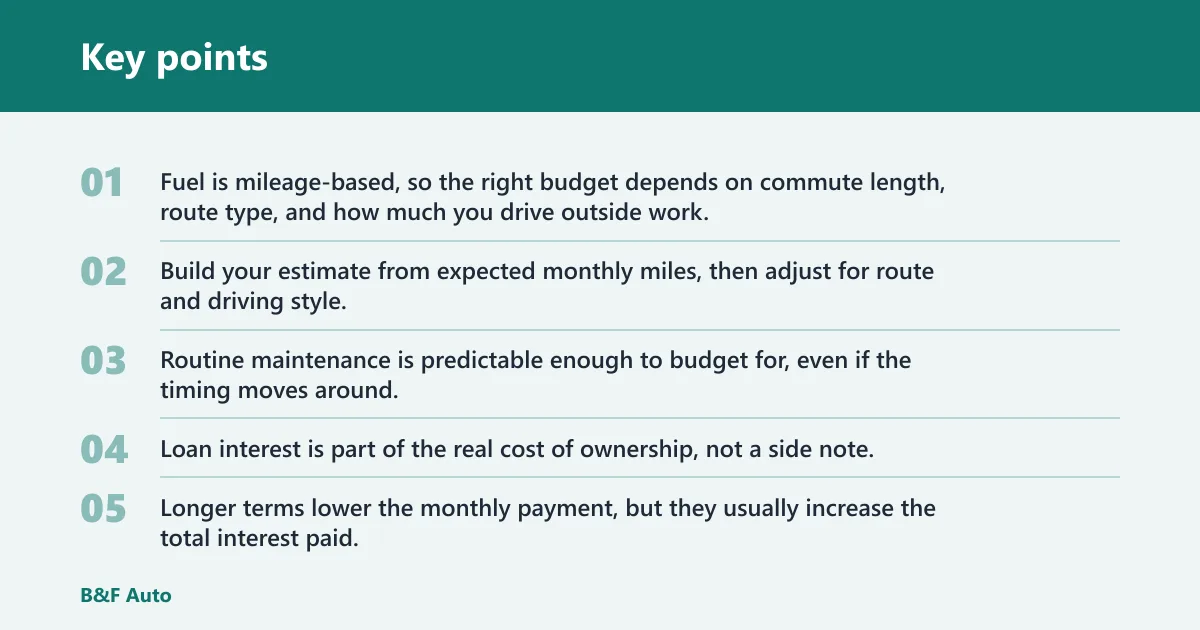
Fuel is mileage-based, so the right budget depends on commute length, route type, and how much you drive outside work. A short city commute with frequent stops can cost more than a similar-mileage highway drive if the car idles, accelerates hard, or sits in traffic. Build your estimate from expected monthly miles, then adjust for route and driving style.
Maintenance reserve
Routine maintenance is predictable enough to budget for, even if the timing moves around. Set aside money each month for oil changes, filters, fluids, tire rotations, and inspections, then add a first-year buffer if the car is used or the service history is thin. Rookie Notes says many first-time owners aim for a few hundred dollars per year in repair reserve, but maintenance is the separate bucket you should fund before failures show up.
Loan interest and payment term
Loan interest is part of the real cost of ownership, not a side note. Longer terms lower the monthly payment, but they usually increase the total interest paid. That is why a smaller payment can look easier while costing more over the life of the loan.
Picture a commuter who drives 1,200 miles a month in a financed sedan. The payment may fit the budget, but insurance, fuel, and interest can push the real monthly total well beyond the sticker price divided by the loan term. The mileage is doing the damage, not the payment alone.
What surprise repairs can hit a first car budget?
Used cars often need money right away for wear items that are not obvious during a quick walkaround. Tires, brakes, batteries, alignment work, towing, and diagnostic labor can all land in the first year. Repair reserve and collision deductible money should stay separate from routine maintenance so a breakdown does not wipe out your service fund.
Tires and alignment
Tires are a variable cost because replacement timing depends on tread depth, age, alignment, pothole damage, and how the car was driven. If the tread is low or wear is uneven, budget for replacement and alignment together. An alignment can help stop fast wear, but it will not fix a tire that is already worn out.
Brakes and battery
Brakes wear with use, and aggressive stop-and-go driving shortens their life. A weak battery can fail with little warning, especially if it is old or the car sits often. Both are common first-car expenses because they may be overdue when the car has incomplete records.
Repair reserve and towing
Repair reserve is for the unknowns: warning lights, failed sensors, no-start events, towing, and the diagnostic labor needed to find the fault. If you carry collision coverage, the deductible belongs in this bucket too, because it is the amount you may owe after an accident. Keep this fund separate from your maintenance money so one problem does not empty both.
-
Inspect wear items first.
Check tire tread, brake thickness, battery age, and visible suspension wear before you buy. If anything looks borderline, treat it as a near-term expense instead of a future maybe.
-
Add a repair buffer.
Set aside a repair reserve from the start, especially for a used car with limited records. Even a modest buffer can cover a diagnostic fee, a towing bill, or part of a deductible.
-
Reserve for first-year fixes.
Use the inspection estimate range to seed your reserve, then add more if the car is high-mileage or the service history is unclear. That keeps a surprise from forcing a credit card decision.
What should you check before buying a used car?
Get a pre-purchase inspection from an independent shop before you buy a used car. Ask for a written estimate range that covers tire tread, brake thickness, suspension play, and any diagnostic codes. The inspection cost is small compared with missing a worn tire set or a fault code that turns into a larger repair soon after purchase.
Service history
Service records tell you whether the car has had regular oil changes, brake work, and fluid service. Missing records do not prove a problem, but they do lower your confidence and should push your repair reserve higher. If the seller cannot show maintenance history, assume more near-term spending.
Mileage and wear clues
Mileage matters, but wear is often more useful than the odometer alone. Uneven tire wear, steering pull, brake noise, warning lights, fluid leaks, or a rough idle can all hint at money you will need soon. Use those clues to budget before you sign, not after.
-
Schedule an inspection.
Book an independent shop to inspect the car before purchase. Ask for notes on tires, brakes, suspension, fluids, and any codes stored in the computer.
-
Read the estimate range.
Use the shop’s written estimate range to plan your first-year repair reserve. If the range is wide, budget toward the higher end unless the seller has documentation proving recent work.
-
Decide using total cost.
If the car needs immediate work, add that amount to the out-the-door price before comparing it with other cars. A lower sticker price can lose once the repair list is added.
Frequently asked questions
What hidden costs should I include in my first car budget?
Include sales tax, registration, title, licensing, insurance, fuel, maintenance, loan interest, tires, brakes, battery replacement, parking if you pay for it, and a repair reserve. If the car is financed, add comprehensive and collision coverage when required. Those costs often matter more than the sticker price.
How much extra should I budget beyond the car payment?
That cushion matters because insurance, taxes, and one worn tire can arrive before the first payment cycle ends.
Do I need to budget for registration, taxes, and title fees?
Yes. Those charges are part of the real purchase cost, and they vary by state. Some are due at purchase, while others recur at renewal time. Treat them as separate line items so they do not disappear into a vague “fees” number.
How much should I set aside for maintenance and repairs on a first car?
Set aside a monthly maintenance reserve for routine service, then keep a separate repair reserve for breakdowns and deductibles. Many first-time owners aim for a few hundred dollars per year in repair reserve, but used cars with uncertain history may need more. Higher mileage usually means a larger buffer.
What insurance costs are easy to miss when buying my first car?
The big misses are deductible choice, required comprehensive and collision coverage on financed cars, higher premiums for certain trims, and local ZIP-code pricing. Age, theft risk, and repair cost can also change the quote. A cheap payment does not guarantee a cheap insurance bill.
Should I include tires, brakes, and battery replacement in my budget?
Yes. Tires, brakes, and batteries are common first-car expenses, especially on used cars with unclear records. Tire replacement may also require an alignment, and brake wear depends on driving style. These are predictable enough to plan for, even if the exact month is unknown.