What Does Upside Down on a Trade-In Mean?
On a trade-in, upside down means you owe more on the car loan than the dealer will credit for the car, so the difference is negative equity. If you miss that gap in the deal, you can end up financing the unpaid balance, paying more interest, or rolling debt into your next car. This guide shows how trade-in math works, where the payoff and credit appear on a dealer worksheet, and how to tell exactly how much you owe beyond the car’s value.
Negative equity and how trade-in value compares
It means your loan payoff is higher than your vehicle’s current market value, which is also called negative equity, underwater, or upside down. The issue matters when you sell, trade in, or total the car. The dealer’s credit for the vehicle is one number; the loan payoff is another. The gap between them is the part you still owe.
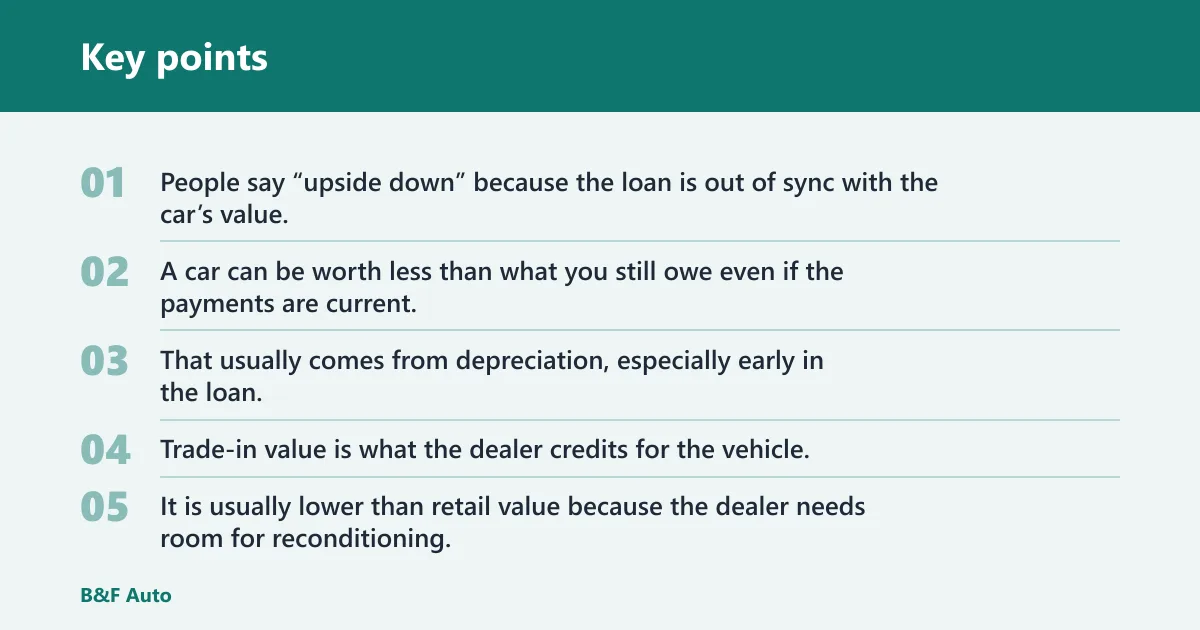
People say “upside down” because the loan is out of sync with the car’s value. A car can be worth less than what you still owe even if the payments are current. That usually comes from depreciation, especially early in the loan, or from a long term that keeps the balance high for longer.
Trade-in value versus payoff amount
Trade-in value is what the dealer credits for the vehicle. It is usually lower than retail value because the dealer needs room for reconditioning, margin, and resale risk. Loan payoff amount is the exact figure needed to close the auto loan. It can differ from the balance shown on your monthly statement, so do not use the statement balance as a shortcut.
Vehicle market value is the current price basis for comparing equity. In a trade-in, the dealer generally compares that value to the payoff amount, not to what you paid for the car or what a private buyer might offer. If the payoff is higher, the difference is negative equity.
How does an upside-down trade-in work?
The dealer applies the trade-in credit against the payoff, then the difference becomes part of the deal. If the offer is less than the payoff, you either cover the shortfall in cash or roll it into the next loan. The worksheet should show that math clearly before you sign.
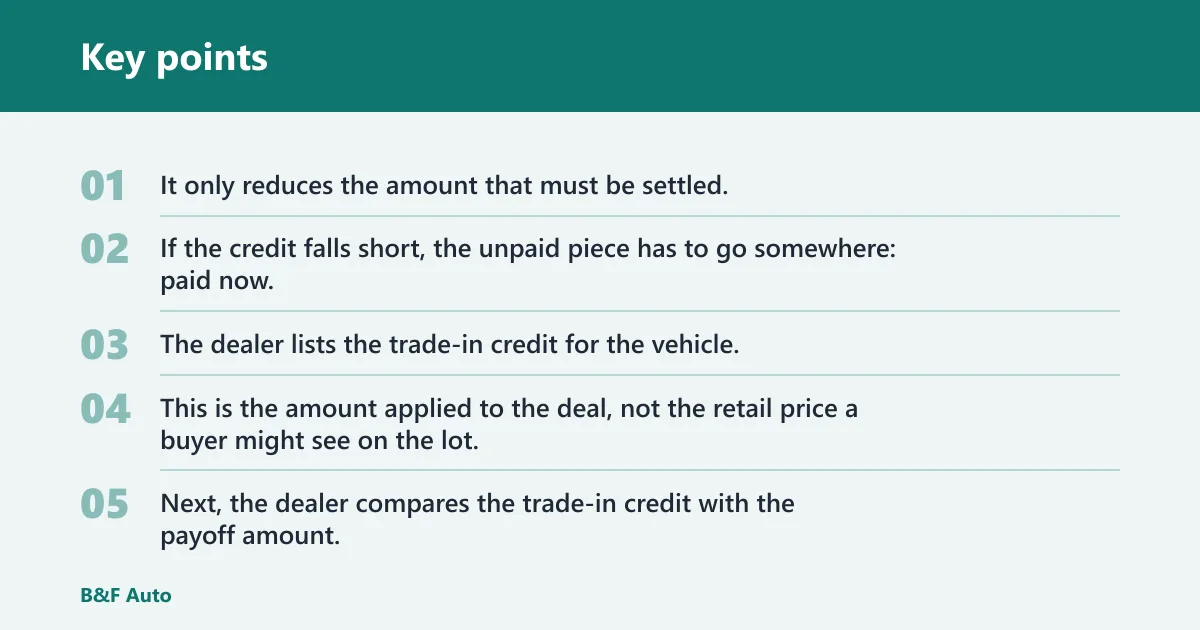
That is where buyers get tripped up. The trade-in does not erase the loan. It only reduces the amount that must be settled. If the credit falls short, the unpaid piece has to go somewhere: paid now, or financed on the replacement vehicle.
Step 1: dealer offer
The dealer lists the trade-in credit for the vehicle. This is the amount applied to the deal, not the retail price a buyer might see on the lot.
Step 2: subtract the payoff
Next, the dealer compares the trade-in credit with the payoff amount. If the payoff is larger, the result is negative equity. If the trade-in credit is larger, you have positive equity that can reduce the next loan.
Step 3: apply the difference to the next loan
If you roll the shortfall forward, it gets added to the amount financed on the next car. That means the new loan starts higher on day one. The payment can be manageable, but the balance now includes old debt as well as the new vehicle.
Trade equity worksheet
This worksheet shows the basic flow. It separates the payoff, the dealer offer, and the equity result so you can see whether the shortfall is paid in cash or rolled into the next loan.
| Loan payoff amount | Dealer trade-in offer | Negative equity result | How the balance is handled |
|---|---|---|---|
| $18,000 | $16,500 | $1,500 upside down | Paid in cash at signing |
| $18,000 | $13,000 | $5,000 upside down | Rolled into the next loan |
| $24,500 | $17,000 | $7,500 upside down | Rolled into the next loan with prior balance included |
Small negative equity example
Suppose your payoff is $18,000 and the dealer offers $16,500. The gap is $1,500. If you pay that in cash, the trade closes with no leftover loan balance tied to the old car.
Moderate negative equity example
Now suppose your payoff is $18,000 and the dealer offers $13,000. That is the same $5,000 example used often in trade-in explanations. If you roll it forward, your next loan starts $5,000 higher before interest is added.
Rolled-over balance example
Picture a car whose current payoff is $24,500, but $2,000 of that already came from an older trade-in shortfall. If the dealer offers $17,000, the new deal still has $7,500 in negative equity. That balance does not disappear; it simply becomes part of the next loan amount.
Why cars go upside down
Depreciation is the main reason. New vehicles can lose 15-20% of their value in the first year alone, while the loan balance falls much more slowly. Longer loans of 72 or 84 months can keep the balance high for longer, and zero or minimal down payment leaves less cushion from the start.
Rolling a previous negative balance into a new loan adds that old debt right away. The new loan starts with more owed than the car is worth, so equity has to catch up before you get back to even. That is why some drivers stay underwater for most of the loan term.
A common first-timer mistake is confusing a monthly statement balance with the real payoff. The statement may show about $17,900, while the lender’s payoff quote may be about $18,120 because of daily interest and timing. The dealer needs the payoff quote, not the monthly balance, to settle the old loan correctly.
Another common trap is comparing a dealer trade-in offer with retail asking prices. Those are different numbers. Retail value is what a shopper may see on a lot or listing; trade-in value is what the dealer credits on the deal. Mixing them up makes the shortfall look smaller than it really is.
Can you trade in an upside-down car?
Yes, you can trade in a car even if it is upside down. The dealer can still accept the vehicle, but the shortfall has to be handled at signing. You either bring cash for the difference or add it to the next loan, which raises the amount financed on the replacement car.
What changes at signing is the contract math. The trade credit reduces the purchase price, then the old payoff gets satisfied. If the payoff is larger than the credit, the unpaid amount appears in the deal as negative equity. It is not erased by the trade.
- Get the lender’s payoff quote, not just the statement balance.
- Compare that payoff to the dealer’s trade-in offer.
- Subtract the offer from the payoff to find the shortfall.
- Choose cash payment or roll-in before you sign.
- Check the new loan amount and total interest cost.
Should you trade it in now?
A trade-in can make sense if you need a different vehicle and the shortfall is small enough that you can pay it without stretching the next loan. It may be smarter to keep paying the loan down first if the gap is large, the car runs well, and the next loan would start too far underwater.
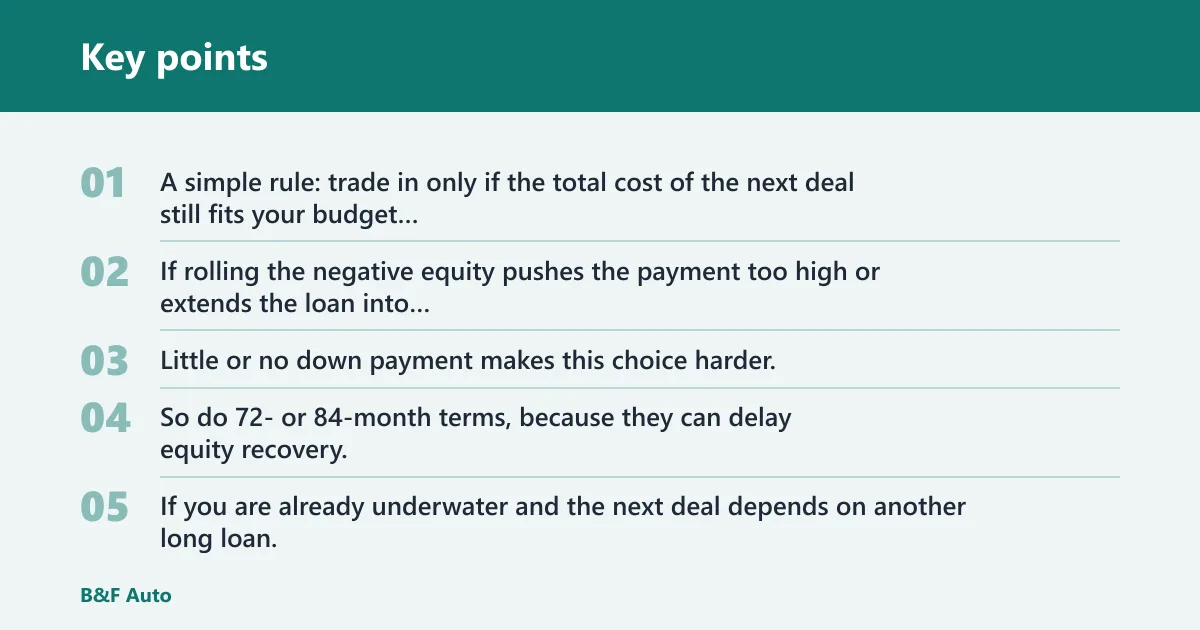
A simple rule: trade in only if the total cost of the next deal still fits your budget after the shortfall is added. If rolling the negative equity pushes the payment too high or extends the loan into another long term, keeping the car longer is often the cleaner move.
Little or no down payment makes this choice harder. So do 72- or 84-month terms, because they can delay equity recovery. If you are already underwater and the next deal depends on another long loan, you may be trading one problem for a larger one.
When keeping the car may be smarter
Keep the car if the payment is affordable, the car is reliable, and the payoff is close enough that a few more months of principal reduction would shrink the gap. That is often the better move when the trade offer is far below the payoff and the next loan would need a long term to stay manageable.
When a trade-in can still make sense
Trade in if the current car no longer fits your needs and the shortfall is modest enough to handle in cash or within a loan amount you can truly afford. The key is not whether the car is upside down. It is whether the next contract still makes financial sense after the shortfall is included.
What happens if the car is totaled?
If the car is totaled, GAP insurance can cover the difference between the loan payoff and the insurance payout on the loss settlement. That protection matters when equity is small or negative. It generally does not cover normal trade-in negative equity on a routine sale or trade.
Without GAP, you may still owe the lender after the insurance check is applied. That is a separate issue from trading in. A trade-in shortfall is handled in the purchase contract; a total loss shortfall is handled after the insurance settlement.
If your car is totaled, the insurer may pay about $14,000, while the lender payoff may be about $17,500. With GAP coverage, the $3,500 difference may be covered, depending on the policy terms. Without GAP, you could still owe that amount even though the car is gone.
Frequently asked questions
What does it mean to be upside down on a trade in?
It means your loan payoff is higher than the dealer’s trade-in credit or the car’s current market value. The gap is negative equity. You can still trade the car, but the shortfall must be paid in cash or added to the next loan at signing.
Can I trade in my car if I am upside down?
Yes. Dealers can take an upside-down car as a trade, but the unpaid balance does not vanish. You still have to settle the shortfall somehow, and the contract should show whether you paid it in cash or financed it on the next vehicle.
Do I have to pay the difference if my trade-in is upside down?
Yes, the difference has to be covered somehow. You can pay it in cash, or you can roll it into the next auto loan if the lender approves the deal. If you do neither, the old loan cannot be closed correctly.
Can negative equity be rolled into a new car loan?
Yes, and that is common. The unpaid balance is added to the amount financed on the next car. This can make the new loan larger from day one and can keep you underwater longer, especially if the new term is also 72 or 84 months.
What happens if my upside-down car is totaled?
If the car is totaled, GAP insurance may cover the difference between the insurance payout and the loan payoff. Without GAP, you can still owe the remaining balance after the insurer pays the vehicle’s value. That is why GAP matters for loans with little or no equity.