Can You Transfer a Car Title If the Seller Forgot to Sign It?
You can sometimes fix an unsigned car title, but if the DMV requires the seller’s signature on the original, the transfer stops until the seller signs correctly or you get a replacement title. One missed signature can stall registration, fees, and the sale. This guide covers the common failure points and the cleanest fix path.
What to do when the seller didn’t sign
A missing seller signature usually blocks the title transfer because the ownership chain is incomplete. DMVs typically check the seller signature first, then compare the title to the transfer paperwork and any required mileage, date, or notarization fields. If the signature is missing, the buyer may not be able to register the vehicle yet.
If the seller is reachable, the fastest path is often to have the seller sign the original title in the correct location and finish any required transfer form. If the seller is unavailable, the issuing state’s DMV or title agency may allow a replacement process, but in many states only the titled owner can request a duplicate title. State rules decide which fix is allowed.
Unsigned title triage
| Mistake type | Likely DMV outcome | Fastest fix | Who must act first |
|---|---|---|---|
| Seller forgot to sign | Transfer usually rejected until the missing signature is fixed | Have the seller sign the original, or request a duplicate title if the original cannot be corrected | Seller, unless the DMV instructs the buyer to start the replacement request |
| Signed in wrong place | May be rejected as an invalid or mismatched signature | Use a correction form only if the state accepts it; otherwise request a duplicate title | Seller |
| Title signed but not notarized | May block registration in states or transaction types that require notarization | Return for notarization if the state allows it, or restart with the proper form | Seller first, then buyer if buyer signatures are also required |
| Title altered with white-out or cross-outs | Often rejected as unusable | Request a duplicate title | Seller, then buyer after the clean replacement is issued |
Picture a buyer who already took the keys and insurance card home, only to find the seller skipped the signature line. The buyer still has possession, but the DMV can refuse registration until the title is corrected. That is why the seller should act first when possible, especially if the vehicle has already changed hands.
Steps to take next
- Check the exact defect. Confirm whether the problem is a missing signature, the wrong signature line, a missing notary, or a changed document. The fix is different for each one, and a generic correction form may not solve all of them.
- Review the state form rules. Look at the title instructions and the transfer certificate requirements for your state. Some states require the date, mileage, or notarization in a specific order, and some reject altered documents outright.
- Contact the state DMV or title office before resubmitting. The issuing authority is the final authority on whether the title can be accepted, corrected, or replaced. A short call can prevent a wasted trip if the office does not accept corrections for signature errors.
- Choose the cleanest fix. If the seller can sign correctly on the original, use that path. If the title has been altered, is unsigned in a way the DMV will not accept, or the seller is unavailable, ask the issuing authority whether a duplicate title or replacement title can be requested and by whom.
What if the seller signed in the wrong place?
A signature in the wrong box can fail even when the seller did sign, because the DMV may treat it as an invalid signature placement rather than a valid transfer. That matters because the title transfer depends on matching ownership documents, not just any handwriting on the page. Some states allow a correction form, but many do not use it for signature placement mistakes.
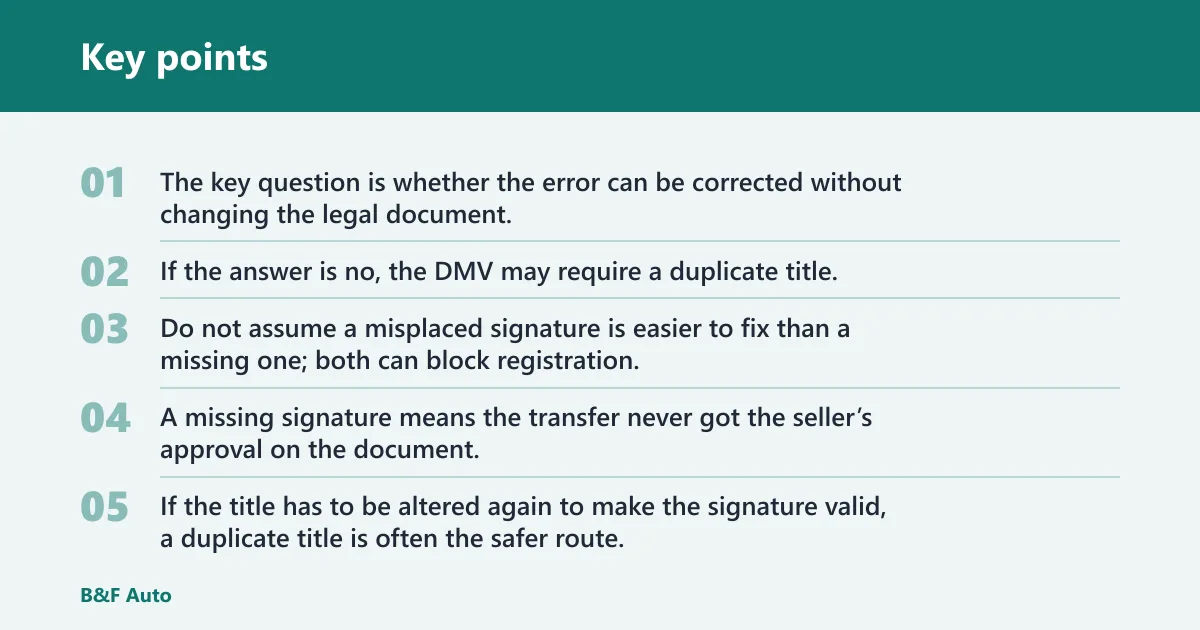
The key question is whether the error can be corrected without changing the legal document. If the answer is no, the DMV may require a duplicate title. Do not assume a misplaced signature is easier to fix than a missing one; both can block registration.
Wrong location versus missing signature
These are different problems. A missing signature means the transfer never got the seller’s approval on the document. A signature in the wrong place may show intent, but the DMV can still reject it if the form says the signature must appear in a specific area.
When a correction form may work
A correction form can help when the state allows minor clerical fixes and the issuing authority accepts a supplemental explanation. That is more likely when the problem is a typed error, a date mistake, or a document detail that does not change ownership. It is less likely to work for a misplaced seller signature.
When a duplicate title is more likely
If the title has to be altered again to make the signature valid, a duplicate title is often the safer route. In many states, the titled owner must request the duplicate, so the buyer may need the seller’s cooperation or a state-approved replacement process. That is especially true when the original is already incomplete, the buyer has it in hand, or the DMV treats the mistake as a defect in the legal transfer document.
Suppose the seller signed above the line reserved for the buyer. The quick fix is often the wrong one, and crossing it out can make matters worse. A replacement title is usually cleaner than trying to repair a bad signature placement on the original.
Can you register the car with an unsigned title?
Usually no, because registration depends on a valid title transfer first. A buyer may have the vehicle, the bill of sale, and even the keys, but the DMV can still hold registration until the ownership documents are correct. If the seller signature is missing, the title is often not enough on its own.
Timing matters if the title was already handed over. Once the buyer has possession, the seller should move quickly to fix the document or start the replacement process, because an incomplete transfer can leave both sides stuck. The buyer should not assume the DMV will accept the title and “fix it later.”
What to check before you go to the DMV
- Confirm the title status. Verify that the seller signed the correct location and that any required date, mileage, or notarization is complete. If the state requires a transfer certificate, check that it is finished too.
- Match all signatures. Compare the title to the transfer paperwork and sale form. The seller signature must match the form requirements, and the buyer signature may also be needed on the title or the transfer certificate.
- Bring supporting documents. Carry the bill of sale, insurance proof if your state wants it, and any state-specific transfer forms. A complete packet can help the clerk spot the problem before a formal rejection.
- Ask about replacement options. If the title is unsigned or altered, ask whether the DMV wants a duplicate title request instead of a correction form. That answer changes the next filing step.
Notarization, filing deadlines, odometer fields, and correction options vary by state. The same signature mistake can be a quick fix in one state and a full replacement in another. Always follow the title instructions and the DMV’s current rules for your transaction type.
Basic documents needed
- Title
- Bill of sale if required
- ID
- Odometer disclosure if applicable
- Lien release if applicable
- Application for title/registration
- Proof of insurance if required
- Fees
Do you need a correction form or duplicate title?
A correction form is not a universal fix. It can work for some clerical problems, but many DMVs will not use it to cure a missing seller signature, a misplaced signature, or a title that has been altered. When the original document is no longer acceptable, a duplicate title is usually the safer path.
The decision turns on whether the original title is still legally usable. If the problem is minor and the state accepts corrections, a correction form may be enough. If the title is unsigned, damaged, or altered, the duplicate title is the cleaner option.
When a correction form fits the problem
Use a correction form only when the issuing authority says it covers that exact error. Some states accept it for a misspelled name or an incorrect odometer entry, but not for a failed seller signature. Always verify whether the form must be signed by both parties or by the seller alone.
When a duplicate title is the safer fix
A duplicate title is the usual backup when the original title is unsigned, damaged, or altered. It is also the better choice when the seller is unavailable, the DMV rejects corrections for signature errors, or the original document has white-out or crossed-out changes that make it look suspect.
Who has to request the replacement?
That depends on the state, but the seller often has to act first because the seller is still the listed owner until the transfer is complete. In many states only the titled owner can request a duplicate title. If the vehicle is already with the buyer, the seller should not leave the problem unresolved. The longer the mistake sits, the more likely the transfer will stall and the more exposure the seller may have to later liability.
Who has to sign the title?
The seller has to sign the title in the correct location, and the buyer may also have to sign the title or the transfer paperwork. In some states, notarization is also required. If any required signature is missing or in the wrong place, the DMV may reject the transfer or delay registration.
Notarization is state-specific. In notarization states, the absence of a notary can stop the transaction just as effectively as a missing signature. That is why the exact instructions on the title and transfer form matter.
Seller signature requirements
The seller signature must match the transfer form requirements. Some states also require the date and mileage on the title or transfer certificate. If the seller signs the wrong line, forgets to date the title, or leaves out a required disclosure, the DMV may treat the document as incomplete.
Buyer signature requirements
The buyer often signs after the seller, especially when the title is handed over at the same time. The order matters because the document should reflect a completed transfer, not an unfinished one. If the buyer signs too early or in the wrong section, the DMV may still ask for a corrected document.
When notarization is part of the transfer
Some states and transaction types require a notary on the title or transfer form. If notarization is required, it must follow local rules exactly. A signed but unnotarized title may still fail at the DMV, even if both parties agreed to the sale.
Altered title problems
White-out, cross-outs, and other changes can make a title unusable. Many DMVs reject altered titles because the document no longer looks reliable as proof of ownership. A crossed-out title may need a duplicate title, even if the seller and buyer both agree that the correction is harmless.
Some states are very specific about how title corrections must be handled, but they do not treat handwritten fixes as a general rule for every transfer. The safest approach is to use the state’s prescribed process instead of trying to repair the original informally.
White-out and cross-outs
White-out is a red flag because it hides the original entry. Cross-outs can also be rejected if they make the title unclear or look like unauthorized editing. If the error is substantial, a duplicate title is usually the best repair, not another handwritten fix.
Damage that makes the title unusable
Water damage, torn security features, heavy smudging, and unreadable signatures can have the same result as white-out. If the clerk cannot verify the ownership chain, the transfer may stop. A duplicate title is often the only document the DMV will accept.
Why the DMV may reject an altered document
The DMV is looking for a clean chain of ownership. Alterations can break that chain by making the signature, date, mileage, or seller information uncertain. When that happens, the registry may refuse to process the transfer until the title authority issues a replacement.
Frequently asked questions
Can you transfer a car title if the seller forgot to sign it?
Sometimes, but not always. If the state allows a correction and the seller can still sign the correct spot, the transfer may go through. If the DMV requires the seller’s original signature and no valid correction path exists, the title usually has to be replaced before the transfer can move forward.
What if the seller signed in the wrong place on the title?
A wrong-place signature can be rejected just like a missing one. The DMV may accept a correction form in some states, but many will not use that form for signature placement errors. If the office will not accept a correction, a duplicate title is often the cleaner fix.
Do I need the seller to fill out a correction form?
Only if your state or issuing authority uses that form for the specific mistake. A correction form is not a universal repair for a signature error. If the title is unsigned, altered, or signed in the wrong place, the DMV may instead require a duplicate title or a fresh transfer document.
Can I still register the car with an unsigned title?
Usually not. Registration normally waits until the ownership papers are valid, and an unsigned title often fails that check. You may be able to prepare the rest of the paperwork, but the DMV can still refuse registration until the seller signature problem is fixed.
What if the title is signed but not notarized?
If notarization is required in your state or for your transaction type, an unnotarized title can still be rejected. That rule matters even when both parties signed correctly. Check the title instructions and the DMV’s current requirement before assuming the document is ready.
Can white-out or cross-outs void the title?
Yes, they can. Many DMVs reject altered titles because white-out and heavy cross-outs make the document unreliable. A duplicate title is often the safer path when the original has been changed in a way that affects the ownership record.
How do I fix a title signing error after both parties left?
Start by identifying the exact error and then check whether the DMV accepts a correction form for that mistake. If the seller can still sign or re-sign in the proper place, that may solve it. If the title is altered or the state does not accept the correction, request a duplicate title.
Who has to sign the title when selling a car?
The seller must sign the title in the correct location, and the buyer may also need to sign the title or transfer paperwork. Some states also require a notary. If any required signature is missing or misplaced, the transfer can stall and registration may be denied until the paperwork is fixed.