What to Do When a Private Seller Says the Car Title Is Lost
Do not pay until the seller proves ownership and can get a duplicate title before the sale closes; if they cannot, walk away. Skip that check, and you can lose money, end up with a car you cannot title, or get pulled into a fraud dispute. This guide shows how to verify the seller, check the duplicate-title process, and decide when to stop the deal.
What a lost title claim really means
A missing title is a legal problem first. A title is the legal proof of ownership, and without it you may not be able to register or insure the car. It can also hide a lien, a title-jump, or other problems such as fraud.
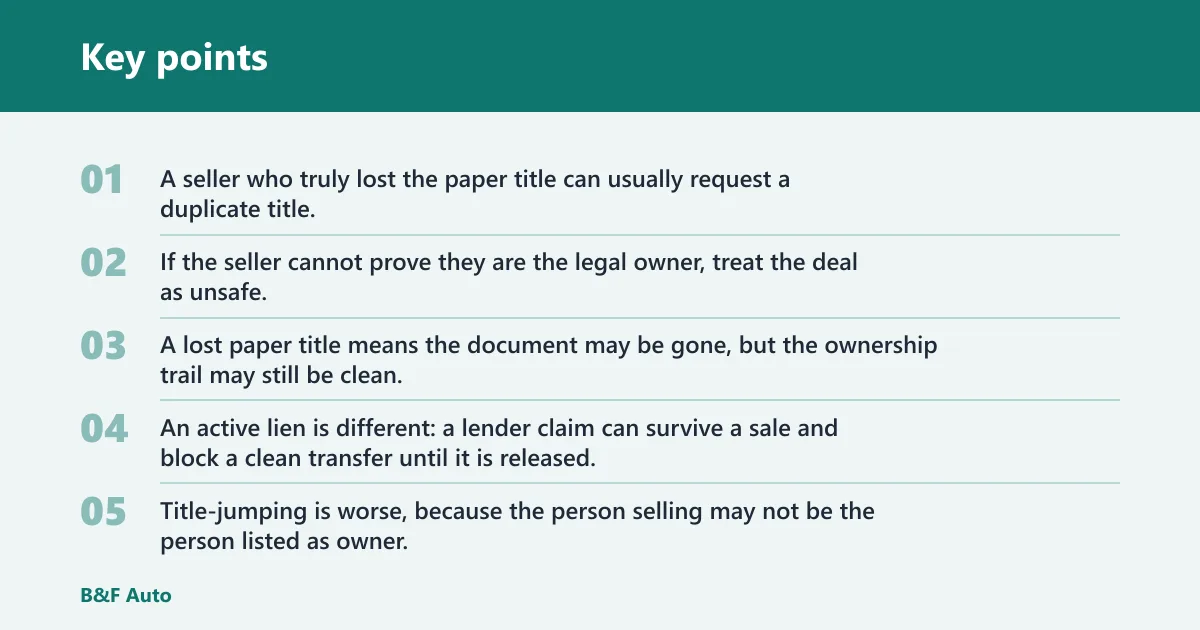
A seller who truly lost the paper title can usually request a duplicate title. That is the best-case fix, but the seller should do that before you buy, and only the legal owner can usually request it. If the seller cannot prove they are the legal owner, treat the deal as unsafe.
How a lost title differs from a lien or title-jumping
A lost paper title means the document may be gone, but the ownership trail may still be clean. An active lien is different: a lender claim can survive a sale and block a clean transfer until it is released. Title-jumping is worse, because the person selling may not be the person listed as owner.
Those three problems can look similar at the curb. That is why the first job is verification, not negotiation.
Can you buy the car without a title?
Sometimes you can agree to buy only after the seller gets a duplicate title, but you should not hand over money until the title is issued and the paperwork is clean. If the seller cannot request a duplicate title, cannot match the name on the record, or cannot explain the missing title clearly, walk away.
When the answer is pause until the duplicate title arrives
Pause when the seller is the legal owner, the VIN matches every document, and the state allows a duplicate-title request with the seller’s cooperation. In that case, the seller should apply for the replacement first, then close the sale after the duplicate title is in hand.
Say your seller has a truck titled in their name, but the paper title was misplaced during a move. The clean path is simple: the seller applies for the duplicate, you wait, and you pay only after the title is ready for transfer.
When the answer is walk away
Walk away if the seller refuses to request the duplicate, the seller’s name does not match the title record, or the paperwork points to another owner. Also walk away if the car has an unresolved lien and the lender will not release it, because a lien can block the transfer even if the seller insists the sale is fine.
A missing title is not a minor delay when the seller cannot prove ownership. It is a warning that the car may be hard or impossible to register later.
Check the seller and the VIN first
Before you talk price, match the seller’s identity to the ownership record and match the Vehicle Identification Number, or VIN, to the car and every document. The VIN is used to verify the vehicle, and it should match the paperwork on file as closely as possible.
Check the seller’s ID. Ask for a copy of the seller’s photo ID and compare the name to the title record and the bill of sale. If the names do not line up, it is wise to stop and verify why before any money changes hands.
Match the VIN. Read the VIN from the dash, the door jamb label, and any available paperwork. The same VIN should appear on the title record, bill of sale, and vehicle history report.
Run the records. Order a vehicle history report from an NMVTIS-approved provider. The Department of Justice keeps a list of approved NMVTIS data providers, and those reports can show title brands, salvage or junk records, and odometer data.
Check DMV title status. Ask the DMV for a title record check, since state records can reveal title status and may show liens. DMV procedures differ by state, so treat the result as one more verification step, not the only one.
Picture a sedan with a clean body and a neat bill of sale, but the VIN on the door sticker ends in 4B while the paperwork shows 4D. That single mismatch is enough to stop the sale until the source of the error is explained.
Lost title decision checklist
Use this table before any payment. If the answer fits the “Proceed” column, the deal can continue only after the duplicate title is in hand and the remaining documents are clean. If the answer fits “Pause,” wait for the seller to finish the title fix. If the answer fits “Walk away,” stop negotiating.
| Scenario | Proceed | Pause until seller gets duplicate title | Walk away |
|---|---|---|---|
| Seller name matches the DMV record and the VIN matches every document | Seller applies for the duplicate title, then transfer happens after the new title is issued | Yes, if the duplicate request is already filed and the seller can prove ownership | No |
| Seller name mismatch on ID or title record | No immediate transfer | Only if the seller can explain the mismatch with legal documents | Yes, if the mismatch cannot be fixed quickly and clearly |
| Active lien appears on DMV or history records | Only after the lienholder releases the claim in writing | Yes, while the seller gets payoff and release proof | Yes, if the lender will not release the lien |
| No ID match for the person selling the car | No | No, unless a legal representative with proof of authority is involved | Yes |
| Out-of-state title with a lost paper copy | Only after the seller checks that state’s duplicate-title process | Yes, until the correct state issues replacement paperwork | No, unless the seller cannot prove ownership |
| Inherited car with no title in the seller’s name | No immediate purchase | Only if the estate or legal heir can complete the state process | Yes, if no probate or transfer documents exist |
| Title is in another person’s name | No | Only if the titled owner can request the duplicate and sign the transfer | Yes, if the titled owner is absent or unwilling |
What documents should you ask for?
If you continue after a title delay, collect documents that prove ownership and preserve the paper trail. A bill of sale helps, but it does not replace the title. It should include names, addresses, the VIN, price, date, and odometer reading.
Request a signed bill of sale. Make sure it includes both parties’ names and addresses, the VIN, the price, the date, and the odometer reading. Those details help connect the seller, the vehicle, and the sale.
Get duplicate-title proof. Ask for evidence that the seller applied for a duplicate title before the sale. That can include a receipt, application confirmation, or other state-issued proof that the request was filed.
Collect lien release records. If a lender or lienholder is involved, ask for payoff or release proof. A bank or credit union claim can survive a sale until the claim is released, so do not treat the car as free and clear without written proof.
Keep inspection records. Save the vehicle history report, DMV check result, and pre-purchase inspection report. A mechanic review before payment can spot condition issues that also point to fraud risk, such as a fresh body panel swap or inconsistent wear.
A common first-timer mistake is accepting a handwritten bill of sale and a verbal promise that the title will arrive later. That leaves you with paper that may help prove the deal happened, but not enough to register the car in many states.
How do you spot fraud or a hidden lien?
Look for any sign that the seller cannot connect themselves to the car cleanly. A name mismatch, missing ID, an unexplained out-of-state title, or a seller who pushes for immediate payment are all warning signs. A missing title can mean hidden liens or fraud, so verify before you decide.
Red flags in name mismatch, missing ID, or out-of-state paperwork
If the seller’s ID does not match the title record, stop. If the title is in a different person’s name, ask who that person is and why they are not present. If the paperwork is from another state, confirm that state’s duplicate-title rules and do not assume the transfer will work the same way at your DMV.
When inherited cars need extra caution
Inherited cars often need estate documents, not just a bill of sale. If the titled owner died, the right to transfer the car may belong to the estate or an heir with legal authority. Do not treat a family story as enough proof.
Signs the car may be stolen or title-jumped
Be cautious if the seller will not show ID, refuses a VIN check, or cannot explain why the title is missing. Also be cautious if the seller wants cash before any verification, because title-jumping often depends on a fast, informal sale. A clean seller should be willing to wait for the duplicate-title process.
What is a bonded title?
A bonded title is a state-specific fallback used when you cannot prove ownership with a title. It is not a routine substitute for a missing title, and it is often temporary before a regular title is issued. In many cases, it appears only after the state decides the ownership trail can be corrected through bonding.
How a surety bond works
A surety bond protects better claimants if someone later proves a stronger ownership claim. The bond amount is commonly set at one and a half to two times the car’s value, and North Carolina’s example bond must equal 1.5 times the vehicle’s value. North Carolina keeps that bond on file for three years.
Why this is a fallback, not a clean fix
A bonded title can help in some ownership problems, but it does not erase the risk that a seller lacked proof in the first place. If the seller can still get a normal duplicate title, that is usually the cleaner path. Use bonded-title language only when the state says the regular title route is not available.
What happens if the seller cannot get a duplicate title?
If the seller cannot get a duplicate title, stop treating the car as a normal private sale. You can still ask about a court order or bonded title path in some states, but those are state-specific legal routes, not a reason to pay first. If ownership cannot be proven, the safer move is to end the deal.
Do not let timing pressure change the order of the checks. Title first. Verification first. Money last.
Frequently asked questions
What should I do if a private seller says they lost the car title?
Verify the seller’s identity, match the VIN to the car and paperwork, and ask the seller to request a duplicate title before any payment. If the seller cannot prove they are the legal owner or will not start the duplicate-title process, walk away rather than take on an untitleable car.
Can I buy a car from a private seller without a title?
Only if the seller can realistically obtain a duplicate title and the transfer can still be documented cleanly. A bill of sale alone usually does not solve registration problems, and some states will not let you register the car without the title or another approved ownership path.
How do I check if there is a lien when the title is missing?
Run an NMVTIS-approved vehicle history report and ask your DMV for a title record check. Those records can show liens or other title issues, though the result depends on the state. If a bank or credit union claim appears, get release proof before any purchase.
Should I ask the seller to get a duplicate title before I pay?
Yes. That is the cleanest path when the seller is the legal owner and the title is simply lost. The seller should request the duplicate before the sale, because once you pay, you may inherit a paperwork problem that is much harder to fix.
What documents should I get if I still decide to buy the car?
Get a signed bill of sale with the names, addresses, VIN, price, date, and odometer reading. Also keep the seller’s photo ID copy, duplicate-title proof, any lien release or payoff proof, the vehicle history report, and the inspection report. Those records matter if the DMV asks questions later.
What red flags mean I should walk away from the deal?
Walk away if the seller’s name does not match the title record, the VIN does not match, the seller will not show ID, or a lien remains unresolved. Also walk away if the seller cannot explain the missing title or insists on payment before proof. Those signs point to fraud or a blocked transfer.