How to Handle a Lost Title for a Gifted Car
You usually need the prior owner to replace the missing title, then complete a title transfer or bonded-title path, because a gift alone does not fix the ownership chain. If you ignore it, registration, resale, and insurance claims can stall. This guide shows how to rebuild the paperwork trail, decide who must apply, and handle the DMV steps when the car was gifted but never titled in your name.
Lost title vs missed transfer
A lost title and a missed transfer are different problems. If the title was already assigned to you and then lost, the DMV usually treats it as a duplicate-title request. If the donor kept the title signed but you never submitted it, the DMV may treat the case as a transfer issue, which can change who must sign and what proof you need.
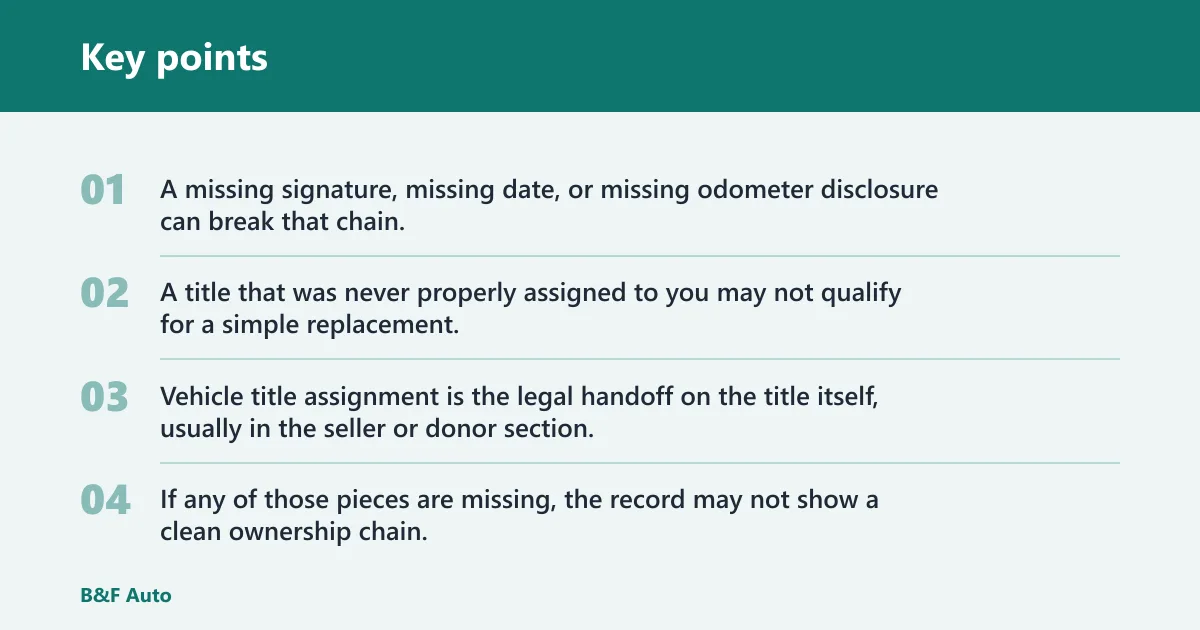
That distinction matters because a duplicate title is a state-issued replacement for an existing record, while a transfer depends on the assignment chain. A missing signature, missing date, or missing odometer disclosure can break that chain. A title that was never properly assigned to you may not qualify for a simple replacement.
How an assignment gap changes the DMV path
Vehicle title assignment is the legal handoff on the title itself, usually in the seller or donor section. Many states often require the donor’s signature, the transfer date, and an odometer disclosure for many vehicles under 10 model years old. If any of those pieces are missing, the record may not show a clean ownership chain.
That gap can send you into a transfer correction, a notarized affidavit, or a fallback title process. The DMV may also ask for the old registration, a gift letter, or proof that the vehicle was delivered even though the title never reached the office.
Can you still title the car?
Yes, often you can still get a title, but the route depends on what happened to the original title and whether the donor can help. A gifted car can still be titled years later if the state accepts late transfer paperwork, identity proof, and the right ownership evidence. If the donor is gone or unreachable, the path usually gets more complicated.
When the donor is available
If the donor is reachable, the cleanest path is usually to finish the assignment they started or replace the lost paperwork through the DMV. The donor may need to sign a duplicate-title request, a corrected assignment, or a gift affidavit, depending on state rules. A notary public is often involved because some states require witnessed signatures on title forms.
When the donor is unavailable or deceased
If the donor cannot sign, the DMV may accept other proof of ownership, but the available options narrow fast. A gift letter, old registration, insurance records, and VIN inspection can help, yet they may not replace a missing title assignment on their own. If the donor is deceased, estate papers or a court order may be needed before the DMV will issue a new title.
When the title was signed but never submitted
If the previous owner signed the title and handed it over, but it was never submitted, the DMV may still treat it as an incomplete transfer rather than a true duplicate-title request. The exact result depends on whether the signature, date, odometer disclosure, and buyer or donee section are still valid under state rules. Late-fee risk may also apply.
-
Check the title chain.
Look for the donor’s signature, the date, the mileage statement, and your name in the buyer or transferee section. If the chain is broken, the DMV may ask for transfer correction instead of a duplicate title.
-
Gather proof of delivery.
Collect the old registration, insurance records, a gift letter, and any bill of sale or receipt showing the vehicle moved into your possession. These documents help connect the car to you when the title record is incomplete.
-
Confirm state requirements.
Go to your state DMV website and pull the exact title packet, ID list, notarization rules, fee schedule, and any late-transfer form. Some states also require a VIN inspection from the DMV, police, or an inspection station, especially when the record is old, incomplete, or out of state.
-
Resolve liens first.
If a lien was ever recorded, get the lender satisfaction letter or state release form before expecting a clear title. An open lien usually blocks a clean transfer until the release appears in the record.
Gifted car title documents
Gift transfers usually need more than a verbal explanation. A gift affidavit or gift letter can document that no sale took place, and some states use that statement to support tax exemptions. Notarization may be required, and the DMV may want both donor and recipient signatures.
Gift affidavit and gift letter
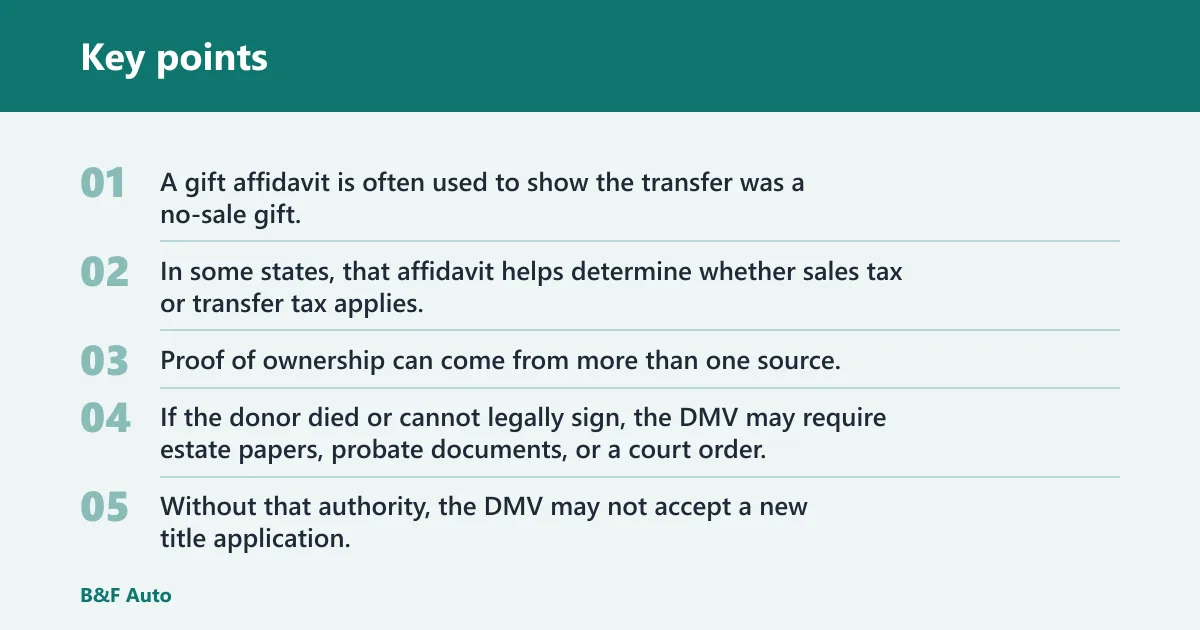
A gift affidavit is often used to show the transfer was a no-sale gift. It may ask for names, VIN, transfer date, relationship, and a declaration that no payment changed hands. In some states, that affidavit helps determine whether sales tax or transfer tax applies.
Old registration, insurance records, and bills of sale
Proof of ownership can come from more than one source. Old registration cards, insurance records showing the vehicle was insured in the donor’s name, and a bill of sale or gift letter can support the file when the title is missing or incomplete. These records do not always replace a title, but they can help close the gap.
Estate or court papers when the donor cannot act
If the donor died or cannot legally sign, the DMV may require estate papers, probate documents, or a court order. Those documents help show who may transfer the vehicle and whether the estate has authority to release it. Without that authority, the DMV may not accept a new title application.
Say your aunt signed the title over, but the assignment section left the odometer blank on a 7-year-old sedan. The DMV may reject the transfer until the mileage statement is completed or corrected, even though the car was clearly a gift. The missing line, not the missing title, becomes the failure point.
Suppose the donor is unreachable and the only paper you have is an older insurance card plus the old registration. That may support a bonded-title application in a qualifying state, but it usually will not substitute for a clean assignment if the state still requires the donor’s signature on a standard transfer.
Gift title checklist
| Scenario | Required documents | Who must sign | Likely DMV path | Common failure point |
|---|---|---|---|---|
| Donor available | Title, gift affidavit, ID, odometer disclosure if required, state transfer form | Donor and recipient; notary if the state requires it | Duplicate title plus transfer, or corrected assignment | Missing signature date or mismatch in names |
| Donor unavailable | Old registration, gift letter, proof of delivery, VIN inspection, state forms | Recipient; donor only if a prior form can still be validly signed | Transfer correction, affidavit-based filing, or bonded title | No acceptable proof that the donor transferred the car |
| Donor deceased | Estate papers, death certificate, old title or registration, court documents | Personal representative or estate authority, plus recipient where required | Estate transfer or court-authorized title issuance | No authority to move the vehicle out of the estate |
| Lien still open | Title, lender satisfaction letter or state release form, transfer paperwork | Lender for the release; donor and recipient for the transfer | Lien release first, then transfer or duplicate-title path | Clear title blocked by unresolved lien record |
| Title already signed but never submitted | Signed title, ID, odometer disclosure if needed, transfer form, proof of possession | Usually recipient; donor may not need to re-sign if the assignment is valid | Late transfer, not duplicate title, in many states | Expired or incomplete assignment details |
What the DMV will ask
The DMV usually wants identity proof, vehicle information, and whatever documents explain the title gap. That can include the title, the assignment section, a gift affidavit, a lien release, and proof that the VIN matches the vehicle. Fee amounts, deadlines, and late-transfer penalties vary by state.
Title assignment and odometer disclosure
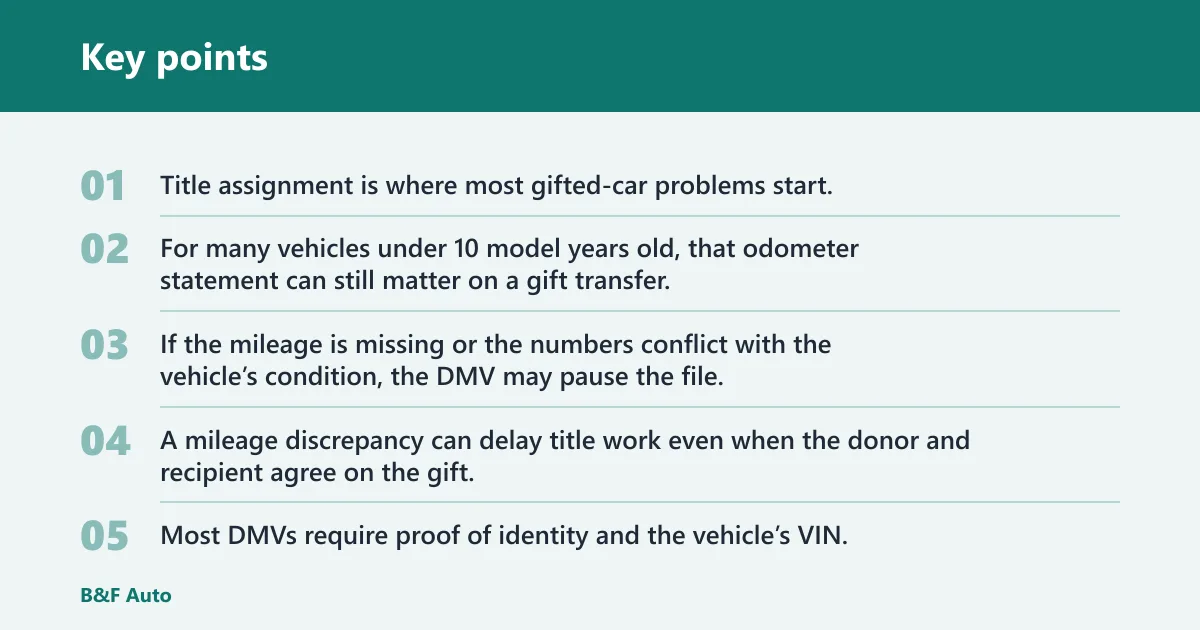
Title assignment is where most gifted-car problems start. The donor section should match the name on the current title, the date should be present, and the mileage disclosure should be completed when federal law applies. For many vehicles under 10 model years old, that odometer statement can still matter on a gift transfer.
If the mileage is missing or the numbers conflict with the vehicle’s condition, the DMV may pause the file. A mileage discrepancy can delay title work even when the donor and recipient agree on the gift.
ID, VIN inspection, and state forms
Most DMVs require proof of identity and the vehicle’s VIN. Some states also require a VIN inspection by the DMV, law enforcement, or an inspection station. That check becomes more common when records are incomplete, the title is out of state, or the name chain has a gap.
Fees, deadlines, and late-risk points
State deadlines can trigger late fees if you wait too long to apply. Some offices appear to count the transfer window from the date on the title, while others use the date of delivery or gift. If the paperwork was never filed, do not assume the old date will be ignored.
Check spelling, VIN, and mileage before submission. A one-character name mismatch or a transposed VIN can send the file back and add weeks.
Do you need the original owner?
Sometimes yes, sometimes no. If the donor’s signature is still legally required and the assignment was never completed, the original owner may need to sign a replacement form or a corrected title. If that person is gone or unavailable, the DMV may require an affidavit, court order, bonded title, or estate paperwork instead.
When a donor signature is still required
A donor signature is often still needed when the title assignment was never finished or when the state requires the owner of record to request a replacement. A duplicate title request often must be signed by the owner or another authorized party. A gift does not cancel that requirement.
When a notarized affidavit may help
A notarized affidavit may help when the donor can confirm the transfer but cannot produce the old paperwork. The affidavit can explain the gift, the date of delivery, and the missing title chain. It is not a universal substitute, but it can support a state-specific transfer review.
When a new signature is not possible
If a new signature cannot be obtained, the DMV may steer you toward bonded title or court documents. A bonded title is a fallback in qualifying states when ownership evidence is incomplete and a standard transfer cannot be proven immediately. It usually requires a surety bond and extra forms.
Open lien or bonded title
An open lien can block a clean title even if the car was gifted. If the lien was never released, the DMV may not issue a clear title until the lender’s record is closed. When the ownership trail is incomplete and the donor cannot re-sign, a bonded title may be the practical backup in states that allow it.
How a lien release affects the title
A lien release proves the lender no longer claims an interest in the vehicle. That release may be a satisfaction letter or a state form, depending on where you file. Without it, the title can remain encumbered, which can stop registration and resale.
When a bonded title is the fallback
Bonded title is usually for cases where the paperwork trail is thin but not hopeless. The state may want proof of possession, old registration, an affidavit, and a surety bond before issuing a new title record. It is not the first choice, but it can move a stalled file forward.
Frequently asked questions
How do I handle a lost title for a gifted car I never transferred into my name?
Start by deciding whether this is a duplicate-title issue or a missed transfer. If the title was never properly assigned to you, the DMV may want a transfer correction, gift affidavit, identity proof, and possibly a VIN inspection rather than a simple replacement request. The donor’s signature may still matter.
Can I still get a title if the car was gifted to me years ago?
Often yes, but the older the gap, the more proof the DMV may want. Old registration, insurance records, a gift letter, and any signed title pages can help rebuild the chain. If the donor is unavailable, bonded title or court documents may be the fallback in your state.
What if the previous owner signed the title but I never registered it?
If the title was signed but never submitted, many DMVs treat it as an uncompleted transfer rather than a duplicate-title request. Check whether the signature, date, and odometer disclosure are still usable. Late-transfer fees, VIN verification, or a corrected assignment may apply.
Do I need the original owner to replace a lost title on a gifted car?
Sometimes yes. If the state considers the owner of record to be the donor, that person may need to sign the duplicate-title request or a transfer correction. If they cannot, the DMV may ask for a notarized affidavit, estate papers, or a bonded-title application instead.
Can I sell or register a gifted car without a title in my name?
Usually not cleanly. Registration and resale generally depend on a valid title chain, and a missing transfer can stop both. Some states allow temporary or conditional filings, but you should expect the DMV to require assignment proof, ID, and possibly a lien release or VIN inspection first.
What should I do if the gifted car also has a lien or estate issue?
Handle the lien or estate issue before expecting a clear title. An open lien needs a release, and a deceased donor may require probate or court authority. If the ownership evidence is incomplete after that, the DMV may steer you toward bonded title or another state-specific fallback path.