How to Use a Car Payment Budget Calculator
Use a car payment budget calculator by starting with your safe monthly payment, then backing into a max vehicle price after taxes, fees, interest, insurance, and any trade-in. Many buyers keep the payment at or below 10% to 15% of take-home pay. Ignore those costs, and the “affordable” payment can become a loan you cannot cover month after month. This guide shows how to turn a payment limit into a realistic max car price.
What the calculator tells you
A car payment budget calculator should give you three things: a monthly payment, a loan amount, and a maximum vehicle price. The better versions also let you include APR or interest rate, sales tax, title, registration, and other fees, and they can show an amortization schedule with payment split details. NerdWallet shows that schedule, and myFICO notes that payment depends on loan amount, term, and interest rate.
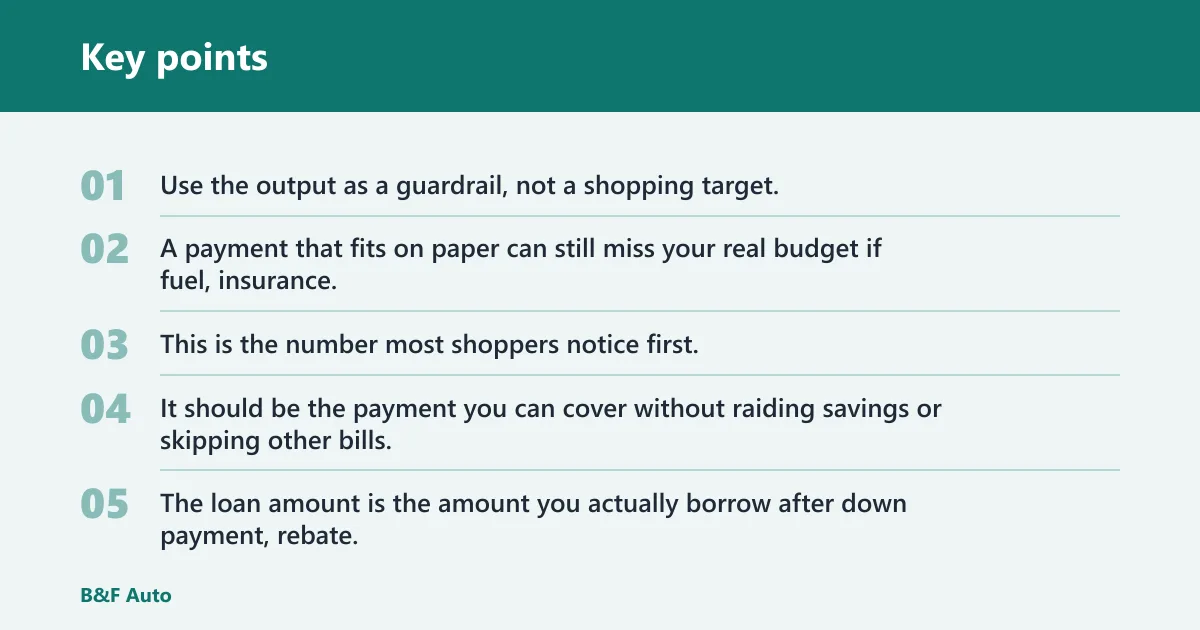
Use the output as a guardrail, not a shopping target. A payment that fits on paper can still miss your real budget if fuel, insurance, maintenance, or existing debt are already eating up your monthly cash flow.
Monthly payment output
This is the number most shoppers notice first. It should be the payment you can cover without raiding savings or skipping other bills, not the highest lender will approve.
Loan amount output
The loan amount is the amount you actually borrow after down payment, rebate, and net trade-in value are applied. myFICO states that loan amount equals price minus down payment, rebate, and net trade-in value.
Maximum vehicle price output
The max price is the price ceiling that still fits your budget after taxes and fees are included. If the calculator only shows payment, you still need to work backward to a real purchase cap.
How much of my budget should go to car payment?
Start with a payment that leaves room for insurance, fuel, maintenance, and your other debt payments. A common guardrail is to keep the car payment at or below 10% to 15% of take-home pay, then check that all monthly debt stays within a safe debt-to-income range. If the car payment crowds out savings, the number is too high.
Set a safe monthly cap
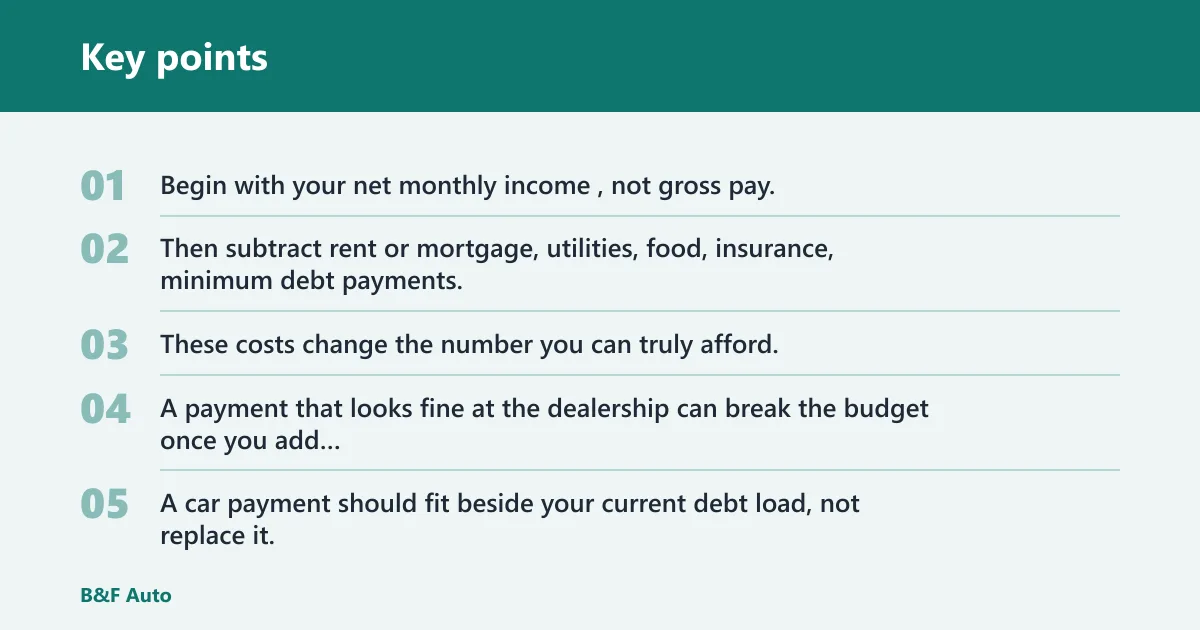
Begin with your net monthly income, not gross pay. Then subtract rent or mortgage, utilities, food, insurance, minimum debt payments, and a savings line before you decide what is left for a car.
Account for insurance, fuel, and maintenance
These costs change the number you can truly afford. A payment that looks fine at the dealership can break the budget once you add full-coverage insurance, regular fuel, oil changes, tires, and repairs.
Check existing debt and cash flow
A car payment should fit beside your current debt load, not replace it. If credit cards, student loans, or another car already take a large slice of monthly income, use a lower target payment and a shorter shopping list.
If take-home pay is about $4,200 a month, a common rule of thumb is to keep the car payment around 10% to 15% of that amount, or about $420 to $630.
Budget-to-price worksheet
This worksheet turns a monthly budget into a purchase cap. The key step is to separate the car payment from the rest of ownership so you do not mistake a manageable loan for a manageable vehicle.
| Monthly budget | Estimated insurance | Fuel | Maintenance | Existing debt payments | Target car payment | Estimated APR | Term | Taxes/fees | Resulting maximum purchase price |
|---|---|---|---|---|---|---|---|---|---|
| $950 | $180 | $140 | $70 | $80 | $480 | 7.0% | 60 months | $2,600 rolled in | $26,775 pre-tax price, assuming 20% down |
| $700 | $130 | $110 | $60 | $40 | $360 | 11.0% | 48 months | $1,800 rolled in | $13,511 pre-tax price, assuming 10% down |
For the new-car row, the monthly budget leaves $480 for the payment after insurance, fuel, maintenance, and debt. At 7.0% APR over 60 months, that payment supports about $23,740 in borrowing; with $2,600 in fees rolled in and about 20% down, the max pre-tax price lands near $26,775.
For the used-car row, the monthly budget leaves $360 for the payment. At 11.0% APR over 48 months, that payment supports about $13,960 in borrowing; with $1,800 in fees rolled in and about 10% down, the max pre-tax price lands near $13,511.
What inputs do you need?
At minimum, you need vehicle price, down payment, APR or interest rate, and loan term. Better calculators also ask for taxes, title, registration, other fees, and trade-in value so the result reflects the real deal instead of a bare sticker price. Experian says the calculator can compare up to three loan options at a time.
Vehicle price and tax treatment
Use MSRP or negotiated price, then decide whether you are working from a pre-tax price or an all-in price. The all-in version is better for budgeting because it includes what you actually need to finance or pay.
Down payment and trade-in value
A down payment reduces the amount borrowed. So does trade-in value, but only the net trade-in value matters after any loan balance on the old car is subtracted. If you owe more than the trade is worth, negative equity gets added back into the new loan.
APR and loan term
APR drives the cost of borrowing, and term drives how long you pay. The same source notes common auto loan terms range from 36 to 84 months, while myFICO says a longer term lowers monthly payment but increases total interest.
How do taxes and fees change the result?
Sales tax, title, registration, and other fees can change a payment enough to move a car out of reach. The calculator can include sales tax in the loan amount, and it also supports title, registration, and other fee inputs. That matters because fees rolled into the loan raise both the borrowed amount and the interest you pay on those fees.
Sales tax, title, and registration
Local tax rate changes the payment before you ever talk about trim levels or options. A higher tax rate means a higher financed amount unless you pay those charges upfront.
Rolled-in fees versus upfront fees
If you roll fees into the loan, the monthly payment rises and so does total interest. If you pay fees upfront, the payment stays lower, but you need more cash at signing.
All-in price versus pre-tax price
Always compare the all-in price against your budget cap, not the pre-tax sticker alone. A low sticker can still fail the budget once taxes and fees are added.
Picture a shopper who can handle a $430 payment on paper. Add insurance, fuel, and maintenance, and the room for the car shrinks fast. If those fixed costs are not counted first, the payment is no longer a true budget fit.
How down payment and trade-in change the loan
A larger down payment lowers the amount borrowed, which can reduce the monthly payment and the total interest paid. The same source recommends 20% down for new cars and 10% down for used cars. Positive trade-in equity works the same way, while negative equity makes the loan larger and the payment harder to carry.
Positive equity versus negative equity
If your trade is worth more than you owe, the extra value lowers the new loan. If you owe more than the car is worth, that shortfall gets folded into the new deal unless you pay it off first.
How much to put down on new and used cars
For new cars, 20% down is the better starting point. For used cars, 10% down is the common target. Bigger down payments help, but only if they do not drain the cash reserve you need for repairs or emergencies.
How loan term and APR affect affordability
Loan term and APR move together but they do different jobs. A longer term lowers the monthly payment but increases total interest, while a shorter term does the opposite. Credit score also matters: Experian lists 2024 Q2 average APRs of 5.25% for super-prime new-car borrowers and 21.55% for deep-subprime used-car borrowers.
Shorter term versus longer term
A 36- to 48-month loan usually costs less in interest and gets you to payoff faster. A 72- to 84-month loan makes the payment easier to fit, but it can leave you paying for a car long after the value has dropped.
New-car and used-car rate differences
Used-car loans often carry higher APRs than new-car loans, so the same payment can buy less vehicle. That is why a payment-first budget should still be tested against the rate you are likely to get.
How shopping lenders can change payment and interest
Comparing lenders can change both the monthly payment and the total interest cost. Ask two or three lenders for quotes, because a lower APR can trim the payment or cut years of interest from the loan.
How do you turn the result into a max car price?
Work backward from the payment to the loan amount, then adjust for down payment, trade-in, and fees to get the max vehicle price. After that, check the result against your total ownership cap and your debt load. If the vehicle only fits when insurance, fuel, or maintenance are ignored, the price is too high.
Work backward from payment to price
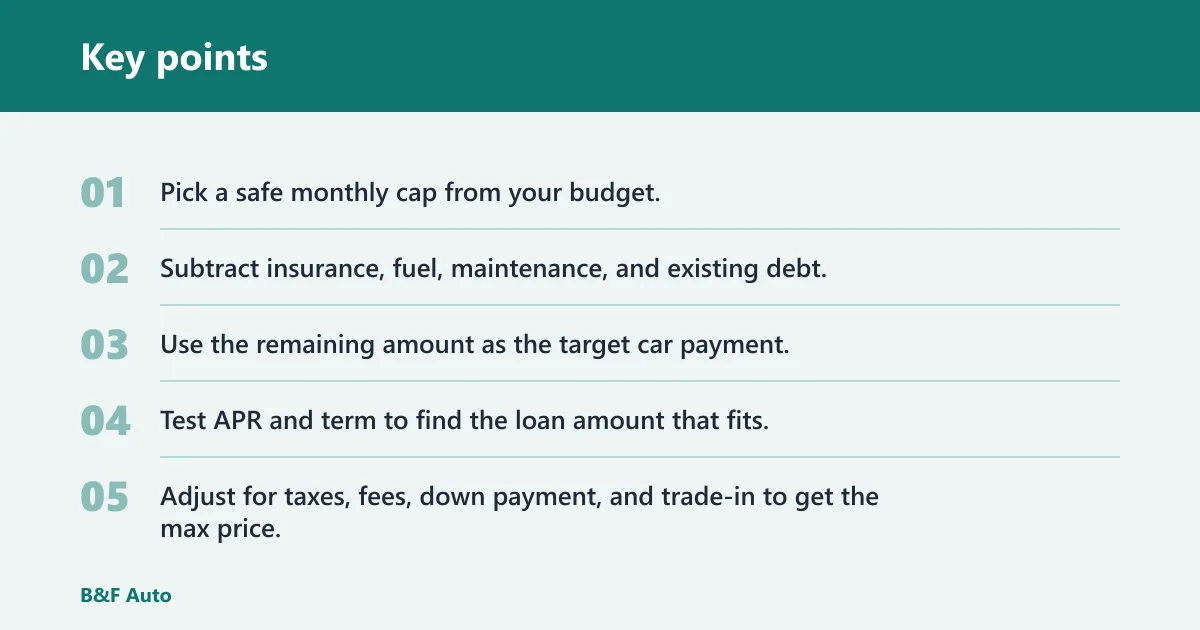
- Pick a safe monthly cap from your budget.
- Subtract insurance, fuel, maintenance, and existing debt.
- Use the remaining amount as the target car payment.
- Test APR and term to find the loan amount that fits.
- Adjust for taxes, fees, down payment, and trade-in to get the max price.
Include total ownership cost
Do not stop at the payment. Add the routine costs that come with owning the car, then compare the full monthly total with your budget. That is the number that tells you whether the vehicle belongs on your shortlist.
Sanity-check against debt-to-income ratio
Debt-to-income is a useful affordability signal. If your total monthly debt load starts getting close to 36% of gross income, or if the car payment alone pushes your budget into a tight corner, slow the purchase or lower the price target.
A common first-timer mistake is picking a payment that fits, then discovering that a higher insurance quote and a longer commute eat the margin. The car still “works” on the calculator, but the real monthly total does not leave enough room for the rest of life.
How to read the amortization schedule
An amortization schedule shows how each payment splits between principal and interest, when the loan is expected to end, and how much interest you will pay overall. The same source shows these payment split details, which helps you see whether a lower payment is costing too much in extra interest.
Principal and interest split
Early payments go more toward interest. Later payments go more toward principal. That is why a loan can feel slow at first even when you are paying every month on time.
Payoff date
The payoff date tells you when the loan should end if you make every payment as scheduled. A shorter term gets you there sooner.
Total interest cost
Total interest shows the full cost of borrowing, not just the monthly hit. When two loans have similar payments, the one with the lower total interest is usually the better deal.
Frequently asked questions
How much of my budget should go to car payment: a practical cap is 10%?
A practical cap is 10% to 15% of take-home pay for the payment itself, then you still need room for insurance, fuel, maintenance, and debt. If those fixed costs make the total too tight, lower the target payment before you shop.
What percentage of your budget should go to a car payment
Use the same 10% to 15% take-home-pay range as a starting point, not a rule that overrides your full budget. The better test is whether the payment still fits after you subtract other transportation costs and existing debt.
How much of my income should go to car payment?
Use monthly net income, not gross income, when you set the payment cap. If the payment plus other debt makes your monthly obligations feel crowded, the car is probably priced above your comfort zone even if the lender approves it.
What kind of car payment can I afford calculator
You want one that does more than estimate a monthly payment. Look for a calculator that also outputs loan amount and max vehicle price, and that lets you add APR, term, sales tax, title, registration, and trade-in so the result reflects the real deal.
How do I use a car payment budget calculator?
Start with your safe monthly cap, subtract insurance, fuel, maintenance, and existing debt, then test the payment against APR and term. After that, roll in taxes and fees, add your down payment and trade-in, and use the result as a price ceiling.
How do I turn my budget into a maximum car price?
Work backward from the monthly amount you can safely spend. Convert that payment into a loan amount with your APR and term, then adjust for down payment, net trade-in value, and rolled-in taxes and fees. The final number is your max purchase price, not your target to exceed.