Car Donation Paperwork: What You Need and How It Works
For most car donations, you need a signed title, the charity’s receipt, and a state release-of-liability filing; for tax deductions over $500, IRS Form 8283 also applies, and over $5,000 usually requires a qualified appraisal. Miss the title, skip the DMV notice, or use the wrong tax form, and pickup can be delayed, transfer can stall, parking or toll liability can stay with you, or the deduction can shrink. This guide explains which title, DMV, charity, and IRS documents apply before pickup, at transfer, and after donation, including lost-title, lien, estate, and out-of-state cases.
Ownership documents
The title, registration, and ID prove different things
The title is the ownership document. In many donation programs, a signed, clear title is the minimum paperwork needed. The only paperwork needed is a signed, clear title, and defines a clear title as being in the donor’s name without a lien.
Registration shows the vehicle was registered, but it usually does not transfer ownership by itself. A donation receipt does not transfer ownership either. The charity, its tow contractor, or state rules may still ask for driver identification to confirm that the person signing matches the owner named on the title.
What a clear title means before acceptance
A clear title needs more than the word “clear.” The owner name on the title should match the signer. The vehicle identification, year, make, and model should match the vehicle being picked up. The reassignment or seller section must stay blank until signing time, and any lien should already be released if the state shows liens on the title record.
If the title lists two owners, both may need to sign depending on whether the names are joined by “and” or “or” under state law. If the title has an odometer disclosure line, fill that line out exactly as the state requires. A wrong odometer entry can force a title correction.
Why a receipt cannot replace a valid transfer
A pickup receipt confirms custody changed hands. It does not, by itself, move the car out of the donor’s legal name. That usually depends on the signed title and any state notice of sale, release of liability, or registration cancellation filing.
One charity says the driver issues a receipt at the time of pick-up. That receipt includes the donor’s name and vehicle details such as year, make, model, and condition. Keep it, but do not treat it as a substitute for the title transfer record.
What paperwork do you need to donate a car?
For a straightforward donation, the basic set is the signed vehicle title, any state transfer or release form, and the charity or agent’s pickup paperwork. Some states or programs also ask for identification, plate or registration handling forms, or odometer disclosures. Vehicle condition details can affect timing even when they do not change ownership.
The minimum documents for a straightforward donation
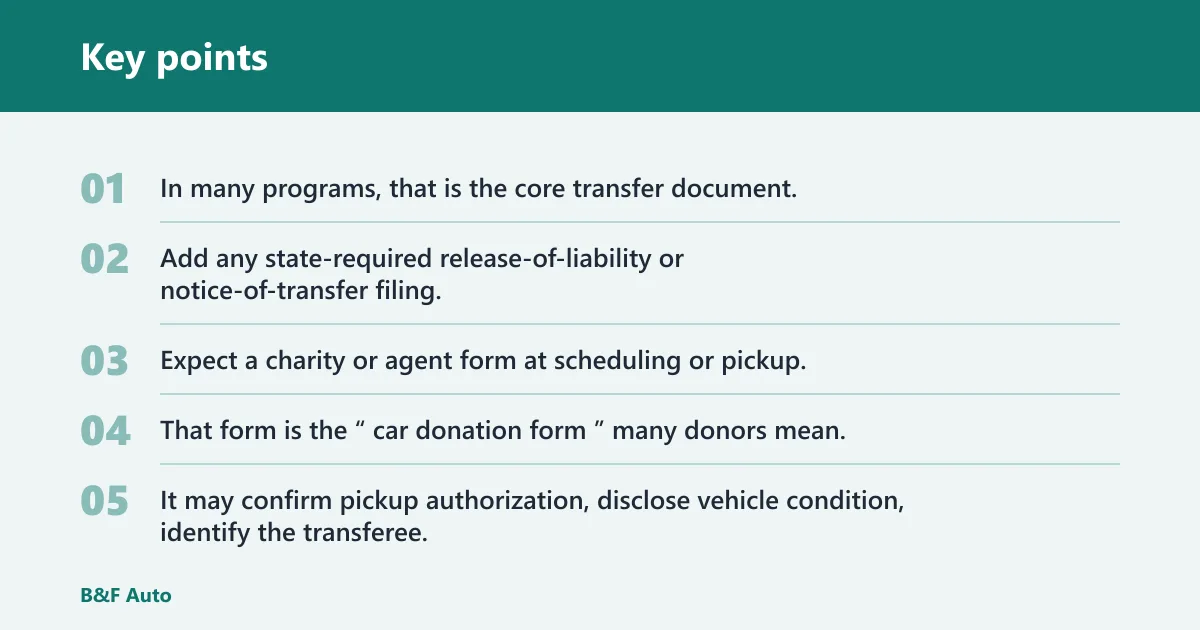
Start with the certificate of title. In many programs, that is the core transfer document. Add any state-required release-of-liability or notice-of-transfer filing, because signing the title alone may not stop later toll, parking, or impound notices.
Expect a charity or agent form at scheduling or pickup. That form is the “car donation form” many donors mean, but it is separate from the title. It may confirm pickup authorization, disclose vehicle condition, identify the transferee, or record contact details.
Extra forms some states or programs require
State DMV or RMV rules can differ by state on several common points: some require notarized title signatures, some require an odometer disclosure on the title or a separate form, some require plate surrender to the DMV, some require you to cancel the registration record after pickup, and some ask for emissions paperwork before transfer. Other states instead require an online or mailed seller’s notice after pickup.
If the vehicle comes from an estate, trust, or business, expect supporting authority documents such as letters testamentary, small-estate papers, a power of attorney accepted by the state, or business authorization. If a lender still has a lien, a release or lienholder signature may be required before transfer.
Vehicle details that affect acceptance and transfer timing
The charity or tow company will usually ask for the year, make, model, approximate mileage, title status, and basic condition, including whether the car runs, rolls, steers, and brakes, plus damage, missing parts, flat tires, locked steering, and whether keys are available. Those details affect dispatch, tow method, and whether the paperwork can be completed at pickup.
Some programs can accept vehicles without a state inspection sticker or current registration. That changes towing logistics, not ownership rules. If the title is missing or a lien is unresolved, a tow can still be refused even if the car itself is towable.
Donation paperwork decision table
| Scenario | Documents needed | Who signs | Can pickup happen? | Next step |
|---|---|---|---|---|
| Clear title | Original title in donor’s name, any state release-of-liability form, pickup receipt, ID if requested | All titled owners; charity or tow agent only in the transferee sections allowed by state law | Usually yes, if the title is complete and lien-free | Check title fields before signing, keep copies, file the DMV notice, then cancel insurance after transfer |
| Lost title | Duplicate title from the DMV or RMV, state transfer form, pickup receipt | All titled owners on the duplicate title | Often no until the duplicate title is issued | Apply for a duplicate title first; one guide says the donor must get a duplicate title before pickup |
| Lien on title | Original title, lien release or lienholder payoff and release paperwork, state transfer form | All titled owners and lienholder when state records still show the lien | Sometimes, but many programs wait for lien release | Contact the lender, get written lien satisfaction, and confirm the state title record is clear before scheduling |
| Deceased owner | Title, death certificate if required, estate authority papers, state transfer documents, pickup receipt | Executor, administrator, or other person the state allows to transfer the vehicle | Often only after estate authority is confirmed | Ask the DMV which estate document fits the title record before signing anything |
| Out-of-state title | Original out-of-state title, any home-state release form, local transfer documents if required, pickup receipt | All titled owners exactly as listed on that title | Usually yes if the title is valid and matches the vehicle | Confirm which state’s notice, plate, and notarization rules control before pickup |
| No current registration | Signed title, state transfer form, pickup receipt; registration card only if the program asks for it | All titled owners | Often yes, if the vehicle can be towed and title is valid | Tell the dispatcher the car is unregistered and whether it runs, rolls, and steers |
Can you donate a car without a title?
Sometimes, but usually not immediately. In many cases, a lost title means the donor must get a duplicate title from the state before pickup. Some programs can accept unusual cases under specific state rules, but no-title donations are where delays, refusals, and ownership mistakes most often begin.
When a duplicate title is usually required
If the original title is lost, one guide says the donor should get a duplicate title before pickup. That is the cleanest path because the duplicate lets the actual owner sign the current transfer document recognized by the state.
Programs may also insist on a duplicate title when the original is unreadable, signed in the wrong place, missing a needed owner signature, or still shows an unreleased lien. A pickup receipt cannot fix those defects.
How to request a duplicate title from the DMV or RMV
- Check the title record in the issuing state, because only that state can usually replace its own title.
- Confirm the owner name, address, lien status, and whether all owners must sign the duplicate-title request.
- Submit the state duplicate-title application with identification and any required fee.
- Wait for the replacement title to be issued, then review it for name, VIN, and lien accuracy before scheduling pickup.
- Sign the duplicate title only when the charity or agent gives the correct transferee instructions.
Cases where a program may still refuse the vehicle
No-title acceptance depends on both state law and program policy. A vehicle may still be refused if the title is from another state with unresolved issues, if the owner name does not match identification, if a lienholder has not released its interest, or if estate authority is incomplete.
Say your title was lost after moving from Ohio to Arizona, and the lender’s lien release was never processed by Ohio. The car may be physically in Arizona, but the paperwork problem still follows the Ohio title record. The next step is the issuing state, not the tow date.
Who signs the title and transfer forms?
The required signer is the legal owner shown on the title, plus any co-owner, lienholder, executor, or authorized agent the state requires. Signatures must match the title record, appear in the correct boxes, and include odometer disclosures when required. A missing or misplaced signature can void the transfer.
Single owner, co-owners, and name-match rules
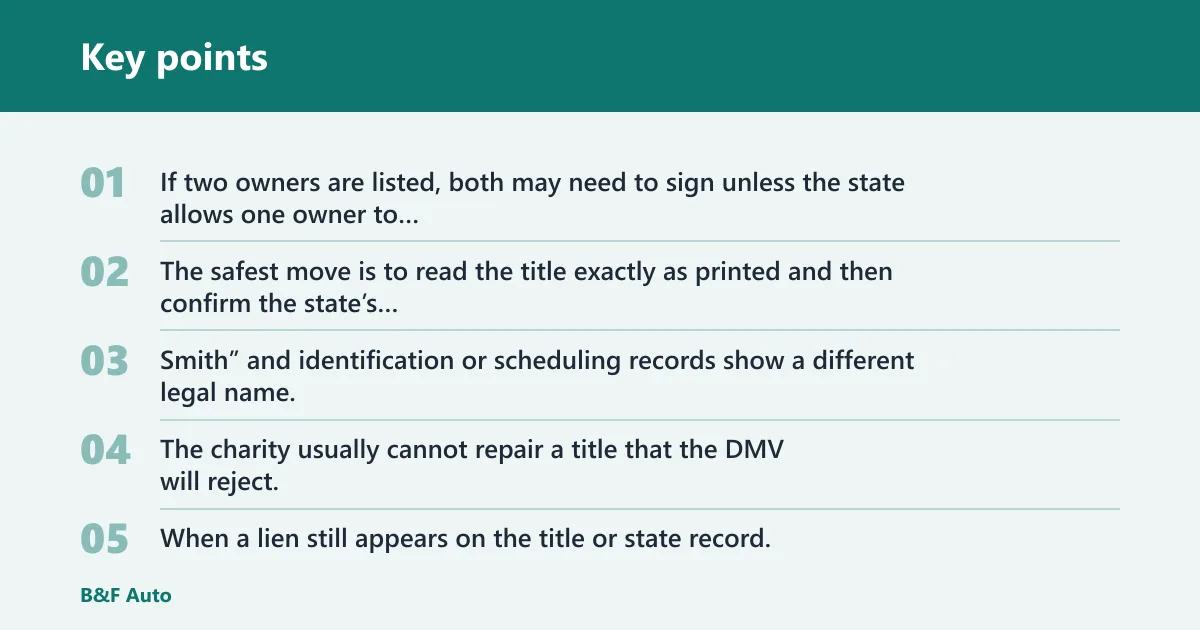
If one owner is listed, that person signs. If two owners are listed, both may need to sign unless the state allows one owner to transfer under the title wording. The safest move is to read the title exactly as printed and then confirm the state’s rule on joined names.
Name mismatch is a common failure point. If the title says “Jane Q. Smith” and identification or scheduling records show a different legal name, resolve that before pickup. The charity usually cannot repair a title that the DMV will reject.
Lienholder, executor, and power-of-attorney signatures
When a lien still appears on the title or state record, the lienholder may need to sign or issue a formal release. For a deceased owner, the person signing is usually the executor, administrator, surviving owner, or another person state law authorizes. A power of attorney works only if the state accepts that form for title transfer.
Suppose a sedan is titled to “Robert Lee or Maria Lee,” but Robert has died and Maria is donating it. Whether Maria can sign alone depends on the title wording and state transfer rules. The death certificate may matter less than the exact ownership wording on the title.
Odometer lines, reassignment boxes, and other common signing errors
Many title problems start with writing in the wrong area. Do not sign the buyer or dealer reassignment section unless the state or charity specifically instructs that it is the correct place. A tow driver or call-center agent should not tell the donor to “just sign anywhere.”
Watch the odometer line. If the state requires an odometer disclosure, enter mileage carefully and mark any required status boxes. Wrong mileage, skipped boxes, white-out, or scratched-out entries can force a replacement title or correction form.
Do you need registration, smog, or inspection paperwork?
Usually, current registration is helpful but not the ownership document, and some programs can accept vehicles without a current registration or inspection sticker. Smog and safety requirements vary by state. The title still controls the transfer, while condition details mainly affect whether and how the car can be towed.
No current registration: what it changes and what it does not
No current registration can affect where the car may sit, whether plates must be removed, and how the tow is handled. It does not automatically block a donation if the title is valid. Some programs can accept vehicles without a state inspection sticker or current registration.
Tell the program whether the vehicle runs, whether the tires hold air, whether it can be rolled out of a garage, and whether keys are available. Those details can decide whether a flatbed, dollies, or a winch is needed.
State differences on emissions, smog, and safety inspection documents
For states requiring smog or safety inspections, one charity says you may donate without those documents. That should not be read as a national rule. Some states care about emissions paperwork for a sale or transfer, while others mainly care about title and registration status.
Ask two separate questions before pickup: does the state require any emissions or safety paperwork for transfer, and does the program require any proof about the car’s operable condition? Those are different issues.
When a non-running or damaged car can still be picked up
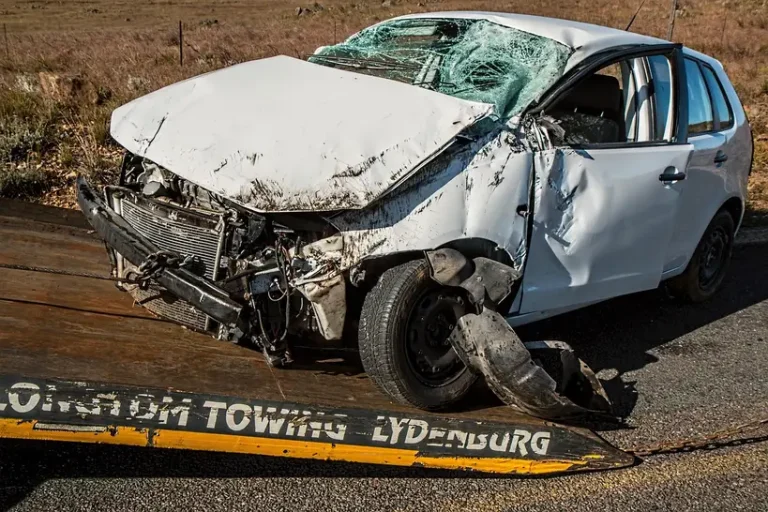
Vehicle condition changes logistics more than title law. A non-running car may still be accepted if it is towable, accessible, and has a transferable title. Missing wheels, front-end damage, a locked steering column, or a car buried behind other vehicles can change scheduling.
Picture a hatchback with no current inspection, a dead battery, and body damage from a parking-lot hit. Those facts may still allow pickup if the title is clear and the car can be winched safely. The missing title, not the bad battery, is the bigger paperwork issue.
What tax documents should you keep?
Keep the pickup receipt, the later written acknowledgment from the charity, copies of the signed title or transfer forms, and any DMV notice filed after pickup. IRS Form 1098-C matters for qualifying vehicle donations and donor records, and tax rules shift at the $500 and $5,000 checkpoints.
Pickup receipt versus written acknowledgment
A pickup receipt is immediate evidence that the vehicle was collected. One charity says the driver issues a receipt at the time of pick-up, and that receipt includes the donor’s name and vehicle details such as year, make, model, and condition.
The later written acknowledgment is the tax record that matters more for qualifying donations. The written acknowledgment is used as the donor’s record for qualifying vehicle donations. Keep both documents, because one proves handoff and the other supports tax reporting.
When IRS Form 1098-C matters
Form 1098-C is used for contributions of motor vehicles, boats, and airplanes. In cited guidance, it applies when gross proceeds exceed $500. If the organization sells the vehicle, the donor’s deduction may be limited by the gross proceeds from that sale unless an exception applies.
This is where donors often mix up forms. Form 1098-C is generally issued by the organization for qualifying vehicle donations, while Form 8283 is the form the donor may file with the return when claiming a noncash charitable contribution over the threshold stated in tax rules.
The $500 and $5,000 checkpoints to know
If a vehicle’s fair market value exceeds $500, the deduction may be limited by gross proceeds. The same general area of tax guidance is why donors should wait for the written acknowledgment instead of guessing the deduction from classifieds or memory.
Additional appraisal and IRS reporting may apply for vehicles valued above $5,000. That does not mean every donor gets that value, and it does not mean every donated car needs an appraisal. It means higher-value claims need more support.
What happens after you hand over the paperwork?
After handoff, the donor’s job is not finished. File any state transfer notice or release-of-liability record, handle plates and registration under state rules, cancel insurance after ownership has transferred, and keep copies of every document. Those steps help prevent later tickets, tolls, and tax record gaps.
Notice of transfer, plate handling, and registration cancellation
Many states expect a seller or donor notice after transfer. Some require plate surrender at a DMV office or by mail. Others require you to cancel the registration record after pickup if the plates stay assigned to that car. Check the issuing state if the title is out of state, because the plate rule may follow that registration system.
Do not assume the charity files everything for the donor. One donation service says it will help transfer the title and provide a donation receipt for taxes. Help is useful, but the donor should still confirm which state notice must be filed personally and keep proof of submission.
When to cancel insurance
Cancel insurance only after the vehicle has actually transferred and the donor has records showing the handoff date. Cancel too early and the car may be uninsured while waiting for pickup. Cancel too late and the donor may pay for coverage on a car already gone.
If plates stay with the donor under state law, remove them before pickup if allowed and record that action in the file. If plates stay with the car in that state, note that in the receipt or transfer paperwork.
How long to keep copies and why
Keep copies of the front and back of the signed title if state law permits copies, the pickup receipt, the written acknowledgment, any Form 1098-C, any Form 8283 filed with the return, and proof of the DMV notice. Those papers solve different problems.
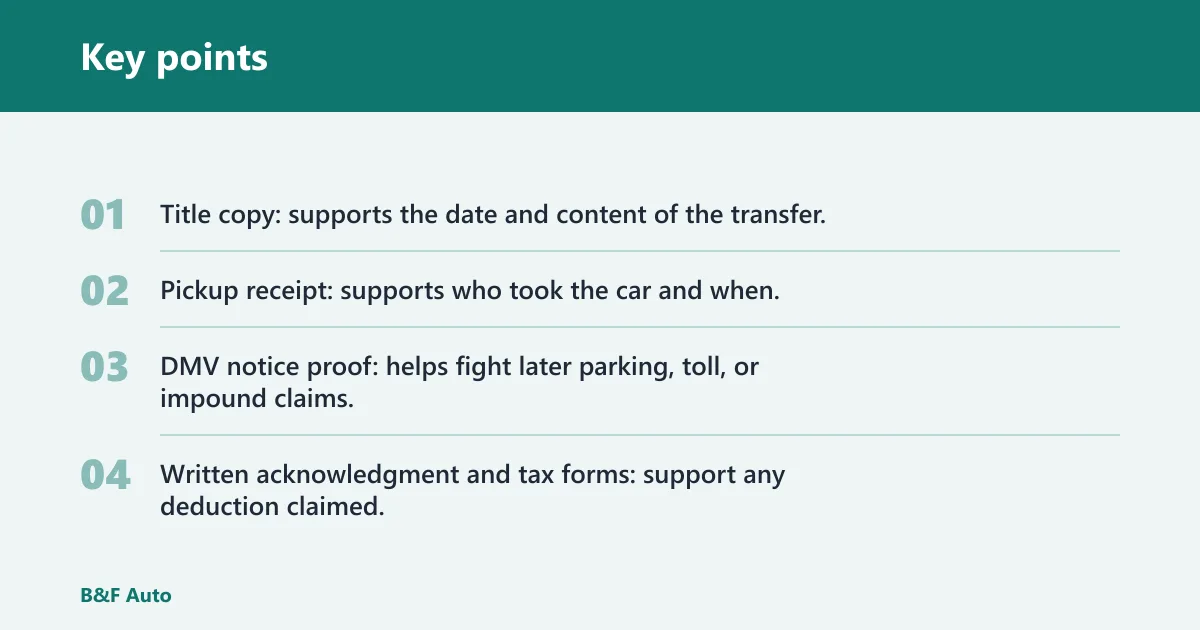
- Title copy: supports the date and content of the transfer.
- Pickup receipt: supports who took the car and when.
- DMV notice proof: helps fight later parking, toll, or impound claims.
- Written acknowledgment and tax forms: support any deduction claimed.
How do you avoid paperwork mistakes and bad operators?
A safe donation operator follows title law, identifies the real transferee, gives clear signing instructions, and does not promise a tax result it cannot support. The main warning signs are shortcuts: blank buyer sections, backdating, “title not needed” claims, and pressure to rely on a receipt alone.
Red flags in title handling and tax promises
Be wary if a caller says the title does not matter, asks the donor to sign a blank reassignment, or tells the donor to leave the buyer section empty when state law does not allow that practice. Those shortcuts can leave the car in the donor’s name.
Another warning sign is a guaranteed deduction figure. Tax results depend on sale proceeds or a limited exception, donor facts, and proper acknowledgment. No pickup scheduler can honestly promise a deduction amount before the paperwork and disposition are known.
Shortcuts that can leave the car in your name
A common first-timer mistake is signing the title at home before the charity confirms which transferee name belongs on the document. If that name changes, the title may be rejected, and the car can sit in limbo while the donor is still tied to the record.
Another mistake is assuming the tow company’s invoice or pickup slip is enough. It is not. The title transfer and DMV filing are what protect against later title, toll, and registration problems.
Final pre-pickup paperwork checklist
- Match the owner name on the title to the person signing.
- Confirm there is no active lien or get the release in writing.
- Check whether all titled owners must sign.
- Verify the VIN, year, make, and model on the title.
- Ask whether the state requires notarization, odometer disclosure, or a separate release-of-liability filing.
- Confirm whether plates must be removed or surrendered.
- Do not pre-sign the wrong section or leave forbidden blanks.
- Get the pickup receipt and keep copies of everything.
Frequently asked questions
What is a car donation form?
Usually it is the charity or agent’s internal transfer or pickup document, not the certificate of title. It may record contact details, vehicle condition, authorization to tow, and the receiving party’s information. It helps the process, but it does not replace the title as proof of ownership transfer.
Who signs the title when donating a car to charity?
The legal owner named on the title signs, and co-owners, lienholders, executors, or authorized agents may also need to sign depending on the title wording and state law. The charity or tow agent should sign only in the transferee sections the state allows, with odometer fields completed correctly.
Do I need a smog certificate or inspection to donate a car?
Not always. Some programs can accept vehicles without a current inspection sticker or registration, and one charity says donors in states requiring smog or safety inspections may donate without those documents. Still, state transfer rules differ, so the title and local DMV requirements should be checked before pickup.
How do I report a car donation for taxes?
Keep the written acknowledgment, pickup receipt, and transfer records. Form 1098-C is used for contributions of motor vehicles, boats, and airplanes, and cited guidance ties it to cases where gross proceeds exceed $500. For donor filing, Form 8283 may also apply, and claims above $5,000 may need extra reporting.