How Does Donating a Car to Charity Work? Step by Step?
Donating a car usually takes about 6 steps: choose a qualified charity, sign the title, arrange pickup, get a sale or transfer notice, receive a receipt, and use Form 1098-C for taxes if the charity sells the car. Skip a step, and you can miss the title transfer, delay pickup, or lose the records the IRS requires for a deduction. This guide maps each stage, the document you should expect next, and the difference between title paperwork and tax paperwork.
How the donation process works
The process usually starts with a qualified charity that can receive deductible contributions, often a 501(c)(3) organization you verify before you hand over the car. From there, the ownership transfer and the tax record are separate tracks. One goes to the state and the charity. The other goes into your tax file.
Choose a qualified charity
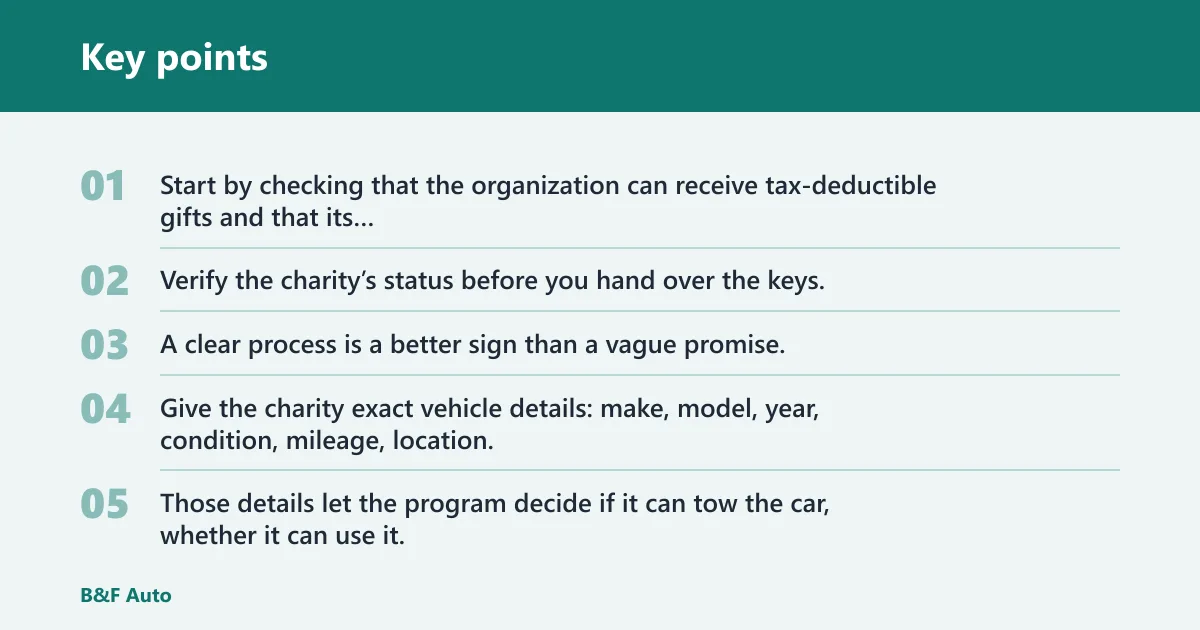
Start by checking that the organization can receive tax-deductible gifts and that its car program spells out pickup, title transfer, and follow-up steps. Verify the charity’s status before you hand over the keys. A clear process is a better sign than a vague promise.
Confirm the car meets donation rules
Give the charity exact vehicle details: make, model, year, condition, mileage, location, and whether the vehicle runs. Those details let the program decide if it can tow the car, whether it can use it, and which records it needs.
Separate ownership transfer from tax reporting
Do not treat the title handoff as the tax step. The donation process includes transferring ownership and any required state documentation, while the federal tax record depends on what the charity does with the vehicle. Those are related, but they are not the same document trail.
Car donation timeline
| Stage | Who acts | Document created | What the donor keeps | Common failure points |
|---|---|---|---|---|
| Pre-pickup check | Donor and charity | Vehicle intake record | Vehicle details, charity contact, pickup time | Wrong VIN, missing title, unknown lien, unclear location |
| Ownership transfer | Donor and charity | Signed title or state transfer form | Copy of signed title or transfer confirmation | Wrong signature, omitted odometer area, lien not cleared, title name mismatch |
| Towing | Charity or its towing partner | Tow record or pickup confirmation | Pickup date, tow company name, vehicle release note | Car blocked in, no keys, inaccessible lot, flat tires or non-running car not disclosed |
| Charity decision | Charity | Sale record, use log, repair note, or scrap record | Notice of what happened to the car | Donation value misunderstood, donor expects one tax result when another applies |
| IRS acknowledgment | Charity | Form 1098-C or written acknowledgment | Donor name, VIN, date, goods/services statement | Missing VIN, missing donation date, no goods/services statement, late form |
| Tax filing | Donor | Form 8283, if needed | Copy of 1098-C, title records, appraisal if required | Claiming without the right form, using the wrong value rule, no itemized return |
What do you need before pickup?
Before pickup, gather the title status, lien status, vehicle details, keys, and the car’s exact location. This is the point where most delays begin. If the charity cannot match the VIN, confirm ownership, or reach the car, pickup usually slows down.
Check the title and lien status
The vehicle title is what transfers ownership. If the title is in your name and free of liens, the process is usually simpler. If the title is lost, damaged, or still shows a lender, handle that before scheduling pickup if the charity asks for it.
Gather vehicle details the charity will ask
Have the make, model, year, mileage, condition, location, and whether the vehicle runs ready before you call. Accurate details matter because they affect pickup timing, whether the tow truck can move the car, and what the charity can do with it after pickup.
Clear out personal items and set aside keys
Remove registration papers, garage openers, toll transponders, insurance cards, tools, and anything else stored in the vehicle. Set aside all available keys and remotes. If the car is parked in a tight driveway or behind another vehicle, tell the charity in advance.
Say your sedan has a dead battery and a flat rear tire, but the title is clean and ready. That can still be a workable donation if the charity accepts non-running cars and the tow company can reach it.
How do you transfer the title?
Transfer the title the way the charity or state requires, and keep the state step separate from the federal tax step. If the title is lost, expired, or missing a required signature line, the donation can stall before pickup or before the charity can legally take ownership.
Sign the title the way the charity or state requires
Follow the exact signature instructions on the title and any program form. Some states require the donor’s full legal name, odometer disclosure, or a separate release form. A wrong signature, crossed-out entry, or missing buyer section can create a fresh title problem.
Handle a lost title or replacement title
If the title is lost, request a replacement title from the state before the handoff unless the charity says it can work with another form. A car with a salvage title or a lender name still attached may need extra paperwork, and some programs will not proceed until that is resolved.
Watch for state DMV release-of-liability steps
Some states require a separate DMV notice that the car left your possession. That notice is different from the charity’s tax acknowledgment. Keep proof that you submitted the state release, because it helps show the transfer date if tickets, tolls, or registration questions arise later.
What happens after the car is picked up?
After pickup, the charity decides whether to sell, use, repair, give away, or scrap the car. That decision changes the donor’s records and can change the deduction amount. The IRS says the deduction depends on what the charity does with the vehicle.
Sale, use, repair, or scrap decision
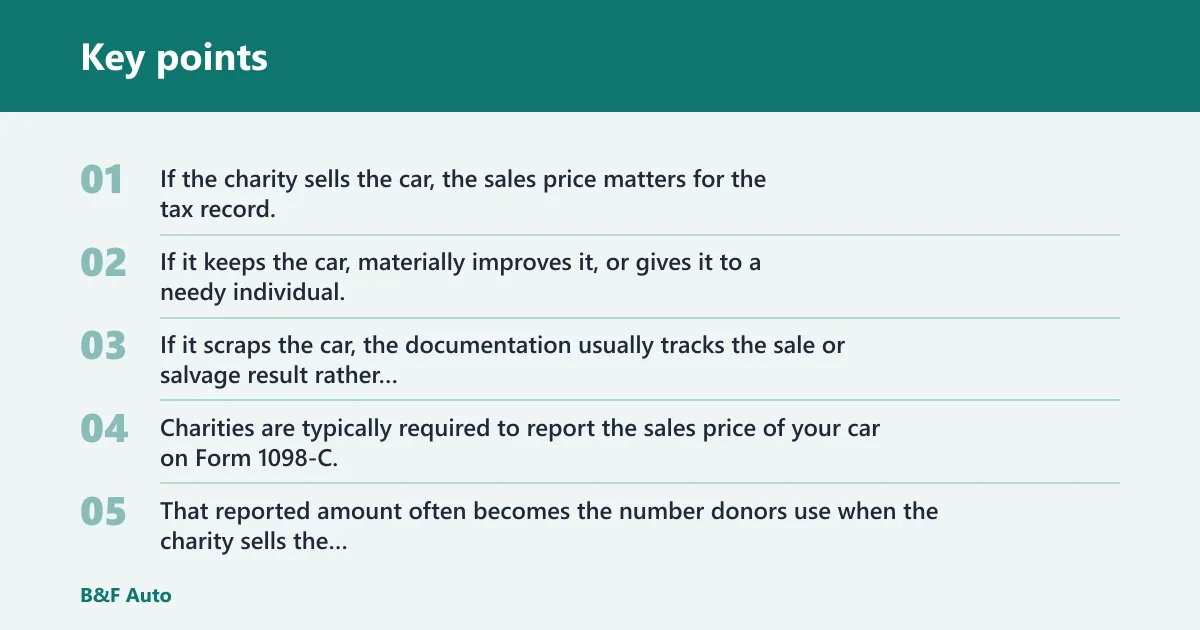
If the charity sells the car, the sales price matters for the tax record. If it keeps the car, materially improves it, or gives it to a needy individual, fair market value may matter instead. If it scraps the car, the documentation usually tracks the sale or salvage result rather than a retail-style value.
Why the charity’s next step changes your records
Charities are typically required to report the sales price of your car on Form 1098-C. That reported amount often becomes the number donors use when the charity sells the vehicle. If the charity uses the car instead of selling it, the deduction can follow a different value rule.
What to expect if the car does not run
A non-running car can still be eligible if the program accepts it and the title is workable. Free vehicle pickup is often included by donation programs, and it may be available even if the car does not run. Scheduling varies by area and program, so confirm the tow window early.
Picture a minivan that starts but cannot move because the transmission failed. If the charity accepts it, the pickup company may still tow it, but the donor should expect extra questions about location, access, and whether the wheels roll freely.
Which tax forms matter?
The donation paperwork for taxes is not the same as the paperwork that transfers ownership. The key records are a written acknowledgment, Form 1098-C in qualifying cases, and Form 8283 when the claimed deduction is more than $500. Keep them together with your title records.
Written acknowledgment basics
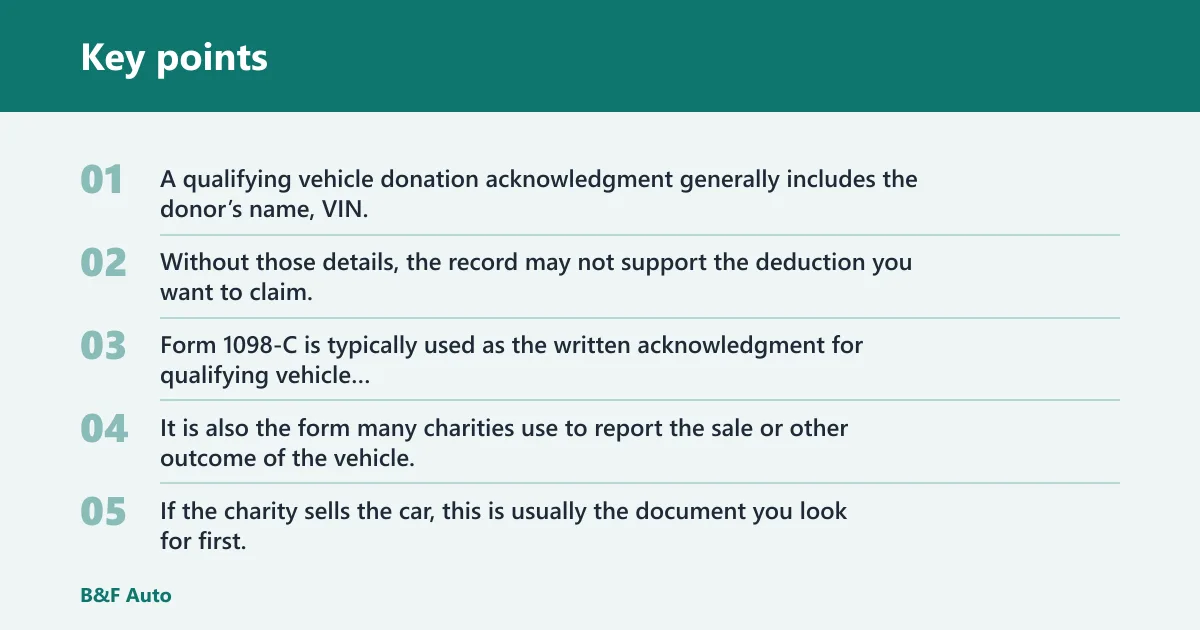
A qualifying vehicle donation acknowledgment generally includes the donor’s name, VIN, donation date, and a goods/services statement. Keep it with your tax records. Without those details, the record may not support the deduction you want to claim.
Form 1098-C
Form 1098-C is typically used as the written acknowledgment for qualifying vehicle donations. It is also the form many charities use to report the sale or other outcome of the vehicle. If the charity sells the car, this is usually the document you look for first.
Form 8283
Form 8283 is needed if the car donation deduction is more than $500. Section A covers $501 to $5,000. Section B applies when the deduction is over $5,000, and a deduction greater than $5,000 needs a written appraisal as documentation of value. (IRS)
Fair market value versus gross proceeds from sale
Fair market value is the figure you use when the charity keeps the vehicle, materially improves it, or gives it to a needy individual. Gross proceeds from sale is the common deduction cap when the charity sells the car, and it is often lower than fair market value. If the sales price is $500 or less, you can deduct $500 or fair market value, whichever is less.
What can go wrong?
Most delays come from paperwork, not the tow truck. Missing title pages, wrong signatures, lien issues, incomplete VIN records, and confusion about which value rule applies are the common failure points. The fix is usually to verify the documents before pickup, not after.
Missing title or wrong signature
If the title is missing or the signature does not match the state’s rules, the charity may pause pickup or refuse to finalize the donation. Check the name on the title, the signature block, and any required notarization before the car leaves your property.
Lien problems
A lien means another party may still have a claim to the vehicle. If the lender has not released the lien, the title may not transfer cleanly. That can delay pickup and make the donation unusable until the lien is cleared or the title is corrected.
Incomplete VIN or mileage records
The VIN ties the car to the donation record. If it is missing, mismatched, or unreadable, the charity may not be able to issue a clean acknowledgment. Mileage matters too, because it is part of the vehicle details the charity will use to process the donation accurately.
Claiming a deduction without the right documents
Do not claim the tax deduction with only a verbal promise from the charity. You need the written acknowledgment, and in many cases Form 1098-C and Form 8283 as well. If the paperwork is incomplete, the deduction can be delayed or reduced.
How does donating a car to charity work?
It works as a chain of documents and dates. You verify a qualified charity, hand over the title, arrange pickup, receive the charity’s acknowledgment, and then use the correct tax form if you qualify for a deduction. The exact deduction depends on what the charity does with the vehicle.
Frequently asked questions
What paperwork do I need to donate a car?
At minimum, you should expect the title, the charity’s pickup or intake record, and a written acknowledgment after the transfer. If the deduction is more than $500, Form 8283 is needed. Keep any state release-of-liability confirmation with the rest of your records.
Do charities pick up donated cars for free?
Often, yes. Free vehicle pickup is commonly included by donation programs, but it depends on the area and the charity’s partner network. Some programs also accept cars that do not run, though they may require more detail before scheduling the tow.
Can I donate a car if it doesn’t run?
Usually, yes, if the charity accepts non-running vehicles and the title is workable. The car still needs to be identifiable, reachable, and transferable. Tell the charity that it does not run before pickup so it can plan the tow correctly.
What documents do I get after donating a car?
You should expect a written acknowledgment, often in the form of Form 1098-C for qualifying donations, plus any pickup or transfer confirmation the charity uses. Keep these with your title records and, if needed, Form 8283 and any state DMV release confirmation.
How do I transfer the title when donating a car?
Sign the title exactly as the charity or state instructs, complete any required odometer or release sections, and hand it over with the car or at pickup. If the title is missing or the car has a lien, resolve that before the transfer if the program requires it.
How do I know if a car donation charity is legitimate?
Check whether the charity is eligible to receive charitable contributions, usually by verifying 501(c)(3) status. Also ask whether it offers free towing, helps with title transfer, and gives clear next steps. If the answers stay vague, choose a different program.