Trade-in Value: How It Works and What Your Car Is Worth
Trade-in value is often described as your car’s wholesale worth minus a dealer’s expected reconditioning costs and resale margin, so offers commonly land below clean private-party prices, often by a noticeable amount. Misreading that gap can cost you thousands or hide negative equity in your next loan. This guide explains the pricing stack, why online estimates and dealer offers differ, and which prep steps can realistically raise an offer.
What is trade-in value?

Trade-in value is the amount a dealer offers for your current vehicle when you use it as part exchange on another purchase. That credit is usually deducted from the price of the next car, but the offer is often lower than private-party or retail value because the dealer still needs room for cost, risk, and profit.
How the credit works in a part-exchange deal
Trade-in value is the amount a dealer deducts from the price of your next car. In a part-exchange transaction, the dealer buys your old car and applies that amount to the replacement vehicle. The whole deal is often completed in one dealership visit, which is why many buyers accept less than a private-sale price.
That lower number is not random. It reflects what the dealer thinks the car is worth in the market today, minus the money needed to prepare it for resale and minus the margin needed to sell it at retail or move it at wholesale.
Why it usually sits below other value types
Trade-in value may be lower than fair market value. It is also different from a retail asking price on a dealer lot, which includes reconditioning, lot overhead, financing risk, and room for negotiation. Private-party value usually falls between trade-in and retail because a private seller does not carry full dealership overhead, but still wants more than an auction-style number.
In practice, think of the order like this:
- Retail value: what a dealer hopes to sell the car for after preparing it.
- Private-party value: what a direct buyer may pay another owner.
- Trade-in value: what a dealer offers you today as part exchange.
- Wholesale value: what the car might bring at auction or in a dealer-to-dealer sale.
How does a trade-in work at the dealership?
A trade-in usually starts with a VIN- and mileage-based online estimate, then moves to an in-person appraisal that checks mileage, features, condition, history, and payoff status. The final number can rise or fall after inspection, and it is then folded into the next-car deal as a credit, down payment substitute, or equity adjustment.
From estimate to final offer
- Online estimate: You enter the VIN or year, make, model, trim, mileage, and condition. TrueCar says trade-in value is the estimated amount received from a dealer, and it says the estimate can be fine-tuned by mileage and features.
- In-person appraisal: A store verifies the VIN, odometer, trim, options, keys, tires, warning lights, body condition, and history-report issues.
- Adjustments: The number changes if the car has damage, missing equipment, open recalls, title issues, or condition that does not match the online description.
- Deal integration: The store applies the trade amount to the replacement purchase and, if needed, contacts your lender for payoff details.
What the appraiser is checking
Dealers price age against current market demand, and they compare mileage with what is typical for that model year and segment. They also check cosmetic condition, service history, accident and repair records, and unresolved manufacturer recalls, all of which can move the offer up or down.
That review is more specific than many online tools suggest. An appraiser will often sort a vehicle into broad condition tiers such as excellent, good, fair, or poor. A clean exterior, unworn interior, matched tires, complete records, and no warning lights can keep the car in a higher tier. A cracked bumper, thin brake pads, stained seats, and missing maintenance records can move it down.
Picture a five-year-old compact SUV with average mileage, a clean history report, and two nearly bald front tires. The online estimate may assume ordinary wear. At the store, the appraiser now sees immediate tire replacement and a safety-check cost, so the final offer drops even though the car still drives well.
Why offers can change after the first quote
Online tools are filters, not final contracts. They cannot confirm tread depth, brake thickness, warning lights, paintwork quality, smoke odor, open recalls, or whether the odometer and trim match the entry form. Even when the tool gives a cash-style figure, the offer usually remains subject to inspection, title status, mileage verification, and market timing.
How do dealers calculate a trade-in value?
Most dealer offers can often be understood as a three-step pricing stack: start with a market baseline for the vehicle, subtract reconditioning and risk costs, then subtract the resale margin needed to retail or wholesale the car. That math explains why similar cars can get different offers at different stores on the same day.
Step 1: market baseline
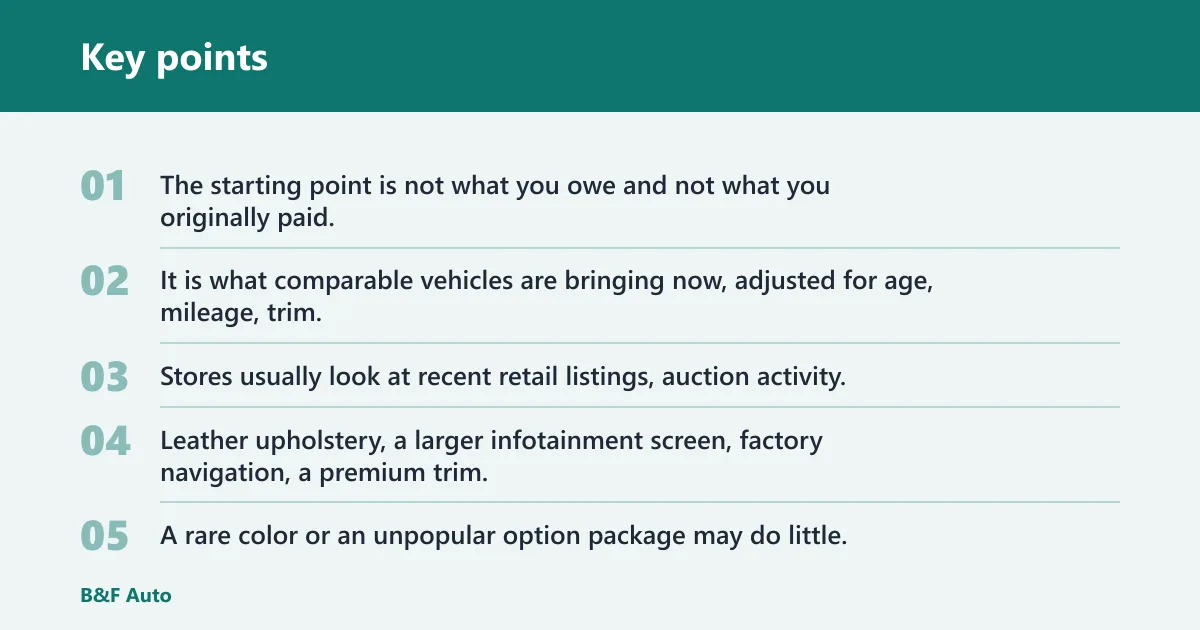
The starting point is not what you owe and not what you originally paid. It is what comparable vehicles are bringing now, adjusted for age, mileage, trim, optional equipment, accident history, and local demand. Stores usually look at recent retail listings, auction activity, and internal sales data for similar vehicles in the region.
Optional equipment matters here. Leather upholstery, a larger infotainment screen, factory navigation, a premium trim, or all-wheel drive may move the baseline up if buyers in your area actually pay for those features. A rare color or an unpopular option package may do little.
Step 2: reconditioning and risk deductions
Next come the costs between the purchase and the resale. These commonly include tires, brakes, fluid service, windshield chips, paintless dent repair, detailing, diagnostic scans, state inspection items, transport, photos, and the chance that a hidden fault appears after intake.
Say your midsize sedan matches local comparables at about a $16,500 baseline. The dealer then estimates about $700 for tires, about $350 for front brakes, about $180 for a cracked windshield repair, and about $270 for detail, intake, and photos. The running number is now about $15,000 before any resale margin is added.
This is where many owners misread the offer. A dealer is not valuing the car as if it can go straight from your driveway to the retail line without cost. Even a clean car usually needs some money spent on it.
Step 3: resale margin
The last layer is the margin the dealer needs for whichever exit fits the vehicle. If the store plans to retail the car, it needs room for negotiation, inventory carrying cost, and the risk that the car sits longer than expected. If the car is headed to wholesale, the store still needs protection against transport, fee, and price-swing risk.
Using the same example, suppose the store wants about a $1,200 cushion to retail that sedan. The $15,000 running number then becomes about a $13,800 trade offer. If another dealer has stronger demand for that exact model and lower reconditioning costs, it may only need an $800 margin and could offer $14,200 instead.
That is why one store can be meaningfully higher without either number being irrational.
Getting a trade-in estimate without a VIN
Yes, you can get a trade-in estimate without a VIN, but it will usually be a rough range rather than a firm number. The supporting article explains why dealers use the VIN to confirm exact trim, drivetrain, mileage history, and title status, and what goes wrong when those details are missing. That matters because even small mismatches can shift an offer from a broad market estimate to a manual review.
It also shows what information to gather instead of the VIN, how much accuracy you lose, and how to verify trim before you submit details. If you only have the year, make, and model, trade-in value without VIN guidance can help you set expectations and avoid surprises at appraisal time.
What makes one offer higher or lower?
Higher offers usually come from stronger local demand, a better trim, clean history, complete records, and a car that stays in a higher condition tier after inspection. Lower offers usually follow high mileage, accident history, visible wear, warning lights, open recalls, missing items, or a model the dealer does not want to retail.
Core inputs that set the condition tier
Age is one of the core valuation inputs, and older vehicles generally receive lower offers. Mileage is a key pricing factor used by dealers and valuation tools, and higher mileage can reduce value. Cosmetic condition includes scratches, dents, cleanliness, and interior wear, and those details can shift the car between condition tiers.
Mechanical condition matters too, even if the check-engine light is off. Appraisers look for brake pulsation, uneven tire wear, fluid leaks, rough idle, poor battery performance, transmission hesitation, and evidence of overdue maintenance. Service history helps here because regular records reduce uncertainty.
History, recalls, and market demand
Clean history often supports a stronger offer. Prior damage, structural repair, airbag deployment, title branding, or inconsistent mileage records can pull the number down quickly. Outstanding recalls can lower offers as well, especially if the recall affects sale readiness or requires parts that are not immediately available.
Local demand is the market variable many shoppers miss. A dealer with a waiting list for small fuel-efficient hatchbacks may bid harder on one with the right trim and mileage. The same store may go soft on a slow-selling luxury sedan with expensive tires and limited financing appeal.
Suppose two dealers appraise the same pickup. One has three similar trucks already aging on the lot, so it prices the trade as a likely wholesale unit. The other has sold every clean crew cab under 60,000 miles in a week, so it can justify a smaller margin and a better offer.
What lowers offers the most
- Structural damage history or visible poor-quality body repair
- Warning lights or unresolved mechanical faults
- Worn tires or brakes that create immediate reconditioning cost
- High mileage relative to age and segment norms
- Missing keys, manuals, or accessories
- Incomplete service history that adds uncertainty
- Weak local demand for that body style, trim, or drivetrain
Trade-in factors checklist
Bring this to the appraisal
| Factor | How dealers price it | What evidence to bring | Likely impact |
|---|---|---|---|
| Mileage | Compared against age, trim, and local comps; higher-than-expected mileage usually lowers the baseline | Photo of odometer, recent service invoice noting mileage, valuation printouts using the same mileage | Positive if below local norms; negative if high |
| Service records | Complete maintenance history lowers uncertainty and can support a stronger condition tier | Oil-change records, major service receipts, timing belt or transmission service proof, digital maintenance log | Positive when complete; neutral to negative when patchy |
| Tire and brake wear | Immediate safety items become direct deductions for reconditioning | Recent tire invoice, tread-depth reading from a shop, brake service receipt, alignment report | Positive if recently replaced; negative if worn |
| Cosmetic issues | Scratches, dents, curb rash, stains, smoke odor, and cracked glass can move the car down a condition tier | Repair estimates for major damage only, clean interior, wash receipt if recently detailed | Negative when visible; neutral if minor and typical |
| Accident history | Prior collision repair, especially structural or airbag-related, can reduce resale confidence and margin | Body-shop invoices showing scope of repair, before-and-after photos if available, alignment documents | Negative if significant; neutral to slight negative if minor and documented |
| Outstanding recalls | Unresolved recalls may delay sale readiness or require a dealer to manage repair logistics | Recall-status printout showing open or completed campaigns, dealer service confirmation if repaired | Neutral if closed; negative if open |
| Tires, keys, manuals | Missing second key, cargo cover, wheel lock key, manuals, or charger accessories adds replacement cost | Both keys, owner’s manual packet, wheel lock key, charging cable, spare tire tools | Positive when complete; negative when missing |
| Financing status | Payoff amount does not set vehicle value, but title delays and negative equity change deal structure and lender risk | Current payoff letter, lender account number, registration, title or lienholder details | Neutral for value; negative for flexibility if deeply underwater |
Equity decision tree
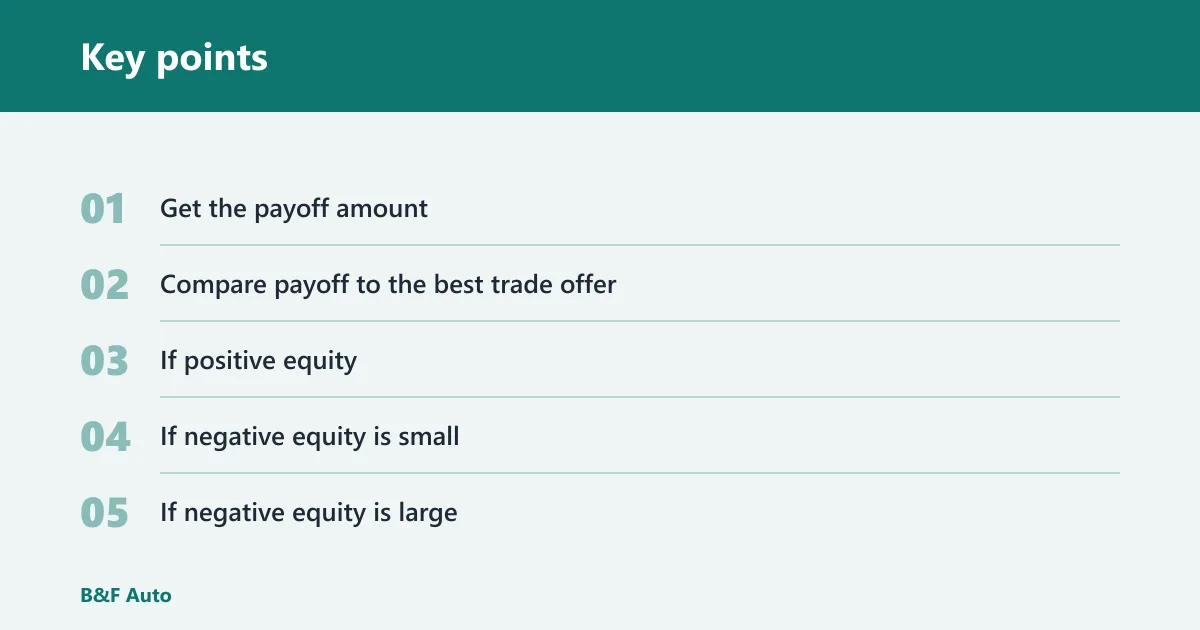
- Get the payoff amount. Ask the lender for the current payoff, not just the monthly balance shown online.
- Compare payoff to the best trade offer. If the offer is higher than the payoff, the difference is positive equity. If it is lower, that gap is negative equity.
- If positive equity: the extra can reduce the next car’s price, taxes where applicable, or amount financed.
- If negative equity is small: the dealer may roll the balance into the next loan, but that raises the amount financed and may worsen payment and approval terms.
- If negative equity is large: compare waiting, paying down principal, bringing cash, or choosing a less expensive next car. Rolling a large shortfall into another long loan raises risk because the next vehicle starts underwater.
Is trade-in value the same as fair market value?
No. Trade-in value is a dealer bid shaped by reconditioning cost and resale margin, while fair market value is a broader idea of what the vehicle might bring in an open market. Wholesale, private-party, trade-in, and retail figures answer different questions, so comparing them without adjusting for selling method leads to bad expectations.
How the value types differ in practice
Wholesale value is what a dealer may expect from an auction or dealer-only channel. Trade-in value often tracks close to wholesale, then moves up or down based on how suitable the car is for that specific store. Private-party value reflects what another consumer may pay after viewing and driving the car. Retail value is what the dealer asks after preparing it for sale.
That means a live trade offer can still be competitive even when it is below the private-party estimate. The real comparison is net proceeds after time, ads, reconditioning, fraud exposure, payoff handling, and any tax treatment that applies in your state.
Why online tools and dealer offers diverge
Online tools rely on the data you enter and on broad market feeds. The dealer sees the actual vehicle. If you chose “good” condition online but the appraiser sees curb-rashed wheels, thin tires, and a missing key, the store is pricing a different car from the one in the estimate.
Credit Karma recommends negotiating the trade-in price separately, and it suggests getting quotes from several dealers. That matters because stores differ in local demand, brand familiarity, and willingness to retail your vehicle instead of wholesaling it.
What can you do to get a better trade-in value?
The best gains usually come from closing evidence gaps, correcting avoidable condition disputes, and collecting competing bids rather than from expensive repairs. Dealers pay more confidently when records are complete, condition is accurately presented, and the car arrives appraisal-ready with no surprises that force reconditioning deductions.
Fix evidence gaps before fixing the car
Gather the VIN, registration, payoff information, both keys, manual packet, service records, tire receipts, and recall status before appraisal day. A missing second key or undocumented major service can suppress an offer more than many owners expect.
Also compare similar local vehicles by trim, mileage, condition, and region. Do not compare a base front-wheel-drive model to a higher trim with all-wheel drive and lower mileage. That mismatch creates inflated expectations before negotiation even starts.
Prep that can help, and repairs that often do not
Cleaning the car, removing personal items, fixing simple bulbs, replacing wiper blades, and bringing complete records can help the appraiser place the car correctly. Modest cosmetic tidying may stop a needless drop from good to fair condition.
Major repairs are different. A common first-timer mistake is spending heavily on work that the dealer will still discount. A fresh $1,400 cosmetic repaint on an older car rarely returns dollar for dollar if the vehicle still has high mileage, worn interior trim, and weak market demand.
Repairs most likely to matter are safety and sale-readiness items with clear deductions: badly worn tires, failed emissions items, broken glass, or a warning light tied to an obvious fault. Repairs less likely to pay back fully include routine wear on aging cars, cosmetic perfection work, and aftermarket upgrades.
Use competing offers the right way
Keep the trade number separate from the replacement vehicle price. The same source recommends negotiating the trade-in price separately for a reason: a dealer can raise one number and hide it in the other. Ask each store for the trade amount, purchase price, fees, and financing terms as separate lines.
Then compare final deal sheets, not just monthly payments. If one store is higher on the trade but higher still on the next car, the better trade offer may not be the better deal.
Should you trade in, sell privately, or keep the car?
Trade-in is usually the lower-grossing path, but it can still be the better financial choice when speed, fraud risk, payoff handling, tax treatment, and needed repairs are included. Private sale often brings more money, while keeping the car can be smarter if negative equity or rapid depreciation makes a change expensive.
Trade-in versus private sale
Private sale can produce a higher price, especially for clean, desirable vehicles with full records. But it also brings ad management, buyer screening, test-drive risk, payment risk, and title logistics. If the car still has a loan, payoff handling can get awkward because the title release may not be immediate.
Trade-in compresses those steps into one transaction. The dealer handles intake, payoff coordination, and resale prep. That convenience is the reason the number is lower.
When keeping the car makes more sense
If the car is reliable, the loan balance is high, and the market for your model is weak, changing cars may make the math worse. Rolling negative equity into the next loan can leave you owing more than the next car is worth almost immediately.
State tax treatment can change the comparison too, but it depends on local rules. In some states, a trade credit reduces the taxable amount of the replacement purchase. In others, it may not. Check the rule that applies before assuming a tax advantage.
Frequently asked questions
Can I trade in a car that isn’t paid off?
Yes. The dealer will usually request your current payoff amount from the lender and compare it with the trade offer. If the offer exceeds the payoff, you have positive equity. If it falls short, that negative equity can be paid in cash or rolled into the next loan, which raises risk and total borrowing.
Can I trade in a leased car?
Often yes, but the math depends on the lease buyout amount, any equity in the vehicle, and whether the leasing company allows third-party buyouts. Some brands restrict outside dealer purchases, so the store may need to structure the transaction through a franchised dealer or at lease-end terms.
How long is a trade-in offer good for?
Offer windows vary, and they can change quickly with mileage, new damage, market shifts, or expired appraisal terms. TrueCar’s True Cash Offer is valid for three days. Even within a stated window, a dealer may still recheck the vehicle if its condition, payoff, or odometer reading has changed.
What factors lower a trade-in offer the most?
Structural damage history, warning lights, unresolved mechanical faults, worn tires or brakes, incomplete service records, missing keys, high mileage, and weak local demand tend to cut offers the most. These issues either raise direct reconditioning cost or force the dealer to widen its resale margin because the car is harder to sell.
What is trade-in value and how does it work?
Trade-in value is the amount a dealer offers for your current vehicle as part exchange toward another car. The dealer applies that amount to the purchase, usually as a credit against the next vehicle’s price. Because the dealer takes on preparation cost and resale risk, the offer is usually below private-party value.
Should I trade in my car or sell it privately?
Choose trade-in if speed, payoff handling, and lower transaction risk matter more than maximizing gross sale price. Choose private sale if the car is clean, records are complete, and there is strong demand for your exact trim and mileage. Compare net proceeds, time, repair needs, and any state tax treatment before deciding.