How to Transfer a Car Title to a Family Member
To transfer a car title to a family member, sign the title, complete the state transfer form, and file the DMV paperwork. Gift, sale, inherited, and out-of-state transfers each follow different steps and tax rules. Missing one form or using the wrong transfer type can delay registration, trigger fees, or leave the title stuck in the seller’s name. This guide walks you through the decision tree, required documents, filing order, taxes, and common DMV edge cases.
Family title transfer decision guide
Start with the transfer scenario, not the form. A family transfer can look simple, but the paperwork changes if the car is a gift, sold for a low price, inherited, or brought in from another state. The safest order is: clear the title status first, confirm the transfer type, then finish the DMV and registration steps.
| Scenario | Likely documents | Common DMV friction points | Resolve lien or title issue first? |
|---|---|---|---|
| Gift | Certificate of title, gift affidavit or statement of transaction, odometer disclosure if required, DMV registration application, ID | Wrong relationship category, missing gift form, tax exemption denied, mileage mismatch | Yes, if the title has a lien or is damaged, lost, or altered |
| Low-price sale | Certificate of title, bill of sale, odometer disclosure if required, DMV registration application, ID | DMV treats the deal as a sale, not a gift; tax due on the sale price or book value; missing purchase details | Yes, if a lender still has a security interest or the title is not clean |
| Inherited vehicle | Title, death certificate, probate or executor papers if required, DMV transfer form, registration application | Wrong signer, missing estate document, title still in the deceased owner’s name, competing heirs | Often yes; the estate may need authority to transfer before the DMV accepts the paperwork |
| Out-of-state family transfer | Out-of-state title, transfer form, bill of sale or gift affidavit, odometer disclosure if required, registration application, proof of insurance | Two DMV rule sets, inspection or emissions requirements, title format mismatch, plate handling confusion | Yes, before any state-to-state title work |
Gift transfer path
A gift transfer works best when the relationship qualifies for the state’s family exemption and the paperwork clearly says the vehicle was given, not sold. A $0 price can still count as a gift in some states, but others want a separate gift affidavit or statement of transaction to support the exemption.
Low-price sale path
A low-price sale is not the same as a gift just because the amount is small. If money changes hands, even a nominal amount, the DMV may treat it as a sale and assess tax based on the sale amount, the vehicle’s value, or both under state rules.
Inherited vehicle path
An inherited vehicle usually needs estate paperwork before the DMV will move the title into a surviving family member’s name. The exact document depends on whether the estate went through probate, whether a small-estate procedure applies, and who has legal authority to sign.
Out-of-state family transfer path
When the new owner lives in another state, the transfer must satisfy the old state’s title release rules and the new state’s registration rules. That can mean different forms, a different tax answer, and a second review for emissions, inspection, or plate replacement.
What documents you need
Most family title transfers use the same basic packet: certificate of title, bill of sale or gift document, odometer disclosure if the vehicle is eligible, DMV registration application, and proof of identity. If the vehicle has a lien, the lender must clear it first by filing a lien release or similar payoff document. If the title is lost, damaged, or altered, replace it before filing the transfer.
Gather the title and identity. Start with the original certificate of title and make sure it is undamaged, unaltered, and free of cross-outs or erasures. The DMV will usually reject a title that appears corrected, unreadable, or incomplete.
Add the transfer document. Use a bill of sale, a gift affidavit, or the state’s statement of transaction form, depending on how the family transfer is being treated. These forms help the DMV separate a gift from a sale and apply the right tax rule.
Complete mileage disclosure. Fill out the odometer disclosure when the vehicle qualifies for it, and make sure the mileage matches the title or state form. A mismatch can stop the transfer even if the rest of the file is complete.
Prepare registration paperwork. The new owner usually files a DMV registration application under their own name. Many states also want proof of insurance and identity before they issue plates or a registration card.
Say the parent is giving a 2019 sedan to an adult child and the title is clean, signed, and free of cross-outs. If the state allows family gifts, the next friction point is usually the gift form, not the title itself. That is where many rejected files start.
How do you sign over the title?
Sign the title exactly as your state requires, with no cross-outs, erasures, or skipped fields. The seller or donor usually completes the assignment area, then the new owner signs where required. If the title has multiple owners or multiple signature lines, each line must match the ownership record.
Check the owner names. Read the title the way the DMV will read it. If two names appear with an “and,” both signatures may be required before the transfer can be accepted.
Enter the transfer details. Fill in the date, price or gift amount, odometer reading if required, and buyer or recipient information. A $0 entry may be acceptable for a gift in some states, but others may want a separate affidavit to support that choice.
Sign cleanly and legibly. Use the exact signature format the title asks for, and do not scratch out mistakes. If a mistake happens, ask the DMV whether a replacement title is needed instead of trying to fix the existing one.
New York is a useful example of why this matters. It says the title must be free of cross-outs and erasures, and it requires the transferee to apply for a new certificate of title within 30 days. New York uses DTF-802 for the statement of transaction on some family vehicle transfers, and it may require a damage disclosure.
What if the car has a lien?
If a lender still has a security interest, the family transfer usually cannot move forward until the lien is satisfied. The lien must be satisfied first through payoff or lender authorization, because the lender may still control the title record. A DMV will often stop the transfer until that release is on file.
Check the title brand. Look for a lienholder listed on the front or back of the title. If a lender is named, the title is not ready for a standard family transfer.
Obtain lien release. Ask the lender for the release after payoff, or follow the lender’s transfer instructions if the lien is being handled another way. The DMV usually wants clear proof that the security interest is gone.
File the clean title. Only submit the transfer packet after the lien issue is resolved. Filing too early can waste time and can leave the new owner unable to register the car.
If the title is still encumbered, the family member may end up with paperwork that cannot be processed. Fix the lien first. Then finish the transfer.
How taxes and fees usually work
Family transfers can have different tax treatment from ordinary private sales, but the exemption rules are state-specific and usually depend on the relationship. Spouses, parents, children, stepparents, and stepchildren often qualify in more states than siblings or cousins, and the gift-versus-sale label can change the result.
Family transfer tax exemptions
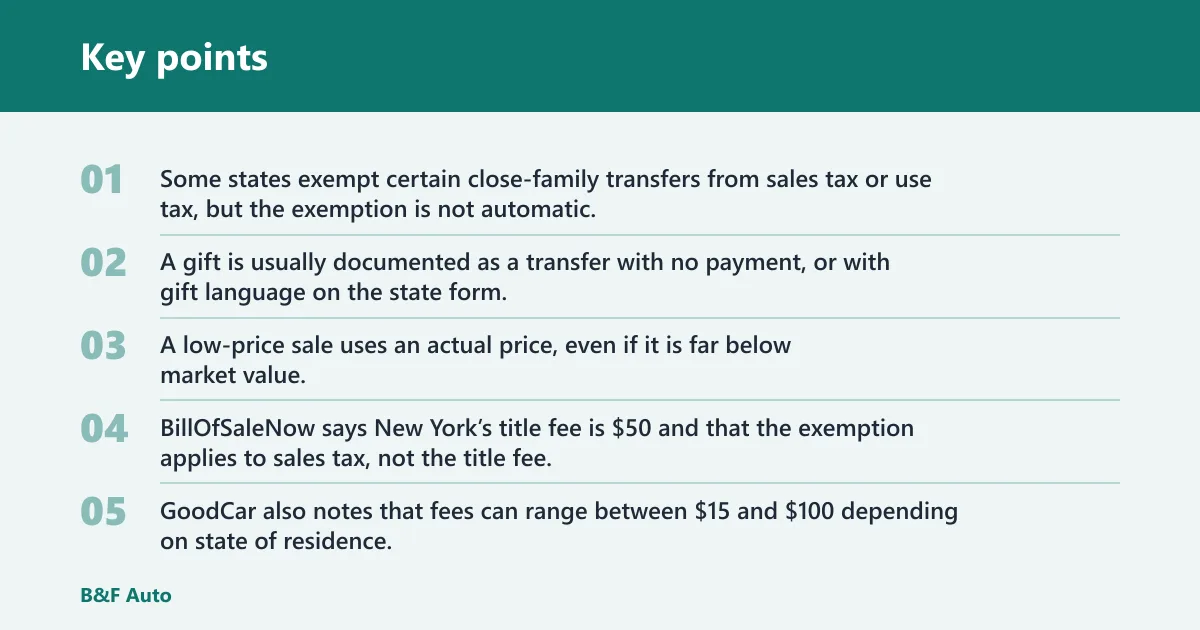
Some states exempt certain close-family transfers from sales tax or use tax, but the exemption is not automatic. New York’s DTF-802 identifies spouse, parent, child, stepparent, and stepchild as close-family relationships, while sibling-to-sibling transfers are not exempt there. GoodCar notes that tax exemptions may apply when the vehicle is given as a gift, and it says Michigan family gifts may avoid sales or use tax.
That means the relationship matters as much as the paperwork. A transfer that is tax-free for a parent and child may still be taxable between siblings, even when no money changes hands.
Gift versus sale treatment
A gift is usually documented as a transfer with no payment, or with gift language on the state form. A low-price sale uses an actual price, even if it is far below market value. That difference matters because the DMV may apply sales tax, gift exemption rules, or both depending on how the transaction is labeled.
BillOfSaleNow says New York’s title fee is $50 and that the exemption applies to sales tax, not the title fee. GoodCar also notes that fees can range between $15 and $100 depending on state of residence. The title fee and the tax are separate charges.
Title and registration fees
Even when a family transfer avoids sales tax, the new owner may still owe title and registration fees. The title fee is not the same as tax, and plates, county fees, or inspection fees can still apply under local rules. Check the DMV fee schedule for the state that will issue the new title and registration before filing so the transfer packet does not stall at payment.
Family transfer documents table
This table helps you match the paper trail to the transfer path before you go to the DMV. It is a practical shortcut, not a substitute for state instructions.
| Document | What it does | When it matters most |
|---|---|---|
| Certificate of title | Shows legal ownership and the current owner’s authority to transfer | Every transfer; must be signed correctly and stay undamaged and unaltered |
| Bill of sale | Records buyer or recipient details, vehicle description, and price | Especially useful for sales, low-price transfers, and some gift files with $0 or “gift” language |
| Odometer disclosure | Records mileage for eligible vehicles | When the vehicle age and state rules require it, and the entry must match the title or state form |
| Gift affidavit or statement of transaction | Supports family-gift status and tax exemption claims | When the state wants a specific form for close-family transfers |
| Lien release | Shows the lender’s security interest has been satisfied | Before transfer if a lienholder is still listed |
| DMV registration application | Requests new registration in the recipient’s name | After the title is properly assigned and insurance or ID is ready |
What happens after the title is signed?
After the title is signed, the new owner must usually register the vehicle under their own name and meet the DMV’s identity and insurance rules. Plate handling depends on the state. Some states let plates stay with the seller, while others require removal or replacement before the transfer is complete.
Registration in the new owner’s name
The new owner should file the registration application with the signed title and any required supporting forms. In many states, proof of insurance and a valid ID are part of that packet. If the vehicle is coming from another state, the new owner may also need inspection, emissions, or a separate title application.
License plate handling
Plate rules vary, so do not assume the plates stay with the car. New York says plates do not remain with the vehicle after a private transfer, which is a good reminder that plate handling is a state issue, not a family-transfer exception. Remove, surrender, or replace the plates exactly as the DMV directs.
Suppose a brother buys a truck from his sister for a low price and keeps the same plates without checking state rules. If the state requires plate removal, the transfer can be rejected or the registration can be tied to the wrong record. That small step can create the biggest delay.
Insurance and identity checks
DMVs often want proof that the new owner can legally operate and register the vehicle. That usually means insurance in the new owner’s name and identity documents that match the application. If the address, name, or county differs from the title record, the DMV may ask for extra proof.
How do you transfer a car title without the title?
You usually cannot complete a family transfer on a missing, damaged, or altered title. Replace the title first, or use the state’s estate process if the owner died. If the title is damaged or shows corrections, the DMV may reject it even if every other form is correct.
Lost title replacement
If the title is lost, request a duplicate title before trying to transfer the car. The DMV generally needs the duplicate in hand because the original ownership document is what gets assigned to the family member. Without it, the transfer can stall at the first review step.
Damaged or altered title
A title with cross-outs, erasures, torn sections, or unreadable fields is a problem, not a shortcut. New York is explicit that the title must be free of cross-outs and erasures, and other states use similar rejection standards. A replacement title is usually the cleaner fix.
Deceased owner cases
If the owner died, the title usually passes through estate paperwork before the car can move to a family member. The DMV may ask for a death certificate, probate papers, or executor authority. The exact sequence depends on state law and whether the estate is open or closed.
Frequently asked questions
How do I transfer a car title to a family member?
Sign the title, complete the state transfer form, and file the DMV paperwork with any required odometer, gift, or sale documents. The new owner then registers the vehicle under their own name. If there is a lien, a damaged title, or an out-of-state issue, clear that first.
What documents do I need to transfer a car title to a family member?
Most transfers need the certificate of title, a bill of sale or gift affidavit, an odometer disclosure when required, and a DMV registration application. Some states also want proof of insurance, identity, and a specific family-transfer form. If the title is not clean, replace it first.
Can you transfer a title to a family member as a gift?
Yes, many states allow family gifts, but the rules depend on which relatives qualify and how the paperwork is completed. A gift may need a separate affidavit or statement of transaction, and tax exemption is not automatic. Some states still charge title and registration fees.
Do I need a bill of sale for a family title transfer?
Often yes, even if the sale price is $0 or the vehicle is listed as a gift. The bill of sale helps document who gave or sold the car, which vehicle changed hands, and on what terms. Some DMVs also want it for tax and recordkeeping.
What happens if there is a lien on the car?
The lien usually has to be cleared before the title can be transferred. That means the lender must release its security interest after payoff or through its own authorization process. If the lien is still active, the DMV may refuse the transfer until the title is clean.
Can I transfer a car title to a family member in another state?
Yes, but the transfer must satisfy both states’ rules. The old state controls the title release, while the new state controls registration, fees, and any inspection or insurance requirements. Expect extra paperwork, and do not assume a family exemption carries over automatically.