First Car Budget: How Much Can You Afford?
For a first car, cap all car costs at 10% to 15% of your monthly take-home pay, then use the cash left after bills, debt payments, and savings to set a payment you can cover without strain. If you start from lender approval or sticker price instead, you can run short on insurance, repairs, or rent within months. This guide shows you how to calculate safe leftover cash, add insurance, fuel, maintenance, APR, term, and down payment, and turn that into a maximum purchase price.
Start with leftover cash, not the sticker price
A first-car budget works best when it starts with monthly take-home pay, then subtracts fixed bills, debt payments, and savings before any car number goes on the page. That keeps the budget tied to real cash flow, not a dealer quote or lender maximum.
Why take-home pay is the right starting number
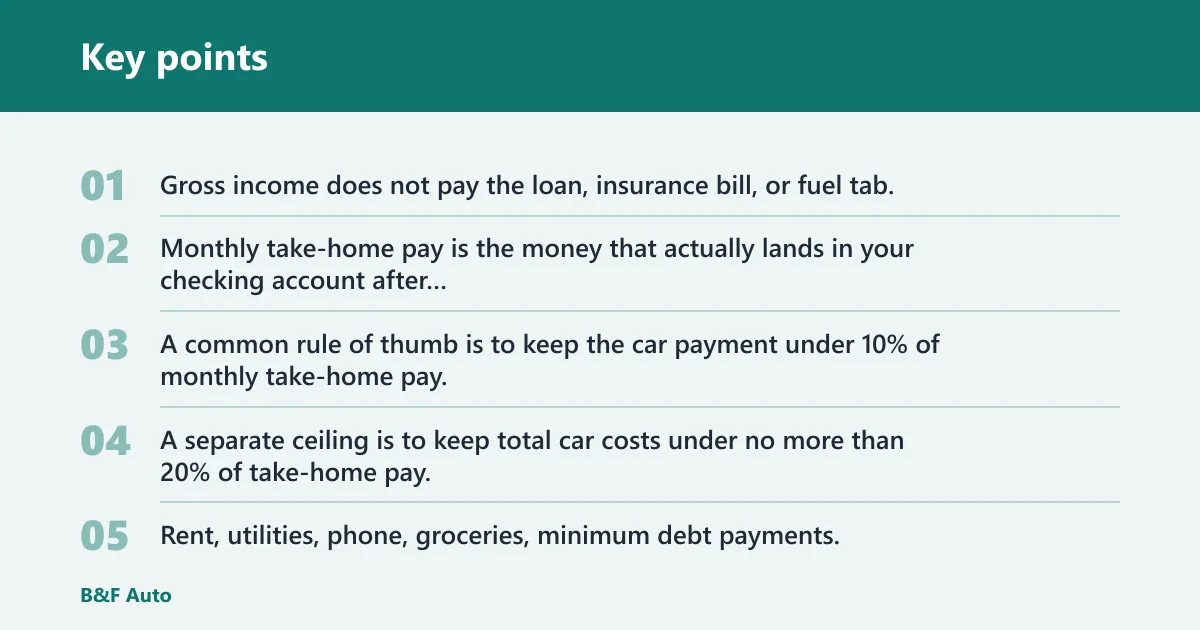
Gross income does not pay the loan, insurance bill, or fuel tab. Monthly take-home pay is the money that actually lands in your checking account after tax withholding and payroll deductions.
A common rule of thumb is to keep the car payment under 10% of monthly take-home pay, if possible. A separate ceiling is to keep total car costs under no more than 20% of take-home pay. Those are guardrails, not approvals.
Subtract fixed bills and current debt first
Rent, utilities, phone, groceries, minimum debt payments, and required subscriptions already take part of each paycheck. If those bills leave only a thin cushion, a car payment that looks fine on paper can still squeeze the month.
Current debt matters twice. It cuts into leftover cash, and it affects debt-to-income ratio, which lenders often watch. The common 36% total-debt benchmark is often used as a warning line, but it is not the same as affordability.
Protect savings before you add a car payment
A first car should fit after a minimum savings target, not instead of it. That means keeping monthly emergency savings in the budget and leaving cash for a post-purchase repair reserve, especially with older used cars.
Thin savings can change the answer fast. If the emergency fund is still small, the safer move is usually a lower price cap, more down payment from money already set aside for the purchase, or a later purchase date.
Why lender approval is not an affordability test
A lender may approve a payment that meets credit and income guidelines while leaving too little room for insurance, fuel, registration, or surprise repairs. Approval answers whether a lender might fund the loan. It does not answer whether the car fits the rest of the month.
How much car can you afford on your income?

Use monthly take-home pay to set two caps: a payment target and a total ownership ceiling. Then test both against real leftover cash after bills, debt payments, and savings. The smaller result is the one that matters, because that is the number your budget can actually support.
Use a safe payment cap from monthly take-home pay
Keep the car payment under 10% of monthly take-home pay, if possible. A $3,000 monthly take-home pay suggests about a $300 car payment. That does not mean every $3,000 earner should spend $300, because rent, debt, and insurance can push the safe number lower.
Use a total ownership cap from monthly take-home pay
Total ownership cost matters more than the loan payment by itself. Count insurance, fuel or charging, maintenance, registration, parking, tolls, and recurring vehicle fees in the same monthly bucket.
A practical ceiling is about 20% of take-home pay for all car costs combined. Some budgeting guidance for EVs puts total ownership costs under about 15-20% of take-home pay, which lands in the same zone. For many first-time buyers, staying below that range leaves room for the rest of the budget.
When income is irregular, base the budget on a low month
Variable income calls for a stricter method. Use a low month, not a good month, as the base for affordability. That means the month with fewer shifts, lower commissions, or slower seasonal work.
Say your take-home pay usually lands near $3,400 but drops to $2,700 in slower months. Building the car budget from $3,400 may look fine until insurance and fuel hit during that lower month. Building it from $2,700 gives a payment that survives both.
How existing debt changes the answer
Student loans, credit cards, and personal loans reduce the room left for a car. They also raise DTI. The 28/36 rule caps total debts at 36% of gross monthly income, and that threshold is often used on housing and budgeting pages, but staying under it can still leave a buyer cash-tight if take-home pay is already spoken for.
What percentage of take-home pay should go to a first car?
The safest starting point is to keep the payment under 10% of take-home pay and total car costs around 20% or less. Those figures work best as upper guardrails, not spending targets, because first-time buyers often face higher insurance and thinner savings.
Why 10% for the payment is a starting point
The 10% payment rule is useful because it is simple and quick to test. It also leaves room for ownership costs that the loan bill does not cover. If payment alone runs well past that line, the full monthly cost usually gets tight fast.
Why about 20% for total car costs is the better ceiling
Total cost catches the items that break budgets after the purchase. Insurance can be high for first-time buyers. Fuel costs vary with commute and vehicle. Maintenance on an older used car is not optional, it often shows up at the worst time.
When to stay below those limits
Stay below those caps when emergency savings are thin, income is irregular, existing debt is high, or insurance quotes are steep. The same applies when shopping older used vehicles that may need tires, brakes, or deferred maintenance soon after purchase.
When a higher percentage is a warning sign
If total car costs push above 20% of take-home pay, treat that as a warning. It may still look workable in a calculator, but the squeeze usually shows up in skipped savings, revolving card balances, or no room for repairs.
Picture a buyer with take-home pay of $3,100 who accepts a $330 payment because it fits the 10% idea closely enough. If insurance comes in high and fuel plus maintenance fill the gap, the real monthly car spend can climb past the safer ceiling before registration and parking even show up.
What other costs belong in your first-car budget?
A first-car budget should include every recurring cost needed to own and use the vehicle, not only the loan payment. At minimum, that means insurance, fuel or charging, maintenance, registration, taxes, fees, and any local parking or toll costs that come with daily driving.
Insurance, registration, taxes, and recurring fees
Insurance is a required line item, and it can vary sharply by age, ZIP code, driving record, coverage level, and vehicle choice. Get real quotes before settling on a model. A car that fits the loan budget can still fail the insurance test.
Registration and state or local vehicle fees matter too. Even when those bills are annual, divide them into a monthly number so they stay visible in the budget.
Fuel or charging by commute and vehicle type
Fuel estimates should come from the actual commute, not a rough guess. A 6-mile city commute can produce a very different monthly fuel bill than a 40-mile highway commute or weekend delivery driving. Mileage drives this line item.
Charging costs for an EV can be lower than gasoline, but the monthly budget still needs a real estimate. If public charging is common or home charging needs electrical work, the numbers change.
Maintenance, tires, and a repair reserve
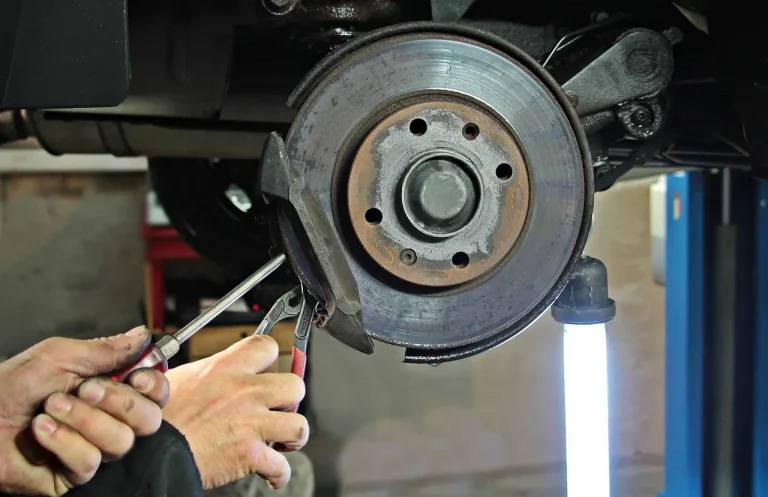
Routine maintenance includes oil changes, filters, fluids, brakes, wipers, and tires. Older used cars also need a repair reserve for the parts that fail with little warning.
A maintenance reserve is not the same as an emergency fund. The reserve belongs in the car budget because repairs are part of owning a used vehicle, even if the timing is uncertain.
Parking, tolls, and required accessories
Parking permits, garage fees, toll tags, snow tires, child-seat needs, and required inspection costs are easy to miss. They still hit the monthly budget. If the car will be used for school, work, or city commuting, add those costs before setting the payment limit.
How do APR and loan term change what you can buy?
APR and loan term directly change the amount a fixed monthly payment can support. A lower APR or longer term raises the loan amount, while a higher APR or shorter term reduces it. The lower payment from a long term can look helpful, but the total interest cost rises.
Why your credit tier should shape your budget before shopping
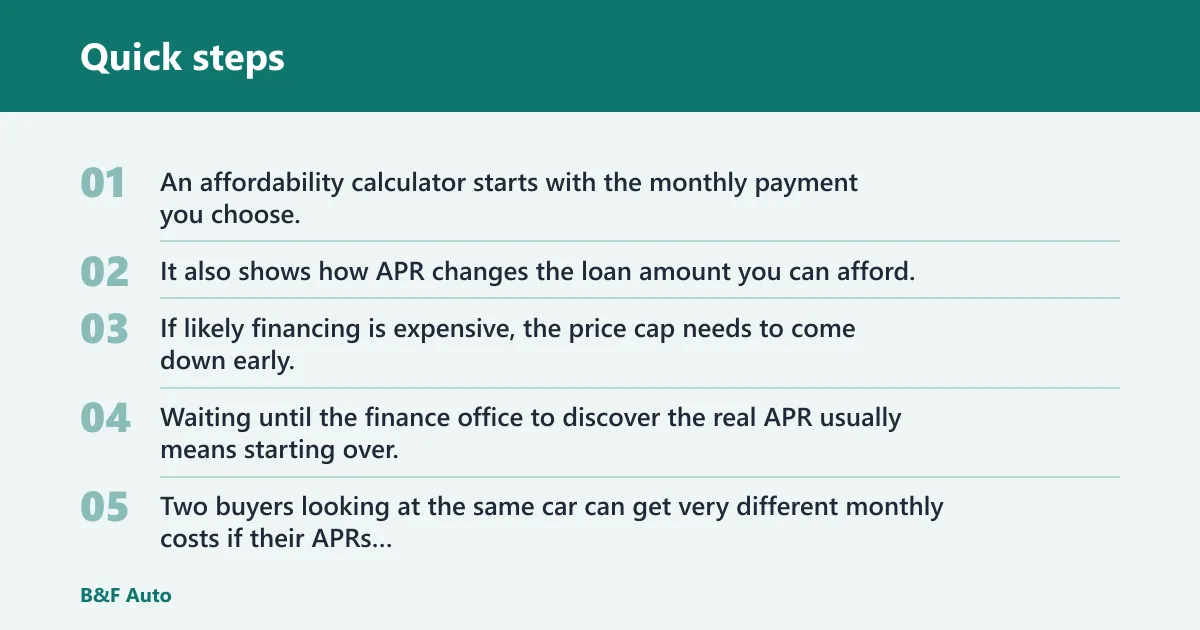
An affordability calculator starts with the monthly payment you choose. It also shows how APR changes the loan amount you can afford, how loan term changes affordability, and it uses credit tier to estimate APR.
That matters before shopping, not after. If likely financing is expensive, the price cap needs to come down early. Waiting until the finance office to discover the real APR usually means starting over.
How APR changes the payment at the same price
Two buyers looking at the same car can get very different monthly costs if their APRs differ. The higher-rate loan puts more of the payment toward interest, which means less buying power at the same payment.
Suppose the budget allows a $300 payment. At a lower APR, that payment may support a loan amount near the edge of the shopping list. At a higher APR, the same payment can cut the affordable price enough to rule out that vehicle entirely.
Why longer terms lower the payment but raise total cost
NerdWallet notes that a longer term lowers the monthly payment but increases interest cost. That tradeoff can also raise the chance of being upside down on the loan if the car depreciates faster than the balance falls.
Reasonable term caps for new and used first cars
The same source says 60 months or less is a good target for new-car loans. The same source says 36 months or less is a good target for used-car loans. Shorter terms cost more each month but usually reduce total interest and shorten the time the buyer is tied to the debt.
How do you turn a monthly budget into a maximum car price?
Start with the total monthly car-cost ceiling, subtract insurance, fuel, maintenance, and other recurring costs, and the remainder is the payment limit. Then convert that payment into a financed amount using estimated APR and term, and adjust for down payment, taxes, and fees.
Start with your total monthly car-cost ceiling
Use take-home pay and pick a ceiling that the rest of the budget can survive. For many first-time buyers, the total cap should land at or below 20% of take-home pay. If savings are thin or income varies, go lower.
Back out insurance, fuel, and maintenance to find the payment limit
- Write down monthly take-home pay.
- Subtract fixed bills, minimum debt payments, and the monthly savings target.
- Set the total monthly car-cost ceiling.
- Subtract insurance, fuel or charging, maintenance reserve, registration, parking, and other recurring car costs.
- The amount left is the maximum safe car payment, as long as it also stays under the payment guardrail.
Add down payment and subtract taxes and fees
Down payment reduces the amount financed, which raises the maximum target vehicle price. Taxes, title, registration, and dealer fees work the other way, because they use up part of the cash or loan capacity.
The cleanest method is to choose a down payment, set aside cash for upfront fees, and then calculate the highest vehicle price that still keeps the financed amount inside the payment limit.
Compare maximum price under three APR and term scenarios
Using more than one scenario matters because financing changes the answer. A buyer who shops only by payment can miss that the same monthly bill may hide a higher rate, a longer term, or both.
Car budget worksheet
The worksheet below uses one example and assumes about a $2,000 down payment and about $1,200 in upfront taxes and fees. The resulting maximum purchase price is the estimated vehicle price before those upfront fees are added back to the deal.
| Take-home pay | Fixed monthly bills | Emergency savings target | Insurance quote | Fuel estimate | Maintenance reserve | Maximum safe car payment | Max purchase price at 6% APR / 36 months | Max purchase price at 9% APR / 48 months | Max purchase price at 12% APR / 60 months |
|---|---|---|---|---|---|---|---|---|---|
| $3,600 | $1,900 | $300 | $180 | $150 | $90 | $300 | $10,661 | $12,644 | $14,148 |
Inputs: take-home pay, bills, debt, and savings target
In the worksheet example, 20% of $3,600 sets a total monthly car-cost ceiling of about $720. Insurance, fuel, and maintenance use $420 of that space, leaving a $300 payment. That payment also stays within the payment guardrail.
Ownership costs: insurance, fuel, maintenance, and fees
This is where many first-time budgets break down. Change one input and the affordable price drops. If insurance rises by $70 a month, the payment limit falls by the same $70 unless the total budget expands, which is usually the wrong fix.
Output: maximum safe payment and price cap
The same $300 payment supports different financed amounts depending on APR and term. That is why a payment-first approach without rate and term is incomplete. The worksheet makes the tradeoff visible before the buyer starts calling on cars.
How to read the three APR and term results
The higher purchase-price result under the longer term is not automatically the better choice. It often means more total interest and more time owing money on a used vehicle. For a first car, the safer read is usually this: if the shorter-term result is too low to buy a reliable car in the market, either save more, raise the down payment from car-buying cash, or wait.
What if the numbers say the car is too expensive?
If the budget says the car is too expensive, lower the price cap before stretching the term. A longer loan can reduce the monthly payment, but it also raises total interest and keeps the buyer in debt longer. The fix is usually a cheaper vehicle, more cash down, or more time.
Lower the vehicle price before stretching the term
Stretching a used-car loan to force the payment down can hide risk rather than remove it. A shorter term on a cheaper vehicle is usually safer than a long term on a car that barely fits the month.
Increase down payment only if emergency cash stays intact
More down payment lowers the amount financed and can move the budget back into a safe range. But that only works if the buyer still keeps enough cash for emergency savings and an immediate repair reserve after the purchase.
Change the vehicle type if insurance is the problem
If insurance quotes are the reason the deal fails, change the shopping list before changing the budget. Different models can produce very different premiums for the same driver profile. A lower-risk vehicle may solve the problem faster than chasing a lower payment.
Wait and improve credit if APR makes the deal unsafe
High APR can turn a workable price into a bad loan. If rate quotes are pushing the payment past the safe limit, the right answer may be to delay the purchase, build credit, reduce other debt, and return with better financing options.
Frequently asked questions
How do I know if a car payment is too high?
A payment is too high if it pushes the loan above 10% of take-home pay, crowds out savings, or leaves too little room for insurance, fuel, and maintenance. It is also too high if the only way to afford it is a long term that raises interest and risk.
Should I budget based on monthly payment or total car price?
Start with the monthly budget, then convert that limit into a maximum total price. The payment alone can hide a high APR or long loan term, while the sticker price alone ignores insurance and running costs. Both numbers matter, but monthly cash flow comes first.
How long should I finance a first car?
For term length, a good target is 60 months or less for a new car and 36 months or less for a used car. Longer terms lower the monthly payment, but they raise total interest cost and can leave a buyer owing money on an aging vehicle.
How much room should I leave for insurance and maintenance?
Leave enough room to budget insurance as a required monthly bill and maintenance as a standing reserve, not a surprise. The exact amount depends on the driver, location, and vehicle, which is why real insurance quotes and a model-specific repair outlook should be checked before buying.
How do I avoid buying more car than I can really afford?
Build the budget backward from take-home pay after bills, debt, and savings, then cap total car costs around 20% or less. Use a low-income month if pay varies, get insurance quotes before choosing a model, and lower the price cap if the deal only works with a stretched term.